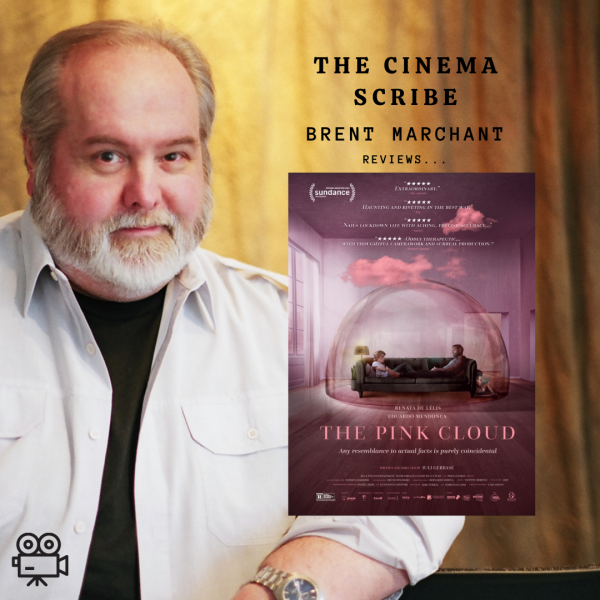
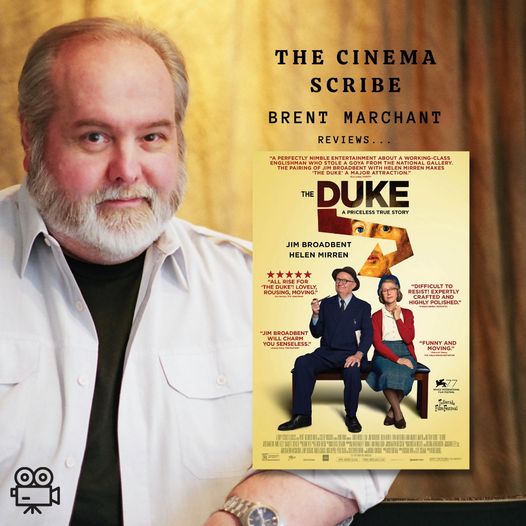
Reviews of "The Duke" and "The Whaler Boy," along with a podcast preview, are all in the latest Movies with Meaning post on the web site of The Good Media Network, available by clicking here.






Reviews of "The Duke" and "The Whaler Boy," along with a podcast preview, are all in the latest Movies with Meaning post on the web site of The Good Media Network, available by clicking here.
Tune in for the latest Cinema Scribe segment on Bring Me 2 Life Radio, beginning Tuesday May 24, available by clicking here. You can also catch it later on demand on Spreaker, Spotify, Apple, iHeartRadio, Google Podcasts, Castbox, Deezer, Podchaser and Jiosaavn.
“The Whaler Boy” (“Kitoboy”) (2020 production, 2022 release). Cast: Vladimir Onokhov, Kristina Asmus, Vladimir Lyubimtsev, Nikolay Tatato, Arieh Worthalter, Maria Chuprinskaia, Ankas Aimetgirgin, Evgeny Ayanto, Ivan Tynau, Zakhar Vykvytke. Director: Philipp Yuryev. Screenplay: Philipp Yuryev. Web site. Trailer.
Coming of age is a singularly human process that virtually everyone goes through, no matter where one lives and under what conditions. It’s a time of wonder, exploration and challenge as we examine and seek to understand the world in which we find ourselves. It’s an odyssey that’s generally as diverse as the various surroundings in which we reside. Yet there are also elements quite common to each individual’s particular experience – triumphs, disappointments, disillusionments and personal awakenings. And all of those experiences are explored in the new Russian comedy-drama, “The Whaler Boy” (“Kitoboy”).
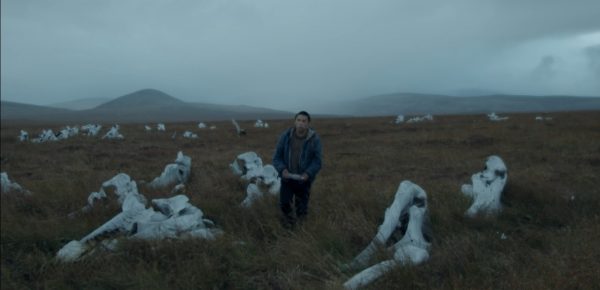
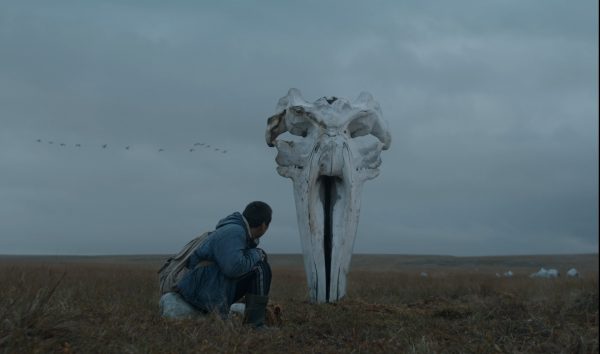
Fifteen-year-old Lyoshka (Vladimir Onokhov) is coming of age in the middle of nowhere. He lives with his elderly grandfather (Nikolay Tatato) in a whale hunting village in the Chukotka region of eastern Siberia along the shores of the Bering Strait. When he’s not engaged in the hunt and performing other everyday chores, he spends his time hanging out with his best friend, Kolyan (Vladimir Lyubimtsev), but there’s precious little to relieve the incessant tedium – that is, until the arrival of something eye-opening: the internet. And it’s not long before Lyoshka and Kolyan figure out how to put it to use in a way that fittingly suits their stage of life.
Like many of the young men in this remote community, which has a pronounced dearth of women, Lyoshka and Kolyan are typical of the village’s red-blooded sex-starved males. They have virtually no contact with the opposite sex. However, with the arrival of the internet, that all changes when Lyoshka, Kolyan and their pals discover the world of erotic video chat sites, most of which are based across the strait in the US. And, like many of those in their peer group, Lyoshka and Kolyan are absolutely captivated with what they see as their raging hormones flourish in the flickering light of their computer screens.
Lyoshka is particularly smitten with a woman who goes by the screen name HollySweet999 (Kristina Asmus), a flirtatious tease with whom he naïvely believes he’s made a genuine connection. He comes to think of her as his girlfriend and takes steps as chivalrous as attempting to learn English so he can communicate with her more effectively. Lyoshka even feels wracked with guilt when his whaling crew foreman (Ankas Aimetgirgin) arranges a visit by a sex worker (Maria Chuprinskaia) for him, an incident that prompts him to believe he’s cheated on his virtual romantic interest.
But, as Lyoshka’s infatuation with HollySweet intensifies, circumstances start taking a more obsessive turn. He truly believes he has a future with the woman on the computer monitor, despite the admonitions offered by the likes of Kolyan and others, who try to convince Lyoshka that sex cam sites are nothing more than venues for erotic fantasies, a hard truth he doesn’t want to hear. Indeed, as he digs in his heels, he even grows jealous when other users engage in private sessions with the object of his desire. Lyoshka soon asks himself, can he realistically settle for a virtual relationship with Holly, or must he attempt to seek out something more by charging valiantly after her?
Given that his love interest resides in America – a mere 86 kilometers across the Bering Strait – Lyoshka seriously contemplates making the crossing to find her. It’s a risky proposition in many regards – weather conditions, sea currents, and, perhaps most of all, the presence of US Border Patrol contingents that routinely navigate the waters in search of poachers and would-be immigrants. It’s also an unrealistic undertaking given that Lyoshka has no clue how far away Holly actually lives. She’s not just across the water in Alaska as he seems to believe; she works out of Detroit, not an easily accessible location for someone who would have to travel there on foot.
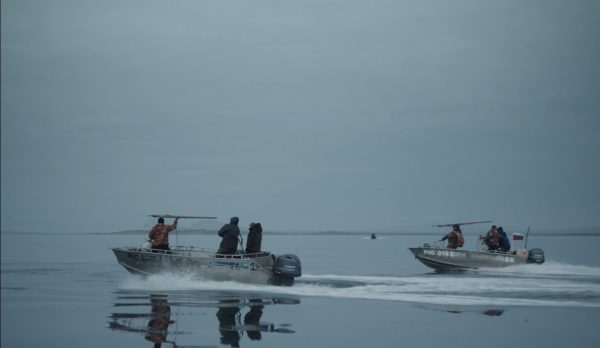
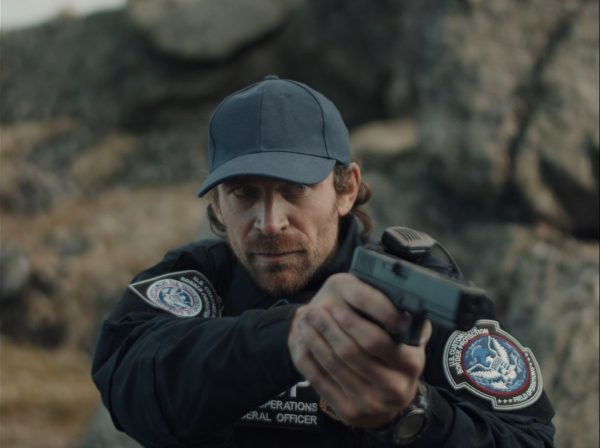
However, despite these obstacles, circumstances soon force Lyoshka’s hand. An unanticipated incident compels him to flee his village, and he impulsively decides to escape by attempting a flight to America in a stolen whaling boat. It’s a journey filled with potential perils, such as his vessel’s engine failure, an emergency beach landing on an island in the middle of the strait, a run-in with a trio of poachers (Evgeny Ayanto, Ivan Tynau, Zakhar Vykvytke) and a tense encounter with a Border Patrol agent (Arieh Worthalter) in which the language barrier could conceivably spell disaster. But, despite the challenges posed by these dangers, they’re nothing compared to what follows as Lyoshka’s experience turns into an ordeal with even more unexpected elements, some of them downright surreal.
Will Lyoshka find his way to America and fall into the arms of his true love? Or will he be thoroughly disillusioned by his experience? And how will these developments affect his coming of age process? That’s what awaits him as his story unfolds, one that’s sure to present him with challenges, adventures and even a few surprises. But, then, isn’t that what coming of age entails for most of us?
Lyoshka’s at that point in his life when opportunities are opening up for him and new experiences are potentially around every corner. That’s especially true with the arrival of the internet, which presents him with a world of possibilities all by itself. There’s so much, in fact, that it can be overwhelming, making it difficult to choose. It can also lead to cloudy judgment and the formation of distorted beliefs, which, in turn, can yield an imprecise assessment of one’s reality. That’s due to the conscious creation process, the philosophy that maintains we draw upon these resources in shaping the nature of our existence.
Given Lyoshka’s tender age and limited life experience, it’s understandable that his interpretation of what’s presented to him in cyberspace may be off the mark, and, the more he buys into that misleading view, the more firmly it becomes entrenched in his beliefs and subsequently reflected in his world. By falsely assuming that Holly is his true love and in light of what she does for a living, the lad is setting himself up for a hard fall when the truth is finally revealed. But that illustrates what the power of our beliefs can do, even if the outcome is not exactly in line with our hopes or ultimately to our liking. And, disappointing though that may be, that’s one of the pitfalls that can be found in the coming of age process – or in the practice of conscious creation.
In all likelihood, Lyoshka has probably never heard of this philosophy or even how it works. However, given that it’s associated with learning how reality functions – in itself a key element of the coming of age process – this is something he will have to go through to get a handle on how our (and his) existence unfolds. In essence, it’s often experienced as a process of trial and error, figuring out what works and what doesn’t and helping us hone our beliefs to grasp the nature and composition of our reality. This forces us to take a hard look at what constitutes our existence and rid ourselves of the beliefs that don’t jibe with our understanding of it. This often involves the shattering of illusions, the development of discernment and the birth of wisdom. It may not be an easy process, but it’s one that can aid us tremendously in these areas for the rest of our lives.
This is what Lyoshka is learning through this experience, difficult though it may be at times. In fact, the experience can be so disillusioning that it may seem surreal, something Lyoshka goes through firsthand. When he sees that the cherished dreams we hold for our reality may be just as illusory at what we’re directly experiencing, we might have trouble separating actuality from imagination, a distinction that we must ultimately sort out to avoid becoming prisoners of wishful thinking.
In Lyoshka’s case, his misconceptions need to be distinguished on multiple fronts. His trumped-up infatuation with Holly is perhaps the most obvious of these illusions, but he holds on to them in other areas as well. For example, like many of the other villagers, he has dreams of going to America, a land that he and they believe is characterized by omnipresent skyscrapers, McDonalds on every corner and supermodels as far as the eye can see, elements supposedly present even just across the water in Alaska. But, if he and they were to experience the reality of America, should they ever visit there, how would they react upon witnessing what’s actually there? What would that do to their beliefs and conceptions of America in particular and, potentially, existence in general? Wouldn’t they be shocked to find that what they come upon, at least initially, actually isn’t much different from what they’re accustomed to in Chukotka?
The bottom line in this is that coming of age is, in many ways, a wake-up call to the nature of life. And, in many ways, Lyoshka’s experience in understanding his world parallels what many of us go through when it comes to gaining a greater appreciation of how reality fundamentally works. The revelations we realize in this regard are undoubtedly just as profound as those that Lyoshka experiences when it comes to the world he lives in. In that sense, then, it should become apparent that coming of age is not necessarily something that’s limited to our adolescence. It’s a process that arguably repeats itself, almost in a cyclical nature, as our beings undergo various degrees of maturation and development in our understanding of the way life – and reality – operate. And, if we go about it correctly, it should prove to be an adventure full of joy, wonder and fun that provides us with a fulfilling template for our existence.
In bringing this story to life, writer-director Phillip Yuryev’s debut feature skillfully blends aspects of multiple genres and narrative formats, including elements of road trip tales, cross-cultural stories and personal transformations, along with adventures in sexual awakening, loss of innocence and rediscovered gratitude. The picture’s expertly penned script captures and conveys a variety of moods, from refreshingly whimsical to delightfully humorous to deadly serious and even deftly surreal, making for a viewing experience that’s always engaging, never dull and generally free of flotsam. In tandem with this, though, sensitive viewers should be aware that the director rarely holds anything back, including rather explicit depictions of sexuality and graphic footage of an actual whale hunt, story elements that some might find offensive or disturbing. There is also a slight tendency for the story to drag a bit toward the end. These matters aside, however, “The Whaler Boy” is an inventive take on a formula format that could easily have become trite, clichéd and melodramatic if left in lesser skilled hands, and, thankfully, that’s not the case here. This enjoyable little-known gem is available for streaming online.
Whether we’re coming to terms with life as an inexperienced teenager or as an evolving soul at any age, the process is in many ways the same. In either instance, the goal is comparable – determining what we make of the experience. The keys in this, of course, are what we put into the process (namely, the beliefs that fuel it) and then subsequently analyzing what we’ve created with them. And, if handled correctly, we just might come up with something that’s noteworthy and satisfying – and that exhibits an ever-increasing understanding and appreciation of the nature of reality.
Copyright © 2022, by Brent Marchant. All rights reserved.
“The Duke” (2020 production, 2022 release). Cast: Jim Broadbent, Helen Mirren, Fionn Whitehead, Matthew Goode, James Wilby, Jack Bandeira, Aimée Kelly, Charlotte Spencer, John Heffernan, Heather Craney, Anna Maxwell Martin, Richard McCabe, Andrew Havill, Charles Edwards, Ashley Kumar, Craig Conway. Director: Roger Michell. Screenplay: Richard Bean and Clive Coleman. Web site. Trailer.
Standing out often means standing alone, especially for proponents of particular causes. Individuals who embrace this stance frequently must engage in striking, sometimes-outlandish behavior that gets them noticed in order to get their initiatives noticed. But having to go to such lengths can be exasperating, frustrating and even legally challenging. So it was for an eccentric activist in early 1960s England as seen in the new fact-based comedy-drama, “The Duke.”
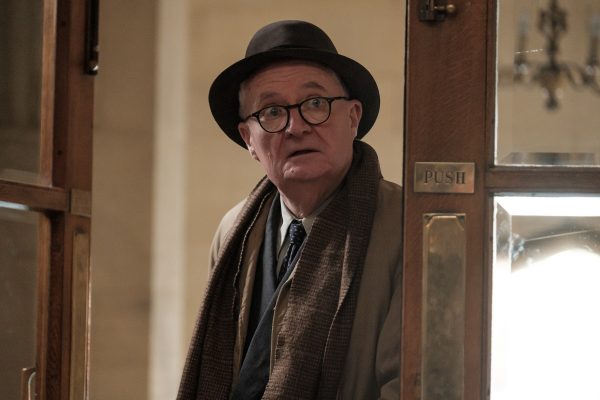
Kempton Bunton (Jim Broadbent) has great expectations of himself. The 60-year-old Newcastle resident and wannabe playwright/political activist wants to make a name for himself, though more so for the causes he believes in and the statements he wishes to make than from hauling in a bundle of cash. Nevertheless, all well-meaning aside, money is something of an issue in the Bunton household, primarily due to Kempton’s inability to hold down a steady job. The principal breadwinning responsibilities fall to his wife, Dorothy (Helen Mirren), a cleaning woman who slogs away in the home of an influential, well-to-do councilman. And Kempton’s son, Jackie (Fionn Whitehead), contributes, too, bringing in money from his job refurbishing boats.
In attempting to carry out his grand plans, Kempton can be something of a loudmouth and a scallywag, sometimes even being less than truthful with others, including his own wife. That’s also true on the job, including on stints as a cab driver and a baker, positions where he’s often seen as difficult, annoying and a rabble-rouser. And, whenever he deals with authorities in officialdom, he’s seen as uncooperative, a malcontent and a scofflaw, incidents that get him in trouble, including landing him in jail. Dorothy frustratedly looks on these exercises in what she sees as frivolous mischief, leaving her head spinning and prompting her patience to grow ever thinner.
This is particularly true when it comes to Kempton’s protests over government-required licenses for household television sets, a fee aggressively sought after by determined collection agents from the local post office. He firmly believes that TV has become a new source of valued companionship for the lonely among Britain’s citizenry, especially elderly pensioners and veterans living by themselves, and that they shouldn’t have to pay the requisite license fees. He attempts to set an example by using a loophole in the license law to avoid paying his own fee, but officials will have none of it and swiftly haul him off to jail for a two-week sentence.
However, even with that punishment, he refuses to let go of the issue. He and Jackie start a petition drive for the cause, but it essentially goes nowhere. He realizes he needs another plan to raise visibility for his campaign. But, given the somewhat trivially bureaucratic nature of what he’s proposing, it’s difficult to generate support. He needs something provocative and attention-grabbing to win over advocates. And, interestingly enough, the idea comes to him while on a trip to London.
Kempton makes the trip in the pursuit of two goals. His first is to drum up support for one of the many teleplays he has submitted to the BBC, hoping that the network will finally accept and produce one of his works, all of which have previously been rejected. His second is to pitch one of the London dailies on the veracity of his campaign to scale back the TV license fee requirements. Unfortunately, both efforts fail, but, while reading a discarded newspaper over lunch in Trafalgar Square, he finds his inspiration.
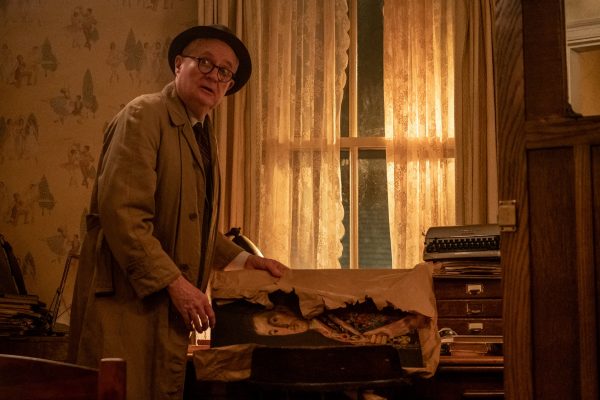
He reads an article about the immense popularity of a painting that’s recently been added to the collection at the National Gallery. The work is a portrait of the Duke of Wellington by painter Francisco Goya, one that the British government snatched out of the hands of eager American interests. The painting was considered a plum acquisition, a purchase highly touted by officials. Kempton even recalled seeing a TV broadcast about it featuring Home Secretary Rab Butler (Richard McCabe) and National Gallery Director Sir Philip Hendy (Andrew Havill). But, when Kempton learned how much the government spent on the acquisition of a painting – £140,000 – he was outraged. How could officials in all good conscience, he mused, expend a sum like that on a portrait when the funds could have been put to what he considered to be better use – like buying television licenses for pensioners and elderly veterans?
Given that the painting was now very much in the public eye, Kempton surmised, if anything were to happen to it, its fate would attract considerable attention. If, perhaps, it were to be stolen and held for ransom by someone seeking to raise awareness for a particular cause, such as the one Kempton was promoting, the attention sought by its pilferer just might follow. And, when the picture actually disappears not long thereafter, officials begin searching in earnest for its recovery.
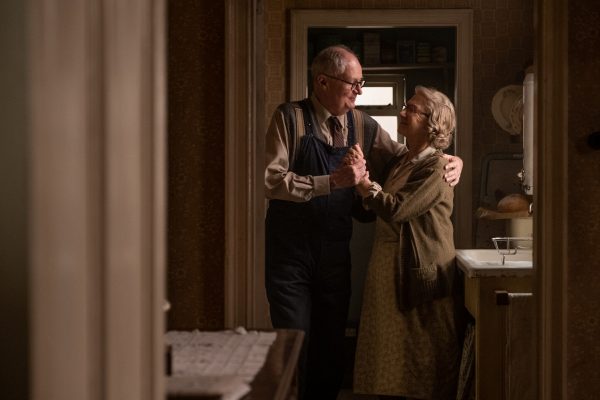
With the portrait in Kempton’s possession, he and Jackie scramble to hide it and issue ransom demands. But things don’t quite go as planned. To begin with, concealing the portrait proves difficult in several ways. Kempton needs to keep Dorothy from finding it, knowing that she’d throw a fit if she found it in her home. He also has to hide it from unexpected house guests, such as his older son, Kenny (Jack Bandeira), a small-time criminal from Leeds who’s visiting to avoid thugs on his tail. Kenny’s accompanied by his new girlfriend, Pammy (Charlotte Spencer), a savvy, shrewd, perceptive sort who rarely misses a trick – or an opportunity – especially when reward money for a certain lost painting is on the line.
As all this is going on, Kempton mails ransom notes to authorities, but, given their cryptic and sometimes-flowery prose – products of his attempts at being a playwright – they’re not taken particularly seriously. He eventually goes so far as to mail the National Gallery tag that had been affixed to the back of the painting to get some attention. But, despite this evidence, officials like Police Commissioner Sir Joseph Simpson (Charles Edwards) remain skeptical of its legitimacy, convinced that the portrait couldn’t possibly have been stolen by an amateur (like Kempton) but that the theft had to have been the work of professional criminals, like “organized Italian gangs.”
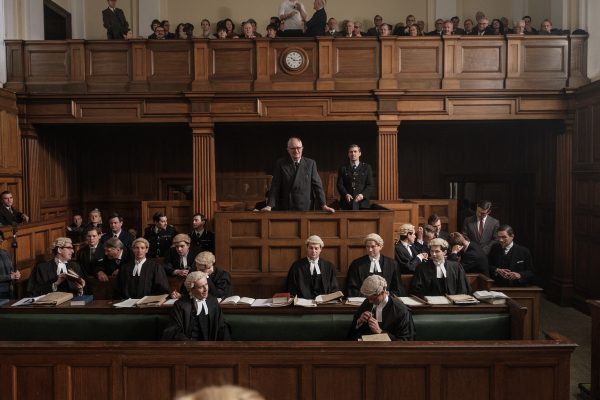
Before long, the truth emerges about how the painting came into Kempton’s possession, leading to its retrieval and a trial in London’s Old Bailey, where the alleged perpetrator at last faces his accusers in what is a very circus-like environment. In a proceeding led by curmudgeonly Judge Aarvold (James Wilby), Kempton is politely grilled by eloquent prosecutor Neddie Cussen (John Heffernan), while overwhelmed defender Jeremy Hutchinson (Matthew Goode) does his level best to minimize the severity of the penalties likely to be imposed on his client. And, if all of these absurd judicial hijinks weren’t already enough, Kempton adds a splash more of his own into the mix when he presents his pleadings – not guilty on all charges.
With this, the stage is thus set for a lively and colorful end game. It’s a proceeding full of surprises in which the defendant’s fate rests on principles that transcend purely litigious matters, opening the door for loftier notions to come into play, ideas that bring new meaning to the word “civil” in “civil proceedings.” And, given how everything began, it’s astounding how events ultimately turned out, including some developments that emerged well after the fact but nevertheless can trace their roots to the legacy of this unconventional landmark case.
Being an idealist is a noble but often-lonely, often-misunderstood pursuit, a mantle that can easily leave one isolated or even persecuted. However, the intents driving such individuals frequently come from an obscured, overlooked place of goodness and fairness. It may take time, effort and discernment to see this, because these altruists frequently must resort to extreme measures just to get themselves and their messages heard. But those who are willing to give them a listen may be pleasantly surprised at what they have to say.
That’s what Kempton Bunton was up against when he sought to make his views known. And many looked upon him as a radical eccentric, one whose messages were far from mainstream, often viewed as fringe, even zealously fanatical. But one quality no one could doubt was his sincerity. He believed in what he was doing, largely because his actions reflected who he was deep down inside. But, more than that, he clung to his romanticized notions in the belief that he could one day make them happen, materializing them in line with his heartfelt hopes. Such is the aim of the conscious creation process, the philosophy that maintains we draw upon these intangible resources in manifesting the reality we seek. Bunton may not have heard of this philosophy, but he certainly practiced its principles, even if he didn’t always attain success in their fulfillment. Nevertheless, in light of his determination and tenacity, on some level he obviously believed that one day he would.
Kempton’s drive was fueled by the tremendous faith he possessed. It bolstered his convictions, as if he were putting his beliefs on steroids, energizing and galvanizing their potency. That faith was further enhanced by his sense of personal integrity, his ability to be true to himself and his beliefs. That’s very much the case with other qualities that he held in high regard, such as compassion and concern for others, traits readily apparent in his efforts to promote his various causes. With all of those elements working in tandem, he concocted a refined recipe for success.
Most of the time, that is.
If Kempton had an area in need of improvement, it would have been his beliefs associated with discernment. He was often so convinced he was right that he didn’t always take into account the views of others. He frequently assumed that they would take an interest in his causes equal to his own. But there were certainly more than enough instances where they would disagree with his notions or simply not place the same degree of emphasis on them as he did. Yet he would carry on his quixotic campaigns with relentless fervor, aiming for success by hook or by crook, with little regard for others’ enthusiasm. And that lack of backing was often his undoing, one brought about by a fundamental miscalculation on his part.
This is apparent, for example, when he’s working his short-lived baking job. While on a break with his co-workers, the bakery boss, Mr. Walker (Craig Conway), enters the employee lunchroom and begins verbally abusing Kempton’s Pakistani co-worker, Javid (Ashley Kumar). Walker tells Javid to get back to work, despite the fact that he still has time left on his break. Kempton stands up for his colleague, calling out the boss for his bullying and prejudicial racist treatment, especially since he makes no comparable demands of any of the other workers, all of whom are White. Javid even pleads with Kempton that there’s no need to intervene on his behalf, but the idealist won’t hear of it and continues berating Walker. One can only guess where this leads as another miscalculation blows up in Kempton’s face.
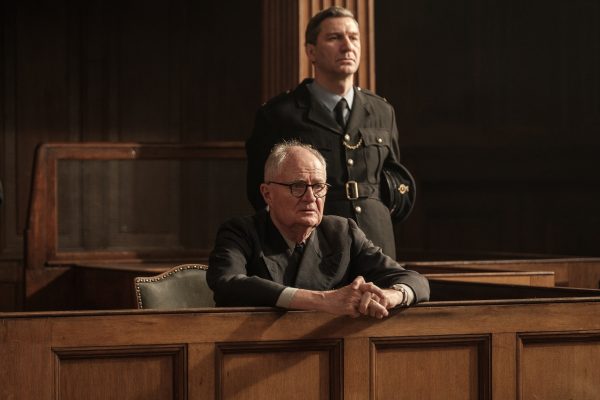
Still, there were times when he succeeded in skillfully winning over allies. He believed that he could sway the views of collaborators, but it became a matter of convincing the right co-creators, those who understood what he was trying to accomplish. That was the result of those supporters using their own capacity for discernment to grasp and appreciate what he was attempting. This is perhaps best evidenced in the film by the efforts of his defender, who eloquently put forth arguments in his client’s favor, helping the judge and jury understand Kempton’s unconventional tactics in a way that they hadn’t previously considered. By presenting arguments that put a previously overlooked spin on Kempton’s plans, Hutchinson enabled his client to be seen in a totally new light. The idealist was at last allowed to shine.
Director Roger Michell’s final narrative feature serves up a whimsical offering that puts a spotlight on the importance of being kind, compassionate and civil, a message that deserves greater importance and attention in days like these. This delightful, fact-based tale tells a story that blends elements from such diverse sources as O. Henry, James Thurber and Miguel de Cervantes, along with fine early 1960s period piece production values. In addition to its primary narrative, the film incorporates several subplots involving Kempton’s efforts to sell a play based on the death of his daughter in a tragic bicycle accident, the polar opposite courtships of his two sons and their decidedly different love interests, and the playfully stormy relationship of the protagonist and his wife, as well as a few surprises along the way. And then there are the spot-on performances of Broadbent and Mirren, both of whom are truly in their element here. Admittedly, the film probably would have worked better if it played off the humor aspect more than it does (particularly in the first hour and especially given the available talent pool in this cast), especially given the prevalence of the many secondary stories. But the picture redeems itself well the further viewers get into it, especially in the final act, presenting a feel good message that’s genuine, heartfelt and in need of being heard. Give this one a little time to develop, and you’ll be richly rewarded by film’s end. After a protracted release delay caused by the COVID-19 pandemic, this 2020 production has finally made its debut, playing in theaters.
What a world it would be if all of the Kempton Buntons on the planet were able to successfully have their say. Given the sense of compassion, kindness and civility propounded by such idealistic individuals, this might be a much better place for us all. But getting the message out might be half the battle. Finding the right wording, the right medium and the right time, as well as being able to drown out the noise that keeps these altruistic spokespeople from being heard, may be necessary elements to factor into the materialization belief mix. With an appropriate degree of discernment, backed by all of the other elements discussed earlier, the correct formula may readily be at hand, making it possible to manifest a world truly fit for a duke.
Copyright © 2022, by Brent Marchant. All rights reserved.
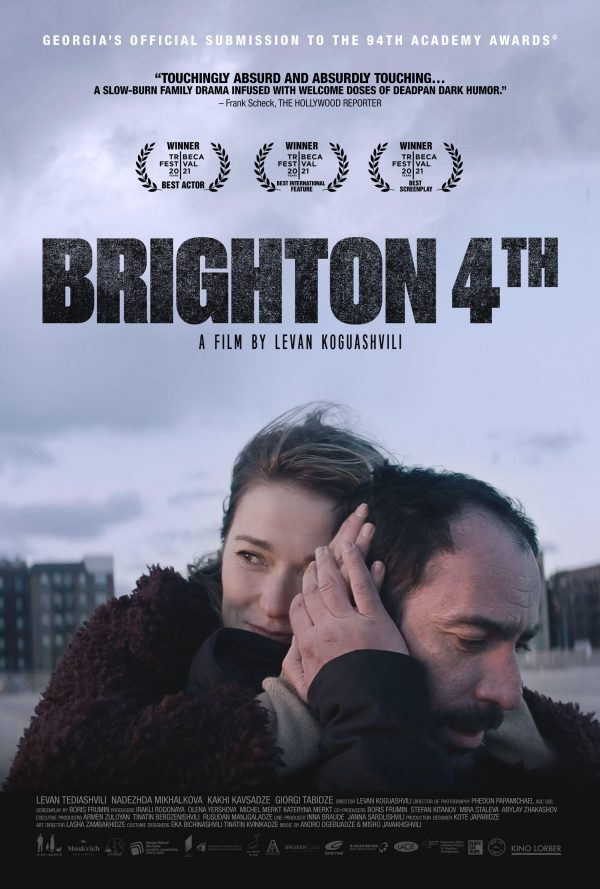
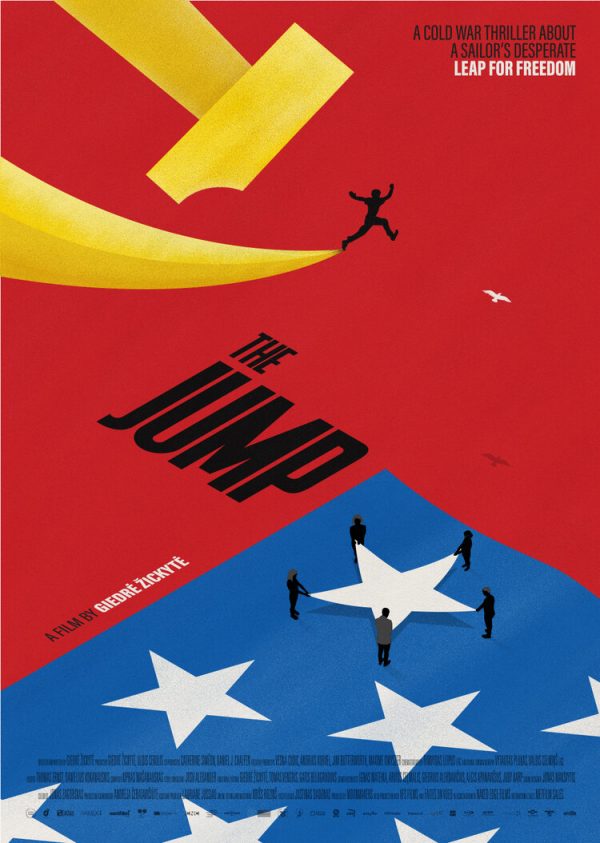
Reviews of "Brighton 4th," "The Jump" and "The Gravedigger's Wife," as well as a film festival wrap-up, are all in the latest Movies with Meaning post on the web site of The Good Media Network, available by clicking here.


“The Gravedigger’s Wife” (“Guled and Nasra”) (2021). Cast: Omar Abdi, Yasmin Warsame, Kader Abdoul-Aziz Ibrahim, Samaleh Ali Obsieh, Hamdi Ahmed Omar, Awa Ali Noor, Fardouza Moussa Egueh, Saharia Ahmed Moussein. Director: Khadar Ahmed. Screenplay: Khadar Ahmed. Web site. Trailer.
What lengths would you go to for the one you love? When adverse situations arise, we can be left with difficult choices, the kind that frequently leave us between a rock and a hard place. No matter how much we care for a loved one, circumstances may thrust us into a position where Herculean efforts – with no guarantee of success – are often foisted upon us. And, if we do nothing, the outcome can be tragic, leaving us devastated. So what are we to do? That’s the core question raised in the new Somalian domestic drama, “The Gravedigger’s Wife” (“Guled and Nasra”).
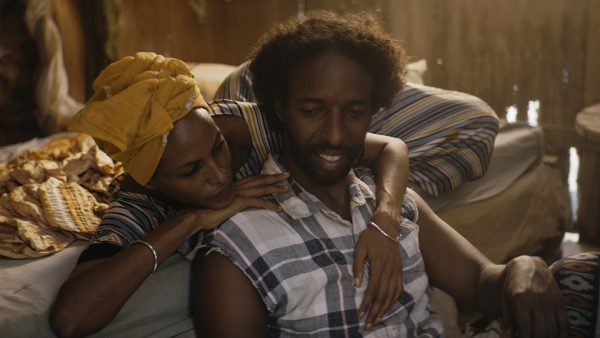
Djibouti gravedigger Guled (Omar Abdi) struggles to make ends meet to keep his family together. His meager earnings are barely enough to stay afloat, yet that doesn’t stop him from seeking out sources of additional income. In fact, during times of no work, he and his colleagues park themselves outside a hospital emergency room, hoping that arriving ambulances will provide them with new money-making opportunities – patients who are near death or have already passed on and in need of burial. As morbidly opportunistic as that may sound, though, it still doesn’t provide the financial resources he needs.
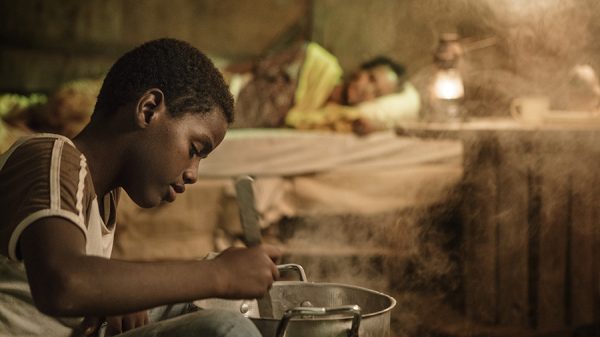
In large part, that’s due to the fact that Guled is spending nearly every penny he earns on medication for his wife, Nasra (Yasmin Warsame), who’s suffering from chronic, debilitating kidney disease. Guled positively adores Nasra and is willing to go to almost any lengths for her, but, no matter how much he does, it never seems to be enough. It’s put quite a strain on the household, particularly in his relationship with his teenage son, Mahad (Kader Abdoul-Aziz Ibrahim), who is growing progressively rebellious and increasingly hard to control. But, what’s worse, Nasra’s condition appears to be worsening, making matters even more difficult.
After visiting the hospital – this time not in search of work opportunities – Nasra’s attending physician (Fardouza Moussa Egueh) informs her and Guled that she requires life-saving surgery, a procedure that has good prospects for restoring her health but that is exorbitantly expensive. Guled doesn’t have nearly enough money for the operation, a prospect that essentially constitutes a death sentence for Nasra if he’s unable to raise the funds in time. But where will he get the cash he needs?

After assessing the situation, Guled realizes there’s only one option, and it’s far from easy. An income source is potentially available, but it will require him to return to the rural village where he grew up, a place he left many years earlier after a difficult and painful falling out with his family. Yet, given that this appears to be his only choice, he knows that he will need to make the long journey – on foot through the heat and rough terrain of the African wilderness – to his family homestead to collect what he believes he’s entitled to.
As the details of Guled’s past emerge, it also becomes apparent that there’s no guarantee that he’ll be able to collect on what he’s owed, especially when family members try to stonewall his attempts at staking his claim. Circumstances become even more complicated when his village’s tribal leaders become involved in the fray, implementing community proceedings to resolve the dispute between Guled and his relatives.
Given Guled’s depleted state after the long journey and his desperation to acquire the resources needed to save his wife’s life, it’s an ordeal that weighs heavily upon him. The anguish and frustration are unbearable, particularly in light of the intractable position assumed by his family, Nasra’s condition notwithstanding. He appears to be saddled with an impossible situation, one in which his own well-being is also now at stake. How will he be able to survive and save Nasra’s life? That’s what remains to be seen as this heartbreaking story unfolds.
It’s been said that, when there’s a will, there’s a way, even if its implementation and execution are difficult, if not seemingly impossible. The key to making it work rests with one’s ability to believe in the manifestation of the possibility, which is where the notion’s likelihood often comes under challenge. However, if one has faith in the idea and a commitment to make it happen, the chances of its materialization increase significantly.
These are the conditions that Guled faces when it comes to devising and enacting a solution to the dilemma he faces. His success will ultimately depend on his ability to tap into the foregoing principles, concepts that form the basis of the conscious creation process, the philosophy that maintains we draw upon our thoughts, beliefs and intents in manifesting the existence we experience. Guled may not have heard of this school of thought, but that doesn’t mean he can’t exercise its fundamentals in coming up with a plan to save Nasra before it’s too late. The question is, how committed is he to making it work?
Guled has a powerful tool at his disposal in attempting to pull off such a scenario – his love for his wife. His profound feelings in this regard are rooted in beliefs directly associated with his commitment to her and the relationship they’ve built together. His love is so deep that he can barely imagine a life without her. And that kind of devotion is a formidable motivation for launching, carrying out and completing the plan, no matter how arduous it might seem.

To be sure, an undertaking like this would almost assuredly deplete anyone’s wherewithal and resources, and Guled is no exception. At some point, though, he must choose whether the effort he needs to expend is worth it. Considering his bond with Nasra, his decision should be obvious. Admittedly it’s a hard choice, but, for those we love as much as Guled loves Nasra, there’s really no other option.
In taking on this venture, there are undoubtedly limitations and obstacles standing in Guled’s way. But, if he’s to achieve his goal, he must believe that they can be effectively overcome. That’s a tall order, to be sure, especially if fears and doubts enter the picture, for, at their core, they’re beliefs that can undermine whatever he attempts, potentially derailing his plans before they ever get off the ground. Consequently, he must set them aside and embrace beliefs related to attaining success and living courageously. That may also be a tall order, but employing those notions is indeed possible with the right mix of faith, commitment and determination, despite the odds.
Carrying out such manifestation efforts can be significantly enhanced with the right motivations. As previously mentioned, Guled’s love for Nasra is already in place, and that, in itself, is a force to be reckoned with. But there are other tools that can be employed, such as the power of compassion, which can infuse an undertaking like this with tremendous fortitude. Then there’s the impact of gratitude, the appreciation that Guled has for the presence of Nasra in his life, an influence that can significantly drive his determination, inspiration and enthusiasm. With all of that backing his efforts, he has an impressive and powerful belief toolkit at his disposal to realize his objective.
Tales like this are truly uplifting. In an age where it has become all too easy to throw in the towel, it’s heartening to witness stories where individuals are willing to place everything on the line to see their aspirations and ambitions fulfilled. Guled sets quite an example given what he undertakes in the name of love, and what greater glory could there be than that?
Writer-director Khadar Ahmed’s debut feature presents a simple but decidedly heartrending and heartbreaking tale, one that certainly tugs at the emotions as the couple’s story plays out, thanks in large part to the excellent performances of Abdi and Warsame, who have a tremendous chemistry on screen. To be sure, the film has its predictable moments and a few story threads that aren’t as fully developed as they could have been, but, overall, this is a fine showcase for a superb emerging talent, one who shows tremendous promise for future projects.
Unfortunately, finding “The Gravedigger’s Wife” may take some effort. It was highly touted as a strong contender at the start of the 2021 movie awards season, receiving considerable acclaim from critics and at film festivals, such as the Cannes Film Festival, where it earned nominations for the Golden Camera and Critics’ Week Grand Prize Awards. However, for whatever reason, those accolades did not translate into significant competition nominations, falling short of many expectations, despite its many laurels. The film has primarily been playing the festival circuit, which is probably the best place to find it, at least for the time being. The picture deserves a shot at general distribution, and here’s hoping that it gets that chance.
It’s been said that love conquers all, and I’m sure many of us would like to hope that’s true. That doesn’t mean, however, that it won’t get put to the test from time to time to verify its strength and resiliency. Such tests can be frustrating, but they can also help to bolster the bonds with our loved ones, taking that love to a deeper level. The choices involved in reaching that point may be difficult ones, but, in the end, we’ll likely find that the effort was worth it, something for which we can be eternally grateful.
Copyright © 2021-2022, by Brent Marchant. All rights reserved.
Tune in for the latest Cinema Scribe segment on Bring Me 2 Life Radio, beginning today, Tuesday May 10, available by clicking here. You can also catch it later on demand on Spreaker, Spotify, Apple, iHeartRadio, Google Podcasts, Castbox, Deezer, Podchaser and Jiosaavn.