Thursday, March 10, 2022

‘Hive’ inspires courage, hope and determination


“Hive” (“Zgjoi”) (2021). Cast: Yllka Gashi, Çun Lajçi, Kaona Sylejmani, Mal Niah Sadqiu, Shkelqim Islami, Astrit Kabashi, Kumrije Huxha, Adriana Matochi, Molikë Maxhuni, Blerta Ismaili, Armend Smajli. Director: Blerta Basholli. Screenplay: Blerta Basholli. Web site. Trailer.


When life beats us down, it can be nearly impossible to pick ourselves up off the ground. With so much holding us back, we may be unable to know how to go about it or even where to start. Yet, if we’re to carry on, we somehow have to figure out how to summon up the courage, hope and determination to move forward. Such is the experience of a group of wartime survivors as seen in the troubling yet inspiring new fact-based drama, “Hive” (“Zgjoi”).


When the madness of war mercilessly tears families apart, the survivors are left to pick up the pieces, a process that can sometimes be far more complicated than one might expect. So it was for the women of Kosovo in the wake of the tiny Balkan republic’s bombardment by neighboring Serbia in 1999, a conflict that resulted in the “disappearance” of many of the nation’s husbands and fathers, leaving their wives and mothers to carry on. But their efforts to do so were often thwarted by a misogynistic culture that sought to prevent them from engaging in anything other than the traditional roles they typically played, including earning a living even in the ubiquitous absence of male breadwinners.


Such is the story of Fahrije Hoti (Yllka Gashi), wife of Agimi (Armend Smajli), mother of two children, a teenage daughter, Zana (Kaona Sylejmani), and a young son, Edoni (Mal Niah Sadqiu), and caregiver to her aging and ailing father-in-law, Haxhiu (Çun Lajçi). In 1999, the family’s town of Krusha e Madhe was stormed by invading forces in which many of the men were summarily rounded up and taken away. Their fates were officially unknown, even though most everyone knew that they had been killed, their bodies dumped in mass graves or a nearby river. This left many families, including the Hoti household, without husbands, fathers and incomes.


While the United Nations stepped in to search for the missing in the wake of the unspeakable carnage, the process was slow, and, in most cases, all that was found were badly decomposed remains and remnants of tattered clothing – not much to work with when it came to making definitive identification of who was found. And, after seven frustrating years of few meaningful results, the survivors of the lost needed to get on with their lives, particularly generating income to keep their family households afloat. Given who was left behind, this was a task that fell to the women, but most attempts aimed at making a living were met with fierce opposition from the remaining men of the village.


The region’s longstanding chauvinistic mindset maintained that women were supposed to clean the house, cook the meals and rear the children only, not engage in prohibited pursuits like starting businesses or even driving cars. After all, these clueless sexists believed, what would their men think once they finally returned home and found their women doing such heinous things? Free-thinking attitudes like this were incontrovertible evidence that these disobedient women were inherently untrustworthy, raising the specter that they were also probably involved in all manner of other nefarious and lascivious activities. This scorn toward them led to acts of violence against them and their property, as well as rampant namecalling that earned them such disparaging labels as “whore.”



In a remote field in Kosovo, Fahrije Hoti (Yllka Gashi) quietly observes United Nations forensic investigators in their search for the remains of the missing, including her husband, in the wake of a brutal 1999 attack by Serbian forces in the gripping and uplifting new drama, “Hive” (“Zgjoi”). Photo by Astrit Ibrahimi, courtesy of Kino Lorber.


Nevertheless, bills had to be paid, and food had to be put on the table. To earn money, Fahrije initially took over the beekeeping operation launched by Agimi, producing honey sold by Haxhiu in the local market. But, even though it produced a modest income, it wasn’t enough. And, compared to many of her peers, Fahrije was fortunate to be earning anything. The women of Krusha e Madhe clearly had to do something to support themselves, despite the obstacles.


With the assistance of a local women’s organization, Fahrije and a group of her kindreds banded together to form a company that manufactured ajvar, a relish made from red peppers and eggplants, which they sold in a local supermarket. They faced numerous challenges, such as vandalism of their delivery vehicle (Fahrije’s car) and attempted sexual abuse by a local produce wholesaler (Astrit Kabashi). They also went to great lengths to keep the business afloat, such as pooling their funds from the sale of family jewelry. But they remained committed, sticking together and drawing from the strength of Fahrije and Nazmije (Kumrije Huxha), the wise old matriarch of the group.


Through it all, in addition to the ongoing financial and cultural challenges, the women also had personal issues to deal with. Fahrije, for example, still had a family to care for, including an often-belligerent adolescent daughter and a father-in-law who vociferously tried to dissuade her from her “dangerous” ventures. Then there was the frustrating ongoing search for Agimi’s remains, a process aided by a forensic investigator (Shkelqim Islami) who, unfortunately, repeatedly failed to obtain a DNA sample from Haxhiu, a tool that could potentially expedite the matter and at last put the issue to rest. This, of course, perpetuated the profound grief that Fahrije felt over the disappearance of her husband and the lingering doubt about what actually happened to him. This all made for quite a full plate.


However, the collective strength of the group helped to keep the business going at a time when its continued existence was essential. Indeed, cooperation and teamwork can be powerful forces to counteract the perils that surround us, as the women of this village learned for themselves. Like the bees who kept their hives thriving, this determined collective did the same, not only for themselves, but also for their sense of hope for a better future.


The burdens placed on Fahrije and the other women of her village are unimaginable. Difficulties in just one of these areas would be challenging enough, but, considering the myriad issues they’re up against, it’s almost inconceivable to fathom how they could possibly carry on. Missing husbands, economic hardship, unresolved grief and relentless ignorance-based harassment represent quite an array of adversity, but what can the women do under these circumstances? Simply giving up is not an option, so something has to be done. But what? And how?
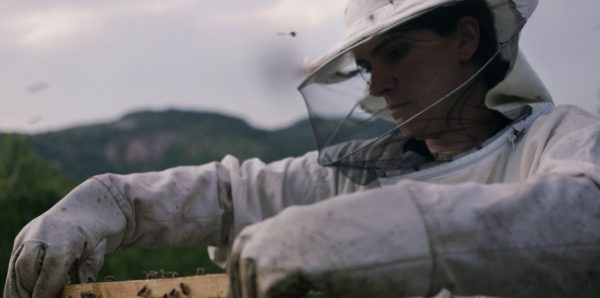


Tending to the bees in her backyard hives, Fahrije Hoti (Yllka Gashi) ekes out a living to help keep her family’s household afloat in director Blerta Basholli’s fact-based debut feature, “Hive” (“Zgjoi”), now playing in limited theatrical release and available for streaming online. Photo courtesy of Kino Lorber.


Overcoming obstacles as overwhelming and pervasive as these is indeed possible, but success depends on one’s ability to become convinced about the prospect. And that, in turn, rests with one’s beliefs, the building blocks of one’s reality according to the conscious creation process, the philosophy that makes such manifestations possible. Embracing that notion is imperative in Fahrije’s case, as everything she and her collaborators hope to achieve depends on it.


For starters, the women of Fahrije’s collective must adopt beliefs that rid them of fears and limitations, impediments that could easily hold them back from attaining any of their goals. And, in light of their circumstances, they have an abundance of potential fear- and limitation-based beliefs to vanquish, any of which could undercut their aims. However, given the power of their motivations and the depth of their needs, they also have ample inspiration and impetus to drive the formation of suitable beliefs designed to overcome these undermining influences and enable them to fulfill their objectives.


Once armed with ample courage, fortitude and determination and free of the hindrances that had long held them back, the women were then able to allocate their energies to the development of beliefs aimed at helping them envision possibilities and creative solutions that they previously had been unable to do. This led to the formation of their support group, then the idea to start a business, and then the means to make its formation, development and growth possible. It also enabled them to stand up to those who tried to undermine their efforts, to put the naysayers in their place, and to allow them to come into their own as fully actualized individuals, savvy entrepreneurs and empowered heroes.


Undoubtedly this all came about largely as a result of the individual strivings of Fahrije and her colleagues. But it also resulted from their collective efforts, their ability to work jointly in committed acts of co-creation, not unlike the bees in Fahrije’s hives. By pooling their belief resources, they were able to significantly amplify the magnitude of their intentions, making it possible to not only achieve, but also to exceed, their expectations. That certainly proved comforting, at least when it came to addressing their everyday basic survival needs. And, with that matter covered, it freed up resources to work on beliefs and solutions for their personal considerations, such as their efforts aimed at searching for their lost spouses and dealing with their long-unresolved grief, concerns that were hard to attend to when faced with issues as fundamental as putting food on the table.
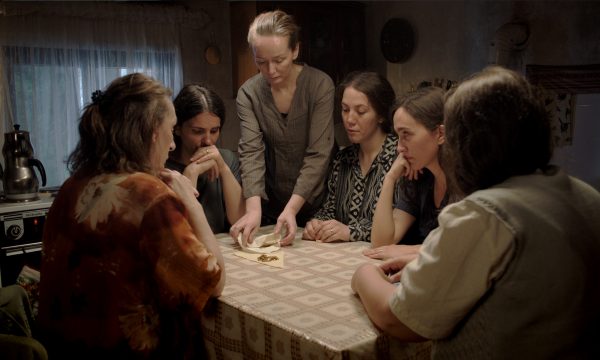


By pooling financial resources with her peers, business owner Fahrije Hoti (Yllka Gashi, second from left) struggles to keep their fledgling operation afloat in the face of numerous challenges as seen in director Blerta Basholli’s fact-based debut feature, “Hive” (“Zgjoi”). Photo by Alexander Bloom, courtesy of Kino Lorber.


Most importantly, though, these creative efforts helped to put Fahrije and the other women on a firm footing for the future. It may not have restored what they lost, but it provided them with a foundation on which they could build new lives for themselves and their families. Even their culture was impacted by the introduction of progressive new ideas, concepts designed to help sweep away archaic, outmoded notions that benefitted only a privileged few and kept the remainder of society on the outside looking in. In the process, they realized gains for their gender, as well as the ability to exercise the joy and power of creation for the betterment of themselves and their society, quite an accomplishment from humble beginnings.


Director Blerta Basholli’s fact-based debut feature hits all of the right notes with this inspired yet troubling offering. Its unique combination of raw emotions, steely determination and supportive sisterhood make for a one-of-a-kind viewing experience, one that’s sure to draw out an array of heartfelt feelings and stirring responses from viewing audiences. The film’s striking cinematography and superb script are genuine stand-outs, placing viewers squarely in the circumstances faced by the finely crafted ensemble of characters. But perhaps its greatest asset is the masterful lead performance of Yllka Gashi as the beleaguered but defiant protagonist. With world events being what they are at the moment, this outstanding release reminds us all too poignantly about what we face in the wake of these insane, misguided catastrophes and the difficulty of coming back from them, a challenge that calls for an abundance of commitment and determination in the face of adversely unrelenting circumstances. The film is currently playing in limited theatrical release and is available for streaming online.


While “Hive” hasn’t earned any major awards season accolades (despite having been shortlisted as Kosovo’s submission for the Academy Awards’ best international film), it has nevertheless fared well on the film festival circuit. The picture has earned 17 wins and an additional 11 nominations in international competitions around the globe, quite an accomplishment for a first-time narrative feature filmmaker. That should say something about the quality and merits of this fine debut production.


The uplifting example set by the women of Krusha e Madhe should inspire anyone who has come up against adversity and needs to determine how to carry on. The challenges they managed to overcome make many of those that we face pale by comparison. It’s hard to imagine how they could have vanquished everything that they did, but, when our circumstances necessitate us having to do so, somehow we manage to find the inner strength and suitable supporting beliefs to make it happen. We should remember that the next time our backs are against the wall. After all, if these courageous souls can rise up to meet their circumstances, there’s no reason why any of the rest of us can’t – especially when we seemingly have no other choice available to us.


Copyright © 2022, by Brent Marchant. All rights reserved.

Monday, March 7, 2022

Conflict Resolution on The Cinema Scribe

Tune in for the latest Cinema Scribe segment on Bring Me 2 Life Radio, Tuesday, March 8, at 2 pm ET, by clicking here. And, if you don't hear the show live, catch it later on demand on Spreaker, Spotify, Apple, iHeartRadio, Google Podcasts, Castbox, Deezer, Podchaser and Jiosaavn.


Friday, March 4, 2022

Five New Movie Reviews for You

Looking for some great new movies? Catch five recommendations on the latest edition of The Good Media Network's Frankiesense & More video podcast featuring special guest host Ishita Sharma and yours truly. Tune in for a fun and lively discussion of five new films well worth your time! Check it out by clicking here. Additional postings to YouTube and LinkedIn to follow soon!


Wednesday, March 2, 2022

A Twofer March on Frankiesense & More

Join new guest host Ishita Sharma and yours truly for a double dose of movie review shows on The Good Media Network's Frankiesense & More video podcast in March! The first, on Thursday March 3, will feature reviews of five new movies, and the second, on Thursday March 24, will feature new movie reviews and my Oscar predictions in the top six categories. Tune in on Facebook or YouTube for all the fun and lively discussion!


Sunday, February 27, 2022

This Week in Movies with Meaning

Reviews of "Lunana: A Yak in the Classroom," "Mass" and "Strawberry Mansion," as well as a video podcast preview, are all in the latest Movies with Meaning post of The Good Media Network web site, available by clicking here.


Saturday, February 26, 2022

‘Strawberry Mansion’ reveals the power of dreams


“Strawberry Mansion” (2020 production, 2022 release). Cast: Kentucker Audley, Reed Birney, Penny Fuller, Linas Phillips, Grace Glowicki, Constance Shulman, Ephraim Birney, Albert Birney. Directors: Kentucker Audley and Albert Birney. Screenplay: Kentucker Audley and Albert Birney. Web site. Trailer.


Dreams carry tremendous power. They give us hope, inspiration and motivation to achieve lofty goals, aspirations that have become synonymous with the word “dream” itself. But there’s even more to them that; their power, backed by the beliefs that drive them, can impact our existence in unimaginable ways, enabling possibilities we may have never envisioned. Getting to that realization may take some doing, though, especially when it comes, ironically enough, to “awakening,” an odyssey insightfully depicted in the new sci-fi fantasy, “Strawberry Mansion.”


Have you ever been on an email or social media web site where you’ve found advertising in the margins or newsfeed that, remarkably, just happens to match what you’ve just been thinking or talking about? Some find it uncanny, while others find it creepy and intrusive. But imagine what it might be like if that highly synchronistic concept could be taken a step further, with promotional messages for products that you have an immediate need or desire for miraculously showing up in your dreams. Those perfectly timed recommendations might almost seem heaven-sent, especially among those who don’t fully understand the nature of their dream life. They’re so unaware – yet so grateful – for the suggestions that they rush out to purchase the products in question upon awakening. On top of that, they’re so appreciative for these leads that they’re even willing to pay taxes for them. Amounts are assessed based on the imagery in their dreams, the details of which are faithfully and willingly recorded to provide documentation for tax authorities. Payment is provided upon awakening, a gesture that has unquestioningly become part of their morning routine. And that goes for virtually everybody.


Sounds rather invasive, doesn’t it? What’s most unnerving about all this, though, is that most people don’t realize that the images related to the recommendations are being planted in their dreams without their knowledge. Like sheep, they go along with what’s being sold to them, and they never raise a fuss about the practice nor object to paying the taxes.


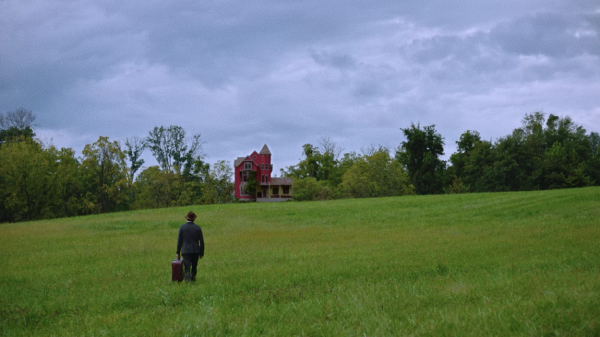
When tax auditor James Preble (Kentucker Audley, back to camera) arrives at the remote home of an elderly eccentric, he’s not quite sure what to expect, as seen in the whimsical new sci-fi release, “Strawberry Mansion.” Photo courtesy of Music Box Films.


Such is life in 2035, where technology has been perfected to a point where these practices have been thoroughly implemented and blindly accepted as standard operating procedure. Our dreams truly aren’t our own any more, and we don’t even realize it. That’s true even for the tax collectors, who generally have no idea that they’re being taken just like everybody else. All they’re concerned with is doing their jobs, conducting audits to make sure that everyone is paying his or her “fair” share.


That’s where tax auditor James Preble (Kentucker Audley) enters the picture. He dutifully dreams his dreams, buys the recommended products, pays the requisite taxes and goes about his work making sure that taxing authorities are getting their “just” due. He’s a good little consumer and civil servant who never questions the status quo and makes a practice of enforcing regulations to the letter.


But that all changes when James is tasked with performing an audit of an eccentric old woman, Arabella Isadora (Penny Fuller). It seems she’s delinquent on her taxes, having apparently not paid them in quite some time. James pays a visit to her rural residence, a bright, magenta, Victorian structure that she calls the Strawberry Mansion. Much to his surprise, Bella warmly welcomes him into her home, whose interior is even more eye-popping than the exterior. The aging artist has filled the rooms with all manner of colorful, inventive paintings, sculptures and figurines, looking as if they were images from her dreams brought to life.


All of this leaves James more than a little baffled. However, he’s even more surprised by the warm hospitality Bella extends to him. That’s true despite his explanation for the purpose of his visit. James is mystified that she offers no resistance and cooperates fully, a reaction far different from how most people respond when the taxman comes for a visit. Nevertheless, he gladly welcomes her assistance, especially when he discovers the extent of the material he’ll need to review for his audit. In fact, it quickly becomes apparent that his work is going to require a great deal of time, so much so that Bella extends an invitation to stay at her home for as long as it takes. After all, she doesn’t want to “tax” him with having to repeatedly make the long commute back and forth between his residence and her remote property.


Upon arrival at his audit subject’s home, taxman James Preble (Kentucker Audley, back to camera) soon realizes he has his work cut out for him, a project that will ultimately help to change his life, as depicted in the delightful indie sci-fi release, “Strawberry Mansion.” Photo courtesy of Music Box Films.


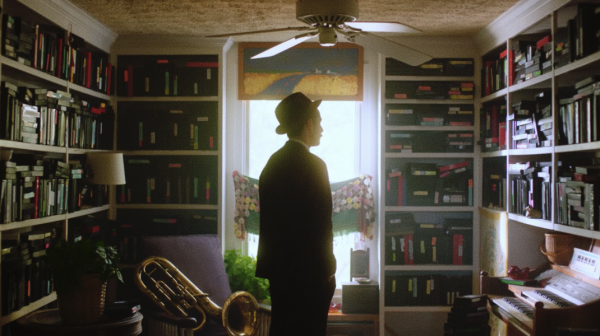
As James begins his audit, he discovers Bella has about 2,000 dream tapes for review, a process that will likely take even longer than expected given that they’re in an outdated format. There are frequent distractions, too, such as Bella routinely interrupting him to graciously serve him tea or a meal. He’s also sidetracked by the unusual imagery in Bella’s house and his host’s perpetually genial and unconventional demeanor, particularly the strange, lighted helmet she often sports. He feels as though his professionalism is being compromised, and it makes him uncomfortable. But those diversions are nothing compared to what’s to come.


In watching Bella’s tapes and assessing taxable amounts, he starts to become captivated by the imagery in her dreams. Many of them are truly out there, such as dinner in a restaurant with a tall, talking frog waiter (Albert Birney) and a series of outdoor encounters with a mysterious “grass man” who looks oddly familiar. But what captures James’s attention most is Bella’s younger self (Grace Glowicki), a beautiful woman who also seems uncannily familiar. James can’t help but be taken in by what he sees.


After reviewing a number of tapes, James and Bella partake in a number of profound conversations. He grows curious about her and her past, and this personal interest unwittingly prompts him to let his guard down. He slowly drops his professional demeanor as they talk about subjects unrelated to the audit. In no time, their discussions turn to the subject of dreams, but not just their own nighttime experiences; they also discuss the nature of dreams and what they’re capable of, notions that Bella has a good handle on but about which James is comparatively clueless. She then confesses that it’s important for James to understand this, because it will open his eyes. What’s more, she says that this understanding will help to show him that the two of them are intrinsically connected in many more ways than just the audit, a revelation that captivates him.


The odd habits, artwork and wardrobe of aging eccentric Arabella Isadora (Penny Fuller) confounds a conventional tax auditor in “Strawberry Mansion,” the latest offering from directors Kentucker Audley and Albert Birney. Photo courtesy of Music Box Films.


What follows is an odyssey beyond imagination, including a strange meeting with Bella’s long-estranged son, Peter (Reed Birney). To say more about it, though, would reveal too much, but suffice it to say that the experience is enlightening and challenging in myriad ways. It’s an adventure that has the potential to not only awaken James to possibilities and secrets he hadn’t previously considered, but also to do the same for many in the viewing audience. Fasten your seatbelts, folks.


As viewers and characters alike discover, what starts out as a small, slice of life-type of story gradually balloons into something far bigger, one that touches on the nature of our dreams, the meaning of existence and the management of our personal power. And, given that, the tax collection story line quickly seems pretty trivial by comparison (a notion we might all be wise to take to heart). Indeed, with so much at stake here, we, like the protagonist, would be wise to pay close attention to what’s unfolding.


For what it’s worth, the audit assignment is the hook that gets James’s attention and leads him down a truly enlightening path. He soon discovers that dreams are more than a coerced revenue source, and the further he examines this notion, the more he comes to realize how his beliefs about them play a significant role in his reality, the one he experiences while asleep and the one he experiences while awake. Such is what comes out of the conscious creation process, the philosophy that maintains we draw upon these intangible resources in shaping our existence. As the picture so eloquently illustrates, what can potentially emerge from our dreams (and the beliefs behind them) is quite a step up from the more mundane “revelations” they have typically yielded, such as learning which brand of fried chicken is the crispiest or what pesticide is most effective in eliminating a spider infestation. But, then, that’s probably to be expected when we discover how powerful and valuable these tools can be to our personal happiness and well-being, especially when we can see past the manipulation that goes into using them for mere consumer good pitches.


While reviewing a dream recording for tax purposes, auditor James Preble (Kentucker Audley, left) becomes captivated with the younger self of his audit subject, Arabella Isadora (Grace Glowicki, right), in “Strawberry Mansion.” Photo courtesy of Music Box Films.


Once James learns how to take control of his beliefs, he realizes how much more they have to offer, particularly in the dream state. Even more importantly, though, he sees how he can employ them to bring about what gives him personal fulfillment and satisfaction. The goals and aims that he had allowed himself to become accustomed to in his dreams suddenly pale by comparison. The vistas that open up to him are more meaningful and significant than those that come to him through nightly visits from a dreamtime avatar (Linas Phillips) who tries to sell him on things like which brand of soda to buy.


This realization enables James to grow and evolve in ways he hadn’t anticipated when he began Bella’s audit. He undergoes a fundamental metamorphosis, one in which he begins to realize his potential in ways he hadn’t previously imagined. In fact, like those in many of the world’s indigenous cultures, he comes to understand that the dream state is the real reality – one in which infinite possibilities for exploration and creative expression are attainable – and that the waking consciousness we think of as “reality” is merely a dream. It may be a powerfully seductive one in which we become heavily invested in the veracity of what we experience, but it’s still only one limited possibility, one that comes up far short in comparison to what true existence can afford us. And, as becomes apparent, it all comes down to the underlying beliefs driving it and how fiercely we adhere to them, something that’s not especially difficult to grasp given their inherent power and persistence.


In light of the foregoing, dreams and beliefs thus place infinite possibilities readily within our reach, provided we give ourselves permission to experience them. This means there are genuine modes of expression that allow us to immerse ourselves in unrelenting joy and freedom, a lesson that Bella – in both of her incarnations – is desperate for James to discover for himself. She realizes that there’s much more to what he can attain than what he’s allowed himself to be compelled into believing. Indeed, reality really can be quite the adventure if we’ll only open our eyes and allow it.


During the course of what is supposed to be a routine audit, taxman James Preble (Kentucker Audley, right) has an unusual encounter with Peter Bloom (Reed Birney, left), the long-estranged son of his audit subject, in “Strawberry Mansion.” Photo courtesy of Music Box Films.


Of course, if this is to happen, we must begin practicing discernment to discover what we truly believe and what we’ve allowed ourselves to become blinded by. This involves eliminating such undercutting influences as fears and limitations, for they only get in our way and keep us from achieving true happiness – the kind that the profit-motivated manipulators don’t want us to see or experience. After all, if we go down that path, we may end up buying a different brand of soda – or no soda at all – much to their exasperated consternation. Think about that the next time you read your email page or visit a social media web site. You’re in charge of your beliefs, which means that you’re in charge of your destiny and how your reality unfolds.


Considering the breadth of material addressed here, this is, without a doubt, one of the best new releases I’ve seen in a while. This little-known sci-fi gem from directors Kentucker Audley and Albert Birney serves up a funny, thoughtful meditation on the nature of existence, the intrusiveness of attempted mental manipulation and the perils of unbridled greed, all wrapped up in a delightful, visually sensational package. It’s also one of the most romantic stories I’ve screened in ages, conveying genuine, heartfelt emotion without ever becoming schmaltzy, a rare accomplishment in general and something rarely seen in this genre. The film’s scrupulous attention to detail in the production design, cinematography and writing is absolutely astounding, and its inventive, clever creativity sparkles but without ever becoming excessive or gimmicky. There’s a lot to like in this one, as well as a lot that gives viewers pause for thought. And, aside from a slight tendency to stretch things out a little too long in the final act (most likely due to the filmmakers’ desire to cover as much ground as possible), there’s really not much else to criticize here. “Strawberry Mansion” may not appeal to everyone, but, for those who value cinematic innovation without becoming tedious, annoying or implausible, this one is for you. The film is playing in limited theatrical release and is available for streaming online.


For many of us, dreams are a mystery, but they need not be mystifying. If we make the effort to understand them and then make use of that knowledge, there’s no telling where they can take us. Of course, if we allow ourselves to become hung up on the impediments that keep us from grasping or employing those insights, we may never realize what we’re missing, and that would be unfortunate. After all, a can of bug spray can’t begin to compare with the wonder of existence and everything it can offer us.


Copyright © 2022, by Brent Marchant. All rights reserved.

Thursday, February 24, 2022

‘Lunana’ showcases the joys of personal evolution


“Lunana: A Yak in the Classroom” (2019 production, 2021 release). Cast: Sherab Dorji, Ugyun Norbu Lhendup, Kelden Lhamo Gurung, Kunzang Wangdi, Tshering Dorji, Tsheri Zom, Sonam Tashi, Tandin Sonam, Dophu, Pem Zam, Dorji Om. Director: Pawo Choyning Dorji. Screenplay: Pawo Choyning Dorji. Web site. Trailer.


If life were to remain stagnant, we’d probably become bored, disillusioned or unfulfilled by the stunning lack of change. That’s especially true for those of us who aspire to something more, to be able to freely express ourselves, regardless of the milieu through which we do so. However, if we’re to realize that objective, we need to make the effort to evolve. But, in attempting to implement that process, we sometimes find that evolution takes on forms that we don’t expect yet nevertheless leave us wholly and pleasantly transformed, providing us with what we need to make that progression possible. So it is for a weary young man looking to steer his life in a new direction in the charming comedy-drama, “Lunana: A Yak in the Classroom.”


Ugyen Dorji (Sherab Dorji) is dissatisfied with his life. As a teacher in the fourth year of a five-year Bhutanese government contract, he’s bored with his work, and it shows in his performance record, which is not up to expectations. He’s not especially enthused about his living arrangements, either, sharing a cramped apartment in the capital city of Thimphu with his grandmother (Tsheri Zom), who raised him after his parents perished. He feels trapped, unable to make any meaningful substantive changes.


Ugyen’s heartfelt desire is to immigrate to Australia to pursue a singing career, and he’s ready to quit and walk away from his teaching job. However, when he meets with his boss, the Education Secretary (Dorji Om), he’s reminded that he’s still under contract and must fulfill his obligations. What’s more, given her dissatisfaction with his track record, she’s not in the mood to extend any favors. In fact, she believes his performance merits reassignment, a prospect that causes his heart to sink, especially when he finds out where he’s being sent. The Secretary sternly informs him that he’s being assigned to fill a teaching position in the remote village of Lunana in the mountains on the Chinese border.


To say the least, Ugyen is stunned. Relocating to Lunana means giving up the relative comforts of the modern world for a Spartan existence, such as learning how to get by without essentials like electricity and cell phone service. The village’s location at altitude with its thin air is also a concern, something Ugyen’s not accustomed to. He attempts to talk his way out of this news, but to no avail; he’s told he must accept the assignment. If there’s a saving grace, he’s informed that the posting is only for a few months; he’s not expected to spend the winter in Lunana, where conditions can become oppressively harsh. But even that reassurance does little to raise his enthusiasm as he embarks on a journey that feels like a jaunt to purgatory.


Upon leaving Thimphu, he takes a bus to a small village that marks the final stop on the route into the countryside. But that’s far from the end of the trip. Upon his arrival, he’s met by two guides, Michen (Ugyun Norbu Lhendup) and Singye (Tshering Dorji), Sherpas of sorts who will escort him to Lunana. They describe the impending trek as an easy journey, but that’s an appraisal based on their perspective. Since they’re accustomed to the prevailing conditions, it’s not a big deal for them. But, for an urbanite like Ugyen, it’s a strenuous adjustment – especially since the journey takes nearly a week on foot through the Bhutanese wilderness, including traversing a high-altitude pass.


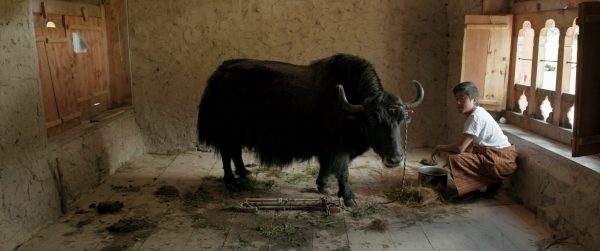
Ugyen’s ready to give up even before he reaches his destination, a decision reinforced once he arrives in Lunana. He’s shocked at his primitive living conditions, such as an oven/furnace that’s powered by burning dried yak dung. And then there’s his classroom, which lacks such basics as a blackboard. He’s ready to pack up and leave.


Oddities like having a yak in the classroom are among the local curiosities that a onetime-urban teacher, Ugyen Dorji (Sherab Dorji), must adapt to when he’s reassigned to a post in a remote mountain village in the new Bhutanese offering, “Lunana: A Yak in the Classroom.” Photo courtesy of Samuel Goldwyn Films.


However, despite these circumstances, Ugyen is warmly welcomed by the villagers. He is treated as a respected guest, an honor frequently accorded to teachers in Bhutan. Village leader Asha Jinpa (Kunzang Wangdi) tells Ugyen that he is willing to provide him, within reason, whatever he needs and wants to do his job. Asha is convinced that education is crucial to the children of Lunana, something that’s integral to their personal growth and development. He believes it’s essential to them being able to attain goals greater than becoming simple yak herders, the vocation that most of the townsfolk end up pursuing, usually by default.


With that understanding, Ugyen begins to realize his personal value and that of his profession in ways that he’s never appreciated before. That awareness is amplified when he meets his students for the first time. They show him reverence and a level of respect that floors him. They’re eager to follow his lessons and to do whatever he asks, and the class captain, Pem Zam (Pem Zam), zealously makes sure that her peers adhere to his instructions. The students are exuberantly pleased to have a teacher in the classroom once again, and they take a genuine liking the new arrival. He quickly becomes their favorite, an attitude that gradually but completely changes Ugyen’s outlook.


In addition to the unexpected career satisfaction that Ugyen begins to develop, he also takes a shine to living in Lunana. The stunning beauty of the surroundings is breathtaking, the whimsical nature of his locale is renewing, and the genuine warmth of the residents leaves him feeling loved and appreciated in a way that he has never experienced before. Ugyen also develops a particularly strong affinity for a local musician, Saldon (Kelden Lhamo Gurung). He’s captivated by her mesmerizing voice, and she plays a key role in teaching him the ways of local musical styles, something that has a profound influence on his own artistic sensibilities. Before long, the assignment that Ugyen once dreaded becomes a transformative experience for him personally, vocationally and artistically, and his dreams of relocating to Australia seem to fade into the background. Ugyen genuinely appears to be in his element.


But, with winter approaching, Ugyen is now facing an important decision: Does he depart as originally planned, or does he stay put in the environment he has become so enamored with? It’s a decision he’ll have to live with once he makes up his mind, given that the heavy snow buildup in locations like the mountain pass will invariably prevent his departure until spring. Is he prepared to tough it out under those conditions? Yet is he ready to leave behind what he has so grown to love? This is a decision Ugyen wasn’t expecting when he took on this assignment, but it’s an important one considering the tremendous impact it will have on him and his future. And, even when he finally makes a decision, he may still find himself unprepared for what awaits him, an outcome that provides him with surprises, opportunities and developments he never anticipated.


Class captain Pem Zam (Pem Zam, left) exuberantly enjoys having a teacher back in her village school after the absence of an instructor, as seen in the Oscar-nominated feature, “Lunana: A Yak in the Classroom,” available for streaming online. Photo courtesy of Samuel Goldwyn Films.


As this story opens, Ugyen feels like he’s stagnating, stuck in a dissatisfying rut from which escape doesn’t appear likely without taking some drastic measures. And, to his credit, in devising his plan to relocate to Australia, he appears to be doing just that. But, when that scenario is thwarted, he feels like he’s digging himself into an ever-deepening hole, one from which flight has seemingly become impossible. Or is it?


Whatever comes next for Ugyen depends on what he believes, for those intangible resources will determine what unfolds, thanks to the conscious creation process, the philosophy that maintains we draw upon those intangible building blocks in shaping our existence. Indeed, Ugyen knows he needs to change the well-worn tape that’s been playing for far too long, and his immigration plan reflects that. But, as becomes apparent through this odyssey, it’s not enough. It doesn’t provide him with all of the elements needed to manifest a truly transformative experience. He not only needs to change locations, but he also needs to change himself. And, as his story plays out, Australia won’t bring that about, but Lunana just might.


Conscious creation maintains that we’re all continually evolving, that everything is in a constant state of becoming, and it’s apparent Ugyen hungers for that kind of change. But, if he’s to bring that about in his life, he needs to make sure that his next step represents a fundamental alteration. That kind of change begins with who he is, something that he apparently (and rightly) believes will only take place under circumstances that make it possible, namely, in a radically different environment under drastically different conditions from what he’s accustomed to. That’s why he creates the circumstances that make such change occur. He may not be fully conscious of that decision when he embarks on that journey, but, somewhere deep down inside his consciousness, he knows that he’s drawing to himself exactly what he needs to make that transformation materialize. And it gives him precisely what he requires to grow and change as an individual.


Road trip stories like this are perfect narrative settings for showcasing adjustments like those depicted here. Those who set out on such journeys seldom end up being the same people at the end that they were at the beginning, proof that these undertakings accomplish their underlying goals. And, when properly tuned beliefs are in place that make such fulfillment possible, the degree of success is generally more than obvious, even if the intents driving them weren’t readily apparent at the outset.


Those who become engaged in these scenarios can often tell that they’re working if they’re paying attention to what’s going on around them as events unfold. For instance, when perfectly attuned developments occur that further the manifestation of the underlying intents, those at the center of them generally experience synchronicities, coincidences that seem so perfectly tailored to their needs that they just can’t be random happenings. And, when synchronicities unfold in succession, they provide a trail of metaphysical bread crumbs leading us to where we need to end up. These sign posts show us that we’re on the right path, headed toward the fulfillment of our destiny.


Teacher and aspiring singer Ugyen Dorji (Sherab Dorji, left, back to camera) develops a strong affinity with a Bhutanese mountain musician, Saldon (Kelden Lhamo Gurung, right), who instructs him in the ways of local musical styles in director Powa Choyning Dorji’s debut feature, “Lunana: A Yak in the Classroom.” Photo courtesy of Samuel Goldwyn Films.


The foregoing is clearly the case where Ugyen is concerned. The longer he stays in Lunana and the more comfortable he grows with his circumstances, the more satisfaction he gets out of the experience, providing him with validation that he’s where he’s supposed to be. He experiences a series of “aha!” moments, each offering more proof of that with each passing day. He comes to realize that his “unexpected” reassignment is exactly what he needed to become who he wanted to be, even if he wasn’t aware of that fact when he started out on this journey.


Of course, if we’re to make the most of such scenarios, we must make every effort to be prepared for them. This means shedding beliefs that could get in the way and serve as roadblocks, definite obstacles to our success. This is perhaps most important where fears, apprehensions and limitations are concerned. They can severely undercut efforts like these, reinforcing the stagnation and stalling forward progress. If Ugyen were to allow these hindrances to interfere in his plans, for instance, there’s a good chance he’d be no further along than when he started. And where would that leave him? Thankfully, his experience sets an inspiring example for all of us who want to move forward with meaningful fulfillment.


It’s always gratifying to find a little-known film that delights beyond expectations, as is the case with this uplifting offering from Bhutan. The joys and insights that emerge throughout the adrift protagonist’s experience open his eyes to fresh new possibilities that he hadn’t previously considered for his life and his art.  Heartening sentiments, gorgeous cinematography and skillfully nuanced performances abound, despite some occasional tendencies toward obvious but forgivable predictability. Director Powa Choyning Dorji’s debut feature showcases the work of a promising new talent who appears poised to deliver elegant, beautiful and revitalizing work from the rooftop of the world. This Oscar nominee for best international feature is available for streaming online.


Moving forward may not be an easy process, no matter how much we hope it will be. We may even view certain developments as setbacks that seemingly deter our efforts. However, if we trust the path we’re on, we often find that we’re headed in the right direction, that the fortuitous changes awaiting us are squarely on the horizon and readily within our sights. And, when we at last come upon them and what they have to offer us, we can proceed with ease and speed, taking us to our desired destination and the rewards that accompany our arrival.


Copyright © 2022, by Brent Marchant. All rights reserved.