Saturday, April 17, 2021

Who Will Win This Year’s Oscars?

It’s that time of year again – time for my predictions of the winners at the upcoming annual Academy Awards. While several of the likely winners have come into view, a few are still up for grabs. So, with that said, here are my picks for who will take home statues in the top six categories this year:


Best Actor

The Field:  Anthony Hopkins, “The Father”; Chadwick Boseman, “Ma Rainey’s Black Bottom”; Gary Oldman, “Mank”; Riz Ahmed, “Sound of Metal”; Steven Yeun, “Minari”
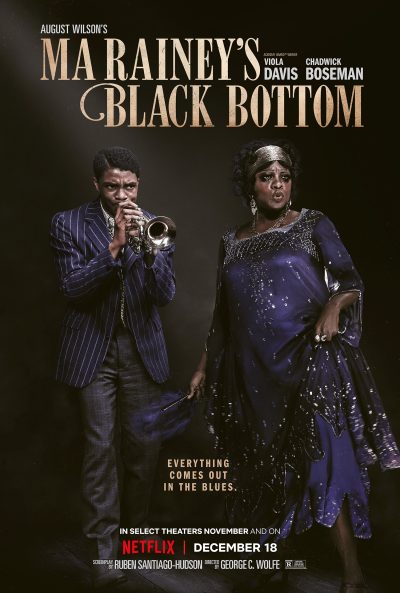


Who Will Likely Win:  Chadwick Boseman. This is a fairly solid lock. Boseman has won virtually every honor during this year’s awards season, and, despite his upset loss to Anthony Hopkins at the recent BAFTA Awards, his status as favorite should hold on Oscar night. So why will Boseman win? For starters, it’s the best performance in this category. It’s also the best performance of Boseman’s career. And, lastly, this is the final opportunity the Academy will have to honor him, something that should have happened a long time ago (especially for his portrayal of soul singer James Brown in “Get On Up” (2014), a performance for which he was inexcusably ignored). Ironically, this is the first Oscar nomination Boseman has received, and it’s likely Academy voters will not only want recognize a fine performance, but also attempt to atone for past oversights.


Who Should Win (Based on the Nominees):  Chadwick Boseman, though good cases could be made for both Riz Ahmed and Anthony Hopkins (but don’t expect that to happen).


Who Should Win (Based on All Eligible Candidates):  Chadwick Boseman, for the reasons cited above.


Possible Dark Horses:  Riz Ahmed and Anthony Hopkins. These are the only performers to have bested Boseman this year – Ahmed in the National Board of Review competition and Hopkins at the BAFTA Awards. It would take a lot for either of them to slip in as the winner at the Oscars, though, and it’s highly unlikely that will happen.


Also-Rans:  Anyone who isn’t Chadwick Boseman.


Who Should Have Been Left Out:  No one in my view, though some have said Steven Yeun. However, I can’t say I agree with that assessment.


Who Else Should Have Been Considered:  Several other noteworthy performances were deserving of consideration here, most notably Delroy Lindo for “Da 5 Bloods,” who was excluded for virtually every other awards competition this year, much to the consternation of many moviegoers. Others who merited attention include Tahar Rahim for “The Mauritanian,” Mads Mikkelsen for “Another Round” (“Druk”), Hugh Jackman for “Bad Education,” Louis Gossett Jr. for “The Cuban” and Rob Morgan for “Bull.”


Snubs:  Delroy Lindo, without a doubt (and that goes for all of the other awards contests this year, too). Some have said that the exclusion of Mads Mikkelsen was a snub as well, an observation that I believe is up for debate, even though his performance was worthy of consideration.


Best Actress

The Field:  Andra Day, “The United States vs. Billie Holiday”; Carey Mulligan, “Promising Young Woman”; Frances McDormand, “Nomadland”; Vanessa Kirby, “Pieces of a Woman”; Viola Davis, “Ma Rainey’s Black Bottom”
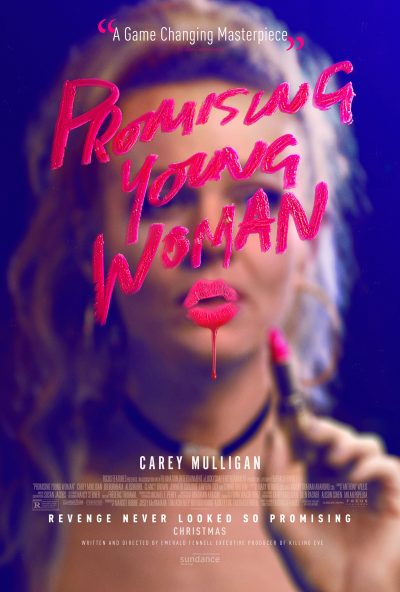


Who Will Likely Win:  Pick someone! This is a field up for grabs. Each nominee except Vanessa Kirby has won an award in this year’s previous competitions, most of which featured diverse candidate fields that didn’t match up actress for actress from contest to contest. If I had to venture a guess (and it is indeed a guess), I’d probably give the edge to Carey Mulligan, who turns in the best performance of her career (despite the questionable nature of her film’s character). Viola Davis and Frances McDormand are both recent winners, which likely rules them out, especially since these performances weren’t quite up to the level of their most recent victories. And Andra Day and Vanessa Kirby – though both stellar in their portrayals – probably don’t have enough clout with voters to pull off a win (though they’ve certainly made significant down payments toward future recognition). That leaves Mulligan, who’s likely to slide in as winner, albeit somewhat by default. Interestingly, Mulligan was considered the frontrunner coming into awards season, even though her campaign to take home hardware hasn’t lived up to expectations, winning only the Critics Choice Award thus far (and not even earning a BAFTA nomination in her native homeland). Nevertheless, she may end up having the last laugh on Oscar night. Of course, given the wide open nature of this category, I could be completely wrong about all this.


Who Should Win (Based on the Nominees):  Andra Day. This was arguably the most demanding of the performances, requiring solid singing and acting, and Day certainly rose to the occasion. And, even though the same could be said of Viola Davis in her role, Day won the day in this contest.


Who Should Win (Based on All Eligible Candidates):  There were many viable candidates for this prize, including a number of performers who weren’t nominated, most notably Radha Blank for “The Forty-Year-Old Version,” Rosamund Pike for “I Care a Lot,” Sophia Loren for “The Life Ahead,” Barbara Sukowa for “Two of Us” (“Deux”), Michelle Pfeiffer for “French Exit,” Susan Sarandon for “Blackbird” and Jasna Djuricic for “Quo Vadis, Aida?” I’d still include Andra Day in this group, as well as Vanessa Kirby, though I can’t necessarily say the same for their other fellow nominees.


Possible Dark Horses:  Given the nature of this category’s field, this could conceivably include virtually anyone.


Also-Rans:  Again, virtually anyone.


Who Should Have Been Left Out:  Frances McDormand. As dynamic an actress as she is, McDormand’s performance here was something a let-down. Her character’s low-key nature didn’t mesh well with her typical spitfire style of acting. Thus this is a case where an experiment in playing against type just didn’t work, and this portrayal should have been excluded from the field.


Who Else Should Have Been Considered:   In addition to the aforementioned performances by Radha Blank, Rosamund Pike, Sophia Loren, Barbara Sukowa, Michelle Pfeiffer, Susan Sarandon and Jasna Djuricic, other worthy candidates included Pamela Mendoza for “Song Without a Name,” Tsai Chin for “Lucky Grandma,” Graciela Borges for “The Weasels’ Tale” (“El cuento de las comadrejas”), Katja Herbers for “The Columnist” (“De Kuthoer”), Sally Hawkins for “Eternal Beauty,” Kara Hayward for “To the Stars,” Eliza Scanlen for “Babyteeth,” Lena Olin for “The Artist’s Wife” and Bukky Bakray for “Rocks.”


Snubs:  There were no obvious snubs in this category, but those who weren’t nominated were certainly just as deserving as those who were.


Best Supporting Actor

The Field:  Daniel Kaluuya, “Judas and the Black Messiah”; LaKeith Stanfield, “Judas and the Black Messiah”; Leslie Odom Jr., “One Night in Miami…”; Paul Raci, “Sound of Metal”; Sacha Baron Cohen, “The Trial of the Chicago 7”
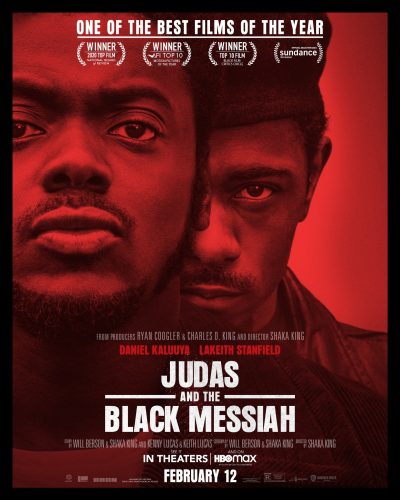


Who Will Likely Win:  Daniel Kaluuya. As far as the major category races are concerned, this is about as solid a lock as any of them can get. Kaluuya has won in this category in every major contest this awards season, and I don’t see that changing on Oscar night. I can only envision one possible scenario where this wouldn’t happen, but I believe it to be highly unlikely (see the Dark Horse discussion below).


Who Should Win (Based on the Nominees):  Daniel Kaluuya. While there are many impressive performances in this pool of nominees, Kaluuya is the cream of the crop and deserves to win.


Who Should Win (Based on All Eligible Candidates):  Kingsley Ben-Adir. Even though there are strong performances in the field of candidates, there are many other portrayals that were worthy of nominations, and that’s certainly the case for Kingsley Ben-Adir for his role as civil rights activist Malcolm X in “One Night in Miami….” I sincerely believe he gave the strongest male supporting performance of the year, and his exclusion from the field of nominees is an oversight and a disappointment. He should be in the field and the winner of the award.


Possible Dark Horse:  Leslie Odom Jr. At the start of awards season, prognosticators labeled Odom the prohibitive favorite, but that prediction has not materialized. And, in all likelihood, that will hold true again here with the exception of one possible scenario that might allow him to slip in as the winner. This is the first competition in which Kaluuya is opposed by his co-star, LaKeith Stanfield. Should Kaluuya and Stanfield split the vote – a possibility, though remote – that could open the door for Odom. Don’t look for this to happen, but it can’t be completely ruled out.


Also-Rans:  LaKeith Stanfield, Paul Raci and Sacha Baron Cohen. They should consider their nominations their awards.


Who Should Have Been Left Out:  Leslie Odom and LaKeith Stanfield. In Odom’s case, the performance was good, though I don’t believe that he was as strong as his co-stars (Kingsley Ben-Adir, Aldis Hodge and Eli Goree); I would have much rather seen his nomination go to one of his other cast members or to one of the many other performers in other films. As for Stanfield, my reason for excluding him here has nothing to do with his performance per se but because it’s the wrong category for him; if he were to have been nominated, it should have been in the lead actor category, not supporting, an outcome that, regrettably, he had nothing to do with.


Who Else Should Have Been Considered:  There are many other candidates deserving of consideration here. Obviously they all could not have been included, but it certainly was a strong year for supporting actor performances, as evidenced by this list of noteworthy portrayals: Ralph Fiennes for “The Dig”; Peter Y. Kim and Reed Birney for “The Forty-Year-Old Version”; Hugh Laurie, Peter Capaldi and Ben Whishaw, all for “The Personal History of David Copperfield”; Alan Kim for “Minari”; Peter Dinklage for “I Care a Lot”; Aldis Hodge, Kingsley Ben-Adir and Eli Goree, all for “One Night in Miami…”; Ibrahima Gueye for “The Life Ahead”; Glynn Turman for “Ma Rainey’s Black Bottom”; Brian Dennehy for “Driveways”; Charles Dance and Arliss Howard for “Mank”; Bruce Dern for “The Artist’s Wife”; William Hurt, Peter Fonda, Ed Harris and Samuel L. Jackson, all for “The Last Full Measure”; Chadwick Boseman for “Da 5 Bloods”; Frank Langella for “The Trial of the Chicago 7”; and Ben Mendelsohn and Toby Wallace for “Babyteeth.”


Snubs:  There were no obvious snubs in this category, but the exclusion of Kingsley Ben-Adir was indeed disappointing.


Best Supporting Actress

The Field:  Amanda Seyfried, “Mank”; Glenn Close, “Hillbilly Elegy”; Maria Bakalova, “Borat Subsequent Moviefilm”; Olivia Colman, “The Father”; Youn Yuh-Jung, “Minari”
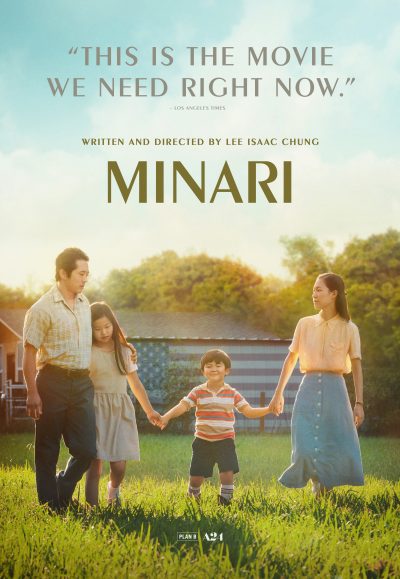


Who Will Likely Win:  Youn Yuh-Jung. Though her momentum was slow to start this awards season, Youn has been gaining steam in the most recent competitions and appears to be pulling away – and deservedly so. Though she has some serious competition in this category, she should prevail on Oscar night.


Who Should Win (Based on the Nominees):  Youn Yuh-Jung, though good cases could be made for Glenn Close and Amanda Seyfried (but don’t expect that to happen).


Who Should Win (Based on All Eligible Candidates):  Youn Yuh-Jung, though good cases could be made for Glenn Close and Amada Seyfried, as well as for un-nominated Ellen Burstyn for “Pieces of a Woman.”


Possible Dark Horses:  Glenn Close and Maria Bakalova. Having been nominated eight times and never won (and having lost at the wire for her performance in “The Wife” (2018)), Close may be seen as something of a sentimental favorite who could pull it out of the fire, though it’s somewhat unlikely. And Bakalova, winner of this year’s Critics Choice Award in this category, can’t be ruled out either, though Academy voters may take issue with her character as being an inappropriate choice (i.e., one that sends the wrong message and doesn’t fit the Oscar image).


Also-Rans:  Olivia Colman. While her performance here is capable, it really isn’t Oscar caliber, especially when compared to her award-winning performance in “The Favourite” (2018). I believe her nomination resulted largely from being swept up in the hype for this film.


Who Should Have Been Left Out:  Olivia Colman. Again, even though this is a solid performance, this is a slot that would have been better opened up to a more qualified candidate.


Who Else Should Have Been Considered:  There were many performances in this category worthy of nomination, most notably Ellen Burstyn for “Pieces of a Woman.” Others worthy of consideration included Jodie Foster for “The Mauritanian,” Dianne Wiest for “I Care a Lot,” Allison Janney for “Bad Education,” Valerie Mahaffey for “French Exit,” Martine Chevallier for “Two of Us” (“Deux”), Helena Zengel for “News of the World,” Tilda Swinton for “The Personal History of David Copperfield,” Essie Davis for “Babyteeth,” and Kristen Scott Thomas and Ann Dowd for “Rebecca.”


Snubs:  Ellen Burstyn, without a doubt.


Best Director


The Field:  Chloé Zhao, “Nomadland”; David Fincher, “Mank”; Emerald Fennell, “Promising Young Woman”; Lee Isaac Chung, “Minari”; Thomas Vinterberg, “Another Round” (“Druk”)
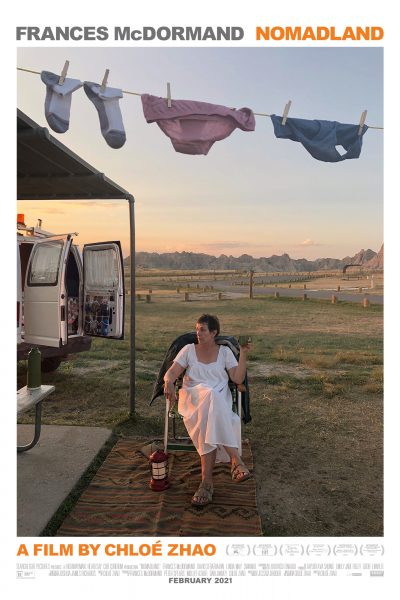


Who Will Likely Win:  Chloé Zhao. This Hollywood favorite has won virtually every major directorial award so far this year, and this trend should hold on Oscar night. Zhao has been a much-applauded rising star for several years, and the Academy has been aching to honor her accordingly, which should happen this time out.


Who Should Win (Based on the Nominees):  Lee Isaac Chung. “Minari” is handily the best picture of the year, and its director deserves the accolades that go with that. Unfortunately, he’s likely to be bested by frontrunner Zhao, who is widely regarded as one of the best filmmakers in the business these days, a reputation that I find somewhat exaggerated. To be sure, “Nomadland” is her best work to date, though I don’t feel it’s up to the level needed to capture this award. Chung, however, meets the standard and truly deserves to win.


Who Should Win (Based on All Eligible Candidates):  Lee Isaac Chung, for the reasons stated above.


Possible Dark Horses:  Lee Isaac Chung, again, for the reasons stated above. I sense a growing groundswell of support for this film, and Chung could pull an upset here (though it’s a long shot).


Also-Rans:  David Fincher, Emerald Fennell and Thomas Vinterberg. They should consider their nominations their awards. The works of Fincher and Vinterberg are a bit too fringe to garner the requisite support they need to win, and Fennell’s film doesn’t rise up high enough to meet the standard for this award.


Who Should Have Been Left Out:  Emerald Fennell, David Fincher and Thomas Vinterberg. From my standpoint, Fennell’s “Promising Young Woman” is one of the most overrated offerings of the year and, except for Carey Mulligan’s fine performance, isn’t worthy of the praise or nominations that have been heaped upon it, including in this category. Fincher’s “Mank” is certainly a well-crafted period piece, but viewing it requires so much pre-existing knowledge of its subject matter that many find it inscrutable, not an especially considerate accommodation to awaiting audiences. And Vinterberg’s “Another Round” (“Druk”) is in many ways just plain weird, inventive in some regards but not up to the standards of his best work. These three slots would have been better reserved for other filmmakers.  


Who Else Should Have Been Considered:  There are several directors who should have easily made the cut in this category, most notably Regina King for “One Night in Miami…,” Aaron Sorkin for “The Trial of the Chicago 7” and Darius Marder for “Sound of Metal.” Other lesser known candidates include Radha Blank for “The Forty-Year-Old Version,” Ital Tal for “God of the Piano,” Christos Nikou for “Apples” (“Mila”), Mohammad Rasoulof for “There Is No Evil” (“Sheytan vojud nadarad”), J Blakeson for “I Care a Lot,” Filippo Meneghetti for “Two of Us” (“Deux”), Kim Yong-hoon for “Beasts Clawing at Straws” (“Jupiragirado japgo sipeun jimseungdeul”) and Jasmila Žbanić for “Quo Vadis, Aida?”


Snubs:  Regina King and Aaron Sorkin. They really deserved to be included.


Best Picture


The Field:  “Judas and the Black Messiah,” “Mank,” “Minari,” “Nomadland,” “Promising Young Woman,” “Sound of Metal,” “The Father,” “The Trial of the Chicago 7”


What Will Likely Win:  “Minari.” I know I’m going way out on a limb with this prediction, but something is intuitively telling me that this will walk away with the statue in an upset. The smart money at this point is on “Nomadland” in light of its track record throughout awards season, and that prophecy could indeed be fulfilled. However, I feel as though “Minari” has not yet received the degree of kudos it deserves based on previous competitions, and I’m sensing a breakthrough here, especially if Chloé Zhao picks up her Oscar in the director category, leaving the door open for “Minari” to snatch away the top prize. This film has the message that the country needs right now, and I’m sensing that Academy voters are quietly beginning to pick up on that. It offers a message of hope, unlike “Nomadland,” which delivers a message of reconciled despair, the wrong signal to send at this time and not in line with the image-conscious leanings of many Oscar voters. Upsets and splits in the best director/best picture mix have become more common in recent years (“Moonlight” defeating “La La Land,” “Green Book” defeating “Roma,” “Parasite” defeating “1917”), so they’re not without precedent, and I wouldn’t be surprised if it happens again here. My only hope is that this predicted outcome is based more on a genuine gut feeling and not wishful thinking.


What Should Win (Based on the Nominees):  “Minari.” Flat out, hands down, no questions asked, this is the best and most deserving release of 2020, and it should be regarded as such by the Academy.


What Should Win (Based on All Eligible Candidates):  “Minari.” Need I say more?


Possible Dark Horses:  “The Trial of the Chicago 7.” Given the battle for the hearts and minds of Academy voters, the two top contenders could conceivably cancel out one another, leaving the door open for another candidate, and “Chicago 7” could be it. The picture’s chances received a potent boost when it won the Screen Actors Guild Award for best ensemble cast, often a strong indicator of which film will take home the top prize on Oscar night, given that a huge percentage of Academy voters come from the acting camp. However, I believe this is still a long shot.


Also-Rans:  “Judas and the Black Messiah,” “Mank,” “Promising Young Woman,” “Sound of Metal” and “The Father.” None of these offerings has enough gas in the tank to come out on top.


What Should Have Been Left Out: “Judas and the Black Messiah,” “Mank,” “Promising Young Woman,” “The Father,” and, despite its frontrunner status, “Nomadland.” Except for “Promising Young Woman,” which is only marginal at best, these four other releases are good films but not great ones – and, in my view, not material for this category.


What Else Should Have Been Considered:  “One Night in Miami…” and “The Forty-Year-Old Version” are better than many of the other nominated contenders and should have been included. Others that merited attention include “Blackbird,” “Two of Us” (“Deux”), “God of the Piano,” “Apples” (“Mila”), “There Is No Evil” (“Sheytan vojud nadarad”), “I Care a Lot” and “Quo Vadis, Aida?”


Snubs:  “One Night in Miami….” This inspiring and enlightening offering deserved a nomination, and its exclusion was a definite snub.


The Oscars will be handed out in televised ceremonies on Sunday April 25. I’ll post my report card on these predictions thereafter. Enjoy the show!


(Oscar® and Academy Award® are registered trademarks of the Academy of Motion Picture Arts & Sciences.)


Copyright © 2021, by Brent Marchant. All rights reserved.

Wednesday, April 14, 2021

The Top and Bottom Documentaries of 2020

Like my list of the year’s best and worst in cinema coming a little late “this year,” so it is with my list of the best and worst in “2020’s” documentaries. But, then, as I wrote in this blog’s predecessor, this was unlike any other “year” that preceded it – especially since, based on distribution schedules, it ended up being longer than 12 months and included offerings whose release dates differed markedly from what was originally planned. That’s played havoc with what’s been made eligible for “2020” awards consideration, given that some haven’t come out until very recently (and some not in public distribution at all), while others originally debuted in 2019 but had their wide-scale distribution plans altered. And, even though I have seen most of this year’s major releases and awards contenders, in the interest of full disclosure, I must confess that there are some offerings I haven’t screened (and thus have not been considered in the compilation of this list).


So, with that said, here’s what made my Top 10 and Bottom 5 for “2020,” along with a short list of honorable mentions, including both domestic and foreign documentary offerings.


The Top 10 Countdown


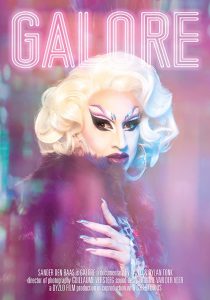
10. “Galore” (Netherlands)


Web site.


When plus-size Dutch drag queen Lady Galore (Sander den Baas) decides to undergo gastric bypass surgery to help improve the state of her health, she wonders whether the change in her body size and shape will affect how others have come to identify her. Will the persona she’s so carefully crafted disappear with the pounds she’s about to lose as a result of her procedure? Or will she be able to reinvent herself and maintain the level of visibility and popularity she’s already attained? This intimate documentary about her journey into a new life provides an intriguing look at a charismatic and caring individual who fights for dignity, self-respect and recognition for herself and her community, even through all the changes and challenges she undergoes. An inspiring and uplifting true life tale from directors Dylan and Lazlo Tonk.


9.  “The New Bauhaus” (USA)


Web site. Trailer. Blog.


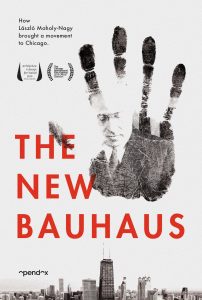
“The New Bauhaus” is a fitting cinematic tribute to László Moholy-Nagy, an underrated artist and visionary whose works and ideas influenced myriad aspects of the design world, changing our views on everything from architecture to consumer products. The film features plenty of examples of his creations and those of the designers and artists he influenced. Director Alysa Nahmias’s production includes extensive archive material showing rare footage of Europe in the days before his immigration, as well as ample still photos from the subject’s time at the New Bauhaus and the School of Design. A wealth of expert commentary is provided by Moholy-Nagy’s daughter, Hattula, along with observations from educators, art curators, historians and former students and quotes from Moholy-Nagy’s writings read by art historian Hans Ulrich Obrist. Aspects of the protagonist’s life chronology could be a little better organized, but the overall portrait painted here provides an in-depth look at the life of someone phenomenally influential but largely unknown.


8.  “Nasrin” (USA)


Web site. Trailer. Blog.


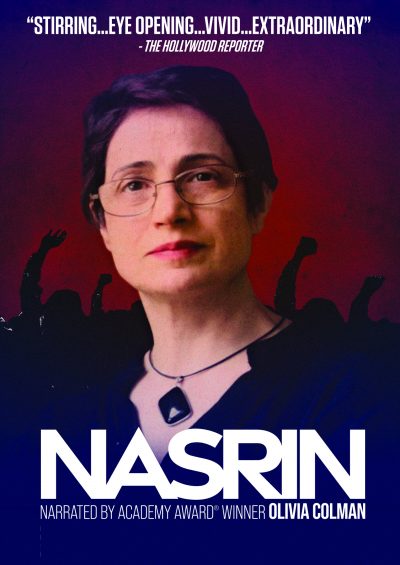
“Courage under fire” is an expression that could best be used to describe Iranian human rights lawyer Nasrin Sotoudeh. The lion-hearted attorney has defiantly taken on a variety of cases defending women, children, religious minorities, persecuted artists and outspoken political reformers against overblown charges brought by a fundamentalist government regime seeking to suppress opposition at any cost, including instances involving blatant illegality, unethical conduct and outright lying. And, for her efforts, she has gained international notoriety but at a cost to herself, including imprisonment and physical torture. Director Jeff Kaufman’s superb documentary looks at Nasrin’s heroic life, chronicling the many challenges she has faced while unflinchingly depicting the stalwart defiance she has demonstrated in the face of odds frequently stacked against her. The filmmaker also candidly yet sensitively illustrates the counselor’s human side – her family life, her involvement in the arts community, and the heartfelt compassion she genuinely feels for her clients and causes – proof of the authenticity guiding her actions. Clandestinely shot in Iran under the threat of prosecution and narrated by Oscar winner Olivia Colman, “Nasrin” paints a truly remarkable portrait of a truly remarkable individual.


7.  “The Capote Tapes” (USA/UK)


Web site. Trailer.


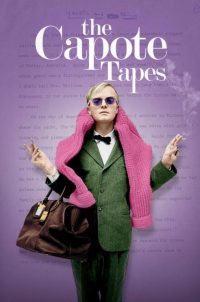
Flamboyant, openly gay author Truman Capote may not have been especially prolific, but he wrote several noteworthy, well-respected works. However, when excerpts of what was supposed to be his crowning achievement – the novel Answered Prayers about the dirty little secrets of New York high society based on the lives of a number of his “friends” – he became a pariah of sorts, losing contact with many of those close to him and triggering a speedy downward spiral in his health and well-being. In this new documentary, excerpts of recorded interviews with many of his friends and colleagues and new interviews with those who knew him and studied his work shed light on the enigmatic icon, his life and his writing, particularly with regard to his final and unfinished work. Included are archive segments featuring Lauren Bacall, Candice Bergen, George Plimpton, Norman Mailer, Lee Radziwill, Harper Lee, William F. Buckley and Capote’s partner Jack Dunphy, along with new conversations with author Jay McInerney, journalist Sally Quinn, Vogue editor André Leon Talley and talk show host Dick Cavett, among others. Director Ebs Burnough’s debut feature presents a captivating look at a talented, troubled and towering figure.


6.  “Cured” (USA)


Web site. Trailer.


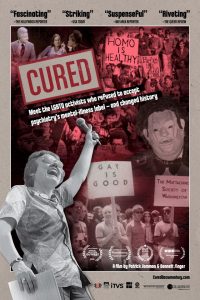
How do you cure millions of supposedly mentally ill people overnight? By publicly proclaiming that their “affliction” of homosexuality isn’t an affliction at all. So it was in 1973, when the American Psychiatric Association dropped being gay from its official list of mental maladies. It was a hard-fought victory in the LGBTQ rights movement, one that’s meticulously detailed in this superb documentary. This film features a wealth of interviews with those who were on the front lines, as well as ample archive footage depicting the key moments in the effort to win over the hearts and minds of those who blindly accepted an assessment for which there was no scientific basis to back it up. In addition to chronicling this seminal development, the film is a fitting tribute to many unsung heroes in the LGBTQ rights movement, giving them the accolades they have long deserved. Patrick Sammon and Bennett Singer’s fine offering is great viewing for those who believe in social justice, and it’s especially highly recommended for younger viewers in the LGBTQ community who may not – but need to – know their people’s history.


5.  “Mr. Soul” (USA)


Web site. Trailer. Blog.


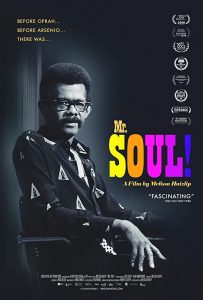
This excellent, informative and entertaining documentary about the NET (now PBS) series Soul! (1968-73) tells the captivating story about the first Afrocentric television show featured on a national network. As a showcase for Black talent, this groundbreaking program introduced the public to an array of rising stars in music, literature, poetry, dance, acting and activism, as well as prominent African-American figures in the arts, sports and politics. It gave the Black community a much-needed voice and paved the way for future Black programming, especially the likes of Oprah Winfrey and Arsenio Hall (who was himself featured on the show as a teenager). But, in addition to paying homage to the show, “Mr. Soul!” presents a fitting tribute to its creator and host, Ellis Haizlip, an openly gay African-American man (a genuinely rare commodity 50 years ago). His vision for the show, both in terms of celebrating the Black community and raising the bar for television quality, was truly radical and innovative for its time – or virtually any time in broadcast history for that matter. Those who have never heard of Haizlip or Soul! owe it to themselves to see this enlightening release.


4.  “Kubrick by Kubrick” (France/Poland)


Web site. Trailer.


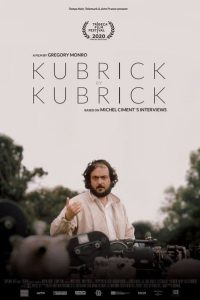
This positively superb documentary about the life and career of legendary director Stanley Kubrick not only does justice to the life of the artist, but also does justice to itself as a tremendous piece of filmmaking. Based on rare audio interviews with the auteur by writer Michel Ciment, director Gregory Monro’s homage to this iconic talent features a wealth of well-chosen clips from most of Kubrick’s pictures (“Paths of Glory” (1957), “Spartacus” (1960), “Dr. Strangelove” (1964), “2001: A Space Odyssey” (1968), “A Clockwork Orange” (1971), “Barry Lyndon” (1975), “The Shining” (1980), “Full Metal Jacket” (1987), “Eyes Wide Shut” (1999)). It also includes incisive archival interview footage with those who worked with him, including actors Jack Nicholson, Peter Sellers, Tom Cruise, Nicole Kidman, Sterling Hayden, Malcolm McDowell, Shelley Duvall and R. Lee Ermey, as well as behind-the-scenes crew members and noted film critics. The documentary’s impeccable editing and inventive production design link its various segments in ways that pay a fitting tribute to its subject’s work, reverently echoing Kubrick’s style and reinforcing the themes and perspectives that made his films so original and unforgettable. It may take some effort to find this offering, given that it has primarily played the film festival circuit, but, for fans of the filmmaker, this is absolute must-see material. 


3.  “The Dissident” (USA)


Web site. Trailer.


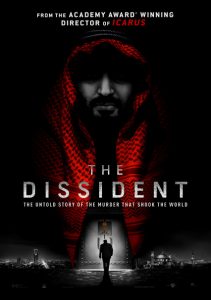
As much as we think we know about the gruesome, unimaginable murder and dismemberment of journalist Jamal Khashoggi at the Saudi Arabian consulate in Turkey, there’s more that we don’t, and it’s even more shocking than we ever thought. Director Bryan Fogel’s chilling documentary about the incident, what prompted it, and the fallout that has come from it – both politically and personally for those who knew him – is staggeringly infuriating. One can’t help but wonder how those behind this killing could be so unspeakably abhorrent, and all over differences in opinion and outlook about the scope of democracy in the writer’s homeland. The film approaches this story from multiple angles, showing how they’re interrelated and presenting them in a layered, progressive pattern that grows ever more damning and upsetting with each new revelation. This release is one that should make us all mad while we’re watching it. How can we allow such acts to continue in this day and age? If we can’t bring a halt to such atrocities, one can’t help but wonder what kind of future we might all have.


2.  “Rebuilding Paradise” (USA)


Web site. Trailer. Blog.


Director Ron Howard, in a rare documentary effort, examines the impact of the deadly wildfire that destroyed nearly all of the historic California town of Paradise and the widespread fallout that has come in its wake. From terrifying footage of the fire as it burned (shot from inside the inferno) to the grim aftermath of its destruction to the valiant efforts of residents to rebuild their shattered lives, this heart-wrenching yet hopeful offering details the pain and suffering experienced by virtually everyone in the community, as well as their determination to rise from the ashes (literally and figuratively) in overcoming the many obstacles hindering the town’s rebirth. It’s rare that a documentary will move viewers quite as profoundly as this one does, evoking both tears and joy – and making us appreciate what we have and what we can lose in a heartbeat. Easily one of the best productions from the filmmaker in quite a long time.


1.  “My Octopus Teacher” (South Africa)


Web site. Trailer.


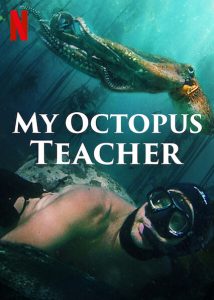
Who would have thought that we could learn anything meaningful from an undersea mollusk? Yet, if we’re willing to devote the time and effort to studying the miracles of nature, there’s no telling what we might glean from the experience, both about our subject and ourselves. Such is the odyssey of filmmaker and oceanic explorer Craig Foster, who spent a year studying and interacting (in a very heartfelt and personal way) with an octopus in an underwater kelp forest off the coast of South Africa. Gorgeously filmed and warmly narrated, this moving documentary from directors Pippa Ehrlich and James Reed shows us a world seldom seen, with insights never imagined about a creature we know of but know virtually nothing about. This is truly a cinematic labor of love, one richly deserving of its Oscar nomination and BAFTA award for best documentary feature.


Honorable Mentions


11.  “All In: The Fight for Democracy” (USA)


Web site. Trailer.


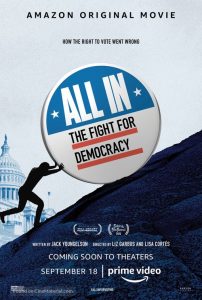
No matter where one stands politically, most of us (or so I would like to hope) believe in a sense of fairness when it comes to our elections. However, as this documentary from directors Lisa Cortes and Liz Garbus details, the country is increasingly under siege from a growing campaign to deliberately suppress voter rights in states across the nation, exposing the myriad techniques being employed by self-interested parties to achieve that result. In telling its story, the film chronicles the history of voter rights from the days of America’s birth through Reconstruction to the Jim Crow Era and eventually the Civil Rights Movement. The picture illustrates the efforts of various constituencies, from African-Americans to women to Asian-Americans and Latinos, in winning and protecting what’s widely considered one of the fundamental rights of living in a democracy. But it then goes on to show insidious initiatives to turn back the clock, as exemplified by a number of emerging state legislative and policy actions, most notably the tactics used to manipulate the outcome of the 2018 Georgia governor’s race and the efforts to derail the campaign of Democratic candidate Stacy Abrams. This offering thus presents a reasoned and damning look at voter suppression efforts, emphatically delivering an urgent message we all need to hear if we hope to preserve our republic. However, despite the importance of this, the film could stand to be less partisan and more even-handed in tone, especially when it comes to balancing its coverage of which states have implemented voter suppression measures, some of which have arisen in some seemingly unlikely jurisdictions, developments that have come in addition to those that have surfaced in more readily expected locales. What’s more, “All In” says virtually nothing about what needs to happen even if voter rights are sufficiently protected – ensuring that our elections produce victors who are actually able to do something to get the nation back on track once they’re in office. That could easily be a topic for another film, though one can’t deny this consideration is inherently tied to being able to cast our votes in the first place, and, on this point, the picture is silent. Still, I suppose we have to start somewhere, and preserving the opportunity to help bring about such an outcome is essential if we ever hope to have a chance to attain that larger goal.


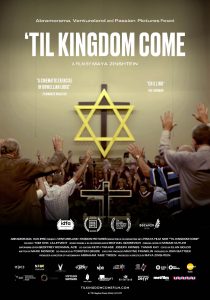
12.  “ʼTil Kingdom Come” (“Ad Sof HaOlam”) (Israel/UK/Norway)


Web site. Trailer.


This simmering documentary about the unlikely bond between American Evangelicals and Israeli conservatives to manipulate policies aimed at fulfilling Biblical prophecy grows scarier with each passing minute. With an agenda of expediency and literal adherence to scripture wrapped around a fundamentally hypocritical core, the undertakings of this potentially calamitous alliance should make everyone shudder. Thankfully, director Maya Zinshtein’s incisive offering makes that abundantly clear. The film could have benefitted from a little more back story and the input of some additional experts, given its scant 76-minute runtime. However, what material is there is rock solid and hard-hitting, presented without judgment and letting the content speak for itself – which it does in volumes.


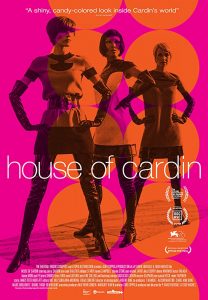
13.  “House of Cardin” (USA/France)


Web site. Trailer. Blog.


This rare look into the life and career of visionary designer Pierre Cardin provides an insightful review of how one man almost single-handedly changed the fashion industry and the marketing of name-based brands involving an array of product releases. In interviews with Cardin himself, as well as associates, fellow designers, and models and celebrities who wore his creations, viewers see how influential he was in such areas as “democratizing” the world of couture, bringing cross-cultural influences to clothing design, making fashion acceptable for male audiences and introducing modernism to a field that had previously been entrenched in conventionalism. While the film has an occasional tendency toward worshiping its subject, its treatment is generally reverent, respectful of his accomplishments and careful to avoid delving too deeply into private matters that are truly no one’s business. Directors P. David Ebersole and Todd Hughes have served up a delightful documentary for those who appreciate good design, no matter what form it comes in.


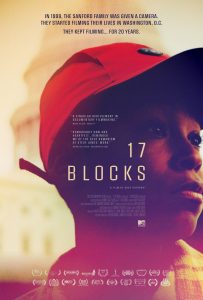
14.  “17 Blocks” (USA)


Web site. Trailer.


Culled from 20 years of raw video footage, this up-close look at a Washington, DC family afflicted by the perils of drug addiction and gun violence examines the challenges of dealing with temptation, fending off negative influences and seeking redemption. In doing so, this gripping documentary tells a story of questionable choices, profound heartbreak and the search for inspiration to turn things around. While the film sometimes comes across as a slice of life vehicle (especially at the outset), it definitely grows stronger with the passage of time, presenting material that’s increasingly more involving and heartrending as it proceeds. Director Davy Rothbart’s sensitive but uncensored look at a family in crisis deservedly earned a 2020 Independent Spirit Award nomination for the competition’s Truer Than Fiction Award, a quality that comes through loud and clear in this engaging offering.


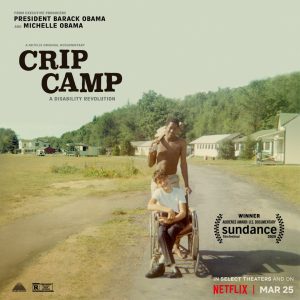
15.  “Crip Camp: A Disability Revolution” (USA)


Web site. Trailer.


When the 1960s civil rights movement got into high gear, one constituency seeking equality felt left out – disabled Americans. But they were not to be denied, and they began finding their voice through a summer camp in the Catskills designed to enable them to experience the feelings of mainstream living. Drawing upon their time here, they would later adapt the lessons learned there to push for the equal rights that would eventually become embodied in the Americans with Disabilities Act, an initiative that would go on to have implications internationally. Through a wealth of archive footage and interviews with camp residents and counselors (many of whom were hippies and minorities, themselves seekers of reform and equal rights), directors James Lebrecht and Nicole Newnham tell this little-known story in a revealing and often quite surprising documentary, filled with an array of moments ranging from touching to heartbreaking to inspiring and even hilarious. However, for all its strengths, the film is not without its shortcomings, such as not enough linkage between camp life experience and the legacy it inspired, as well as some less-than-ideal selections of archive footage that seem more incidental than enlightening, material that could have easily been cut. Still, it’s indeed captivating to see what can emerge out of humble (and seemingly unrelated) beginnings, the film’s greatest asset of all.


16.  “Stray” (USA)


Web site. Trailer.


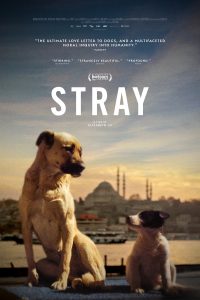
It’s the kind of movie that makes you go “awwwwwwwwwwwwww” about every 30 seconds. However, director Elizabeth Lo’s debut documentary feature about the street dogs of Istanbul – which are legally protected against euthanasia and illicit captivity – diverges from its central narrative a little too much, pursuing tangents that draw attention away from its principal subject. In particular, the film devotes considerable footage to the city’s homeless refugee workers, an attempt to draw parallels (and distinctions in treatment) between Istanbul’s street people and their canine companions, an intriguing approach that, while interesting, comes across as somewhat unfocused. The film might have fared better if it had either (1) sought to do for the city’s street dogs what “Kedi” (2016) did for its feral felines or (2) retooled the focus of what it seems to have been trying to depict. If you’re looking for a film loaded with loving footage of adorable pooches, “Stray” makes for a nice diversion. However, if you’re searching for groundbreaking documentary filmmaking, this one misses the mark somewhat, despite seemingly good intentions.


17.  “Collective” (“Colectiv”) (Romania/Luxembourg/Germany)


Web site. Trailer.


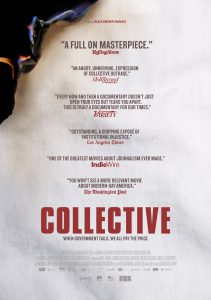
When a tragic 2015 fire in Bucharest’s Colectiv nightclub killed 64 and injured 143, with 37 of the victims dying after the fact, primarily from hospital infections, the event launched a sweeping investigation into the Romanian health care system. This revelation, which was brought to light by a team of reporters from a daily sports journal of all things, led to the dissolution of the government and a probing look into the nation’s hospital network, exposing system-wide corruption that had been in place long before the catalytic event that spurred this inquiry. “Collective” relates the unfolding of these events through unprecedented access to the journalists and reformers who sought to expose a system where patient care was secondary to the self-serving interests of politically connected administrators and their crooked affiliates. However, while director Alexander Nanau’s impressive and authentic documentary is indeed a remarkable piece of investigative journalism, its raw footage approach to the presentation of its material is often dry and talky, failing to stoke the kind of outraged emotional response that a work like this should handily accomplish. It thus plays more like a radio report on film than an engaging cinematic presentation, diluting much of the impact that its findings should generate. Sadly, the victims of this tragedy truly deserve more, not only from the government that let them down, but also from the vehicle through which their story was told.


The Bottom 5


5.  “The Social Dilemma” (USA)


Web site. Trailer.


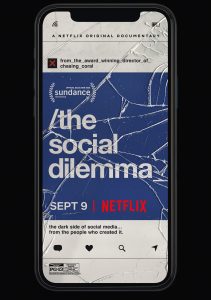
Though the cautionary tales here are noteworthy (especially for the younger and more impressionable users of social media), “The Social Dilemma” tends to sideline such personal attributes as choice and free will in presenting its arguments, as if we’re all too weak-willed to make decisions for ourselves. As a result, the absolutist nature of its contentions weakens their impact, suggesting that our behavior is unavoidably alterable and that we’re all ill-equipped to handle the compellingly manipulative forces of technology and an intrusive business model relentlessly driven by profits at all costs, both of which have been mercilessly thrust upon us. What’s more, the film under-emphasizes the human factor in the creation of these issues, generally placing blame more on the technology that drives them than on the individuals who initiated them, as well as on those (i.e., virtually all of us) who obviously lack the personal power to drag themselves away from these destructive influences. Through interviews with former social media and information technology experts, backed by fictionalized examples illustrating their assertions, director Jeff Orlowski’s documentary makes some valid points that we should all be aware of, but its dogmatic approach – despite the inclusion of some tangible and genuinely scary real world incidents – effectively removes us from the equation in being able to do anything about it. A handful of solutions is offered to address this social dilemma, and fleeting references to the benefits this technology has afforded are given passing acknowledgment, but the prevailing outlook is one that we’re all doomed by our inherent ignorance and an inability to protect ourselves from an impending horror. Personally, I refuse to give up that easily, and I’m troubled by a fear-mongering film that suggests resistance is futile. Responsibility is key, something this offering makes little allowance for.


4.  “Myth of a Colorblind France” (USA)


Web site. Trailer.


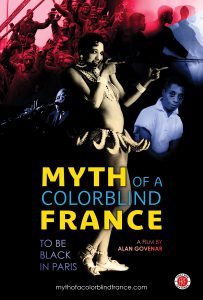
As a collection of anecdotes about expatriate African-Americans who found fame in France that they never would have found in the US (as well as the reasons behind that success), this documentary succeeds well. However, as a treatise on the subject that is the essence of the film’s title, the picture comes up woefully short, skimming the surface of this topic but never really delving into the meat of it. Viewers are treated to mere morsels of why the notion of French colorblindness is a myth, never really exploring the reasons for this in any great depth. In light of that, then, it seems that some retooling of this project – beginning with its essential premise – would have resulted in a much better film. To improve upon what’s here, the production would either have to focus more on what it already does best or get more serious about what the title promises it’s going to do.


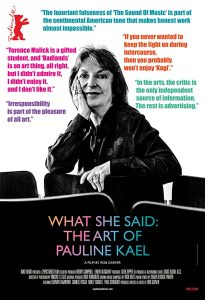
3.  “What She Said: The Art of Pauline Kael” (USA)


Web site. Trailer.


This cinematic homage to one of film criticism’s most influential – and controversial – representatives provides audiences with a passable overview of its subject, but it feels unsatisfyingly incomplete, never quite getting to the heart of the matter as effectively as it could have. We’re provided with the requisite biography, interviews with knowledgeable commentators and narrated snippets of the critic’s prose, but what’s lacking is a meaningful, coherently organized discussion of the motivations and sensibilities that drove her work. Instead, we’re given a scattershot buffet of passing observations, reminiscences of colleagues and those she wrote about, and anecdotes about specific films that she either liked or detested. Viewers come away from this offering never really grasping what drove Pauline Kael’s work and why, leaving a more than palpable and lingering sense of hunger, a disappointment given how significant a role she played in the field in which she became such a powerful influence.


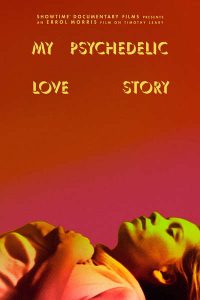
2.  “My Psychedelic Love Story” (USA)


Web site. Trailer.


To paraphrase the Grateful Dead, “What a long strange trip it was” (emphasis on the word “long”). Director Errol Morris’s protracted Showtime TV documentary about Joanna Harcourt-Smith, LSD guru Timothy Leary’s so-called “perfect woman,” tells the story of their time together at the height of the psychedelic era, including their globe-trotting days on the run from authorities to evade capture for drug law violations. While some of Harcourt-Smith’s stories are indeed entertaining and colorful, many of them ramble on endlessly, leaving viewers wondering if they have a point – or a conclusion. Meanwhile, others are so outlandish that they stretch credibility and come across more like tall tales, a possibility that’s not entirely improbable given Harcourt-Smith’s own admission to having been a chronic liar in her youth. Ultimately, though, much of this film just isn’t particularly interesting, a collection of essentially insignificant anecdotes that don’t shed any revelatory light on the principals, the era in which they lived or their legacies. It seems like this material could have provided rich fodder for an engaging picture, but it instead presents little more than a name-dropping counterculture tell-all, the kind of story swapping to come out of a conclave of aging hippies.


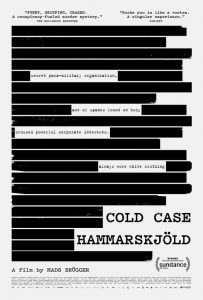
1.  “Cold Case Hammarskjöld” (Denmark/Norway/Sweden/Belgium)


Web site. Trailer.


This “documentary” investigating the death (i.e., likely assassination) of former UN Secretary General Dag Hammarskjold in a mysterious 1961 plane crash shamelessly blurs the line between legitimate journalism and cheeky speculation, with consequences that extend far beyond the demise of one individual. What starts out seeming like a valid inquiry into a long-unsolved mystery regrettably degenerates into a questionable spectacle that doesn’t seem to take its own purpose seriously, prompting viewers to ask, “So what’s the point of all this?” While the film does uncover what could be a horrific untold story if definitively proven true, the credibility of the information underlying such a possibility is undercut by a filmmaker who could ultimately just be jagging everybody’s chain – and with material that’s no joking matter. And the problem with that is, should viable evidence ever surface behind the truth of these incidents, it’s likely to be discounted by the travesty depicted here.


Copyright © 2020-2021, by Brent Marchant. All rights reserved.

Monday, April 5, 2021

Laughs Aplenty on The Cinema Scribe

Tune in for the latest Cinema Scribe segment on Bring Me 2 Life Radio, Tuesday, April 6, at 2 pm ET, available by clicking here. And, if you don't hear the show live, catch it later on demand on Spreaker, Spotify, Apple, iHeartRadio, Google Podcasts, Castbox, Deezer, Podchaser and Jiosaavn.


Saturday, April 3, 2021

This Week in Movies with Meaning

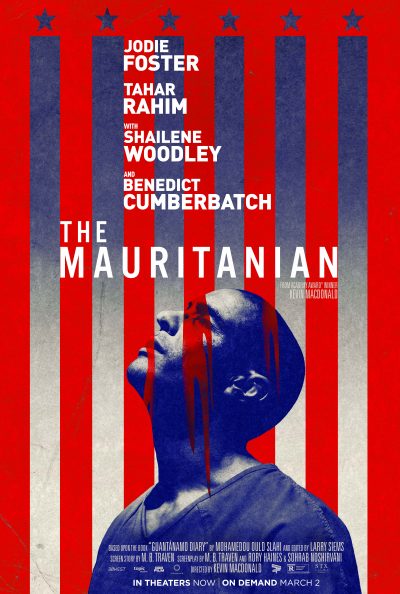
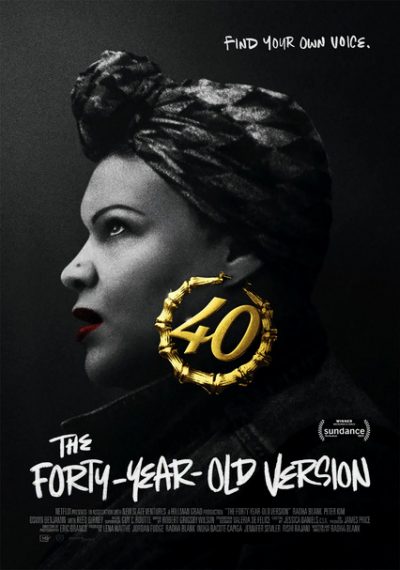
Reviews of "The Mauritanian," "The Forty-Year-Old Version" and "Nasrin" are all in the latest Movies with Meaning post on the web site of The Good Media Network, available by clicking here.


Friday, April 2, 2021

‘The Mauritanian’ passionately pursues the truth


“The Mauritanian”(2021). Cast: Tahar Rahim, Jodie Foster, Benedict Cumberbatch, Shailene Woodley, Zachary Levi, Corey Johnson, Baya Belal. Director: Kevin Macdonald. Screenplay: M.B. Traven, Rory Haines and Sohrab Noshirvani. Story: M.B. Traven. Book: Mohamedou Ould Slahi, Guantánamo Diary, Larry Siems, editor. Web site. Trailer.


Pursuing the truth is indeed a noble endeavor, one that’s made all the more virtuous when infused with passion. That’s particularly crucial when attempts are made to intentionally obscure it and the stakes are high. So it is for an intrepid counselor defending a falsely accused suspect in the fact-based historical drama, “The Mauritanian.”


In the wake of the 9/11 attacks, the government was eager to round up suspects responsible for the event at any cost – and no matter how valid the evidence was against them. The campaign to arrest them was carried out with all deliberate speed, even if the detention and prosecution of said suspects moved at a snail’s pace. Many of the alleged guilty parties were sent to a high-security holding facility at the U.S. military base in Guantanamo, Cuba, where they were essentially locked up with the keys thrown away. During their stay, they were subjected to repeated extreme interrogation tactics in a relentless attempt to extract information from them – information that often was not forthcoming, largely because the supposed evidence collected against them was frequently questionable at best. Some were held for years without ever being charged, yet there was also no way they were going to be released, either. A government hell-bent on exacting justice was itself now guilty of thwarting it toward suspects who were, in fact, innocent. And the only hope these individuals had was to pursue protracted legal battles against a government that routinely put up roadblocks to prevent the truth from emerging – and from justice being served.


So it was for Mohamedou Ould Slahi (Tahar Rahim), a Mauritanian national who was accused of being the key terrorist recruiter for the 9/11 attacks. Yet, as the film reveals, his only “crime” was having minimal, marginal contact with individuals who knew or may have known some of the principal players in those tragic events. Nevertheless, the government felt that, despite the flimsiness of that “evidence,” it was enough to arrest him and detain him at Guantanamo (a.k.a., “Gitmo”). Once there, he was subjected to all of the injustices and indignities described above, with little hope of ever being released.


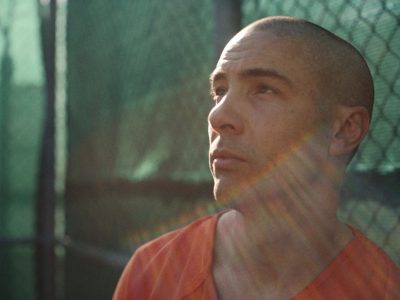
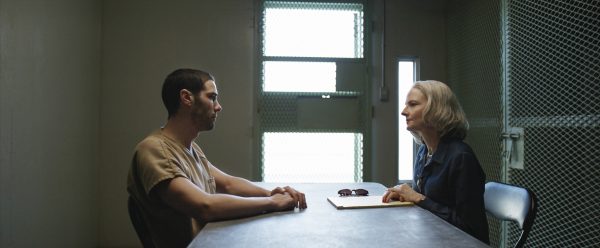
Detainee Mohamedou Ould Slahi (Tahar Rahim) spent years in confinement at the Gitmo holding center in Cuba after false accusations of being a key terrorist recruiter in the 9/11 attacks as seen in “The Mauritanian,” now available for online streaming. Photo courtesy of STX Films.


Circumstances changed, however, when attorney Nancy Hollander (Jodie Foster) became involved. When she heard about Slahi’s case, she was initially reluctant to take him on as a client, but, the more she looked into the miscarriage of justice that was playing out, she changed her mind, convincing her law firm to pursue his representation as a pro bono case. With the assistance of her associate, Teri Duncan (Shailene Woodley), the duo began their work on his defense. Little did they realize what they were getting into.


At the same time as Hollander and Duncan were preparing their representation, the government started ramping up its prosecution, led by Lt. Col. Stuart Couch (Benedict Cumberbatch), a Marine Corps lawyer charged with getting a conviction. Under orders from his superior, Col. Bill Seidel (Corey Johnson), Couch initially approached his task with great zeal. But, like Hollander and Duncan, at that point, he had no idea what awaited him.


As each team prepared their cases, they came up against various obstacles. For Hollander and Duncan, just meeting with their client was an ordeal that required them to jump through an array of hoops. And, when they requested copies of discovery materials that the government had compiled against Slahi, they met with delays, bureaucratic red tape and other assorted hindrances, including significant redactions of information that often rendered the documents useless.


But Hollander and Duncan weren’t alone in this. As Couch prepared his prosecution, he often found his hands tied as he attempted to build a case with significant pieces of evidence apparently missing. At one point, he met with his friend Neil Buckland (Zachary Levi), a CIA operative whom he believed had access to the missing information. However, no matter how much Couch pressed Buckland, he was continually rebuffed. This stall tactic made him increasingly skeptical about what he was involved in, a conclusion not unlike the one being drawn by his opposing counsel.


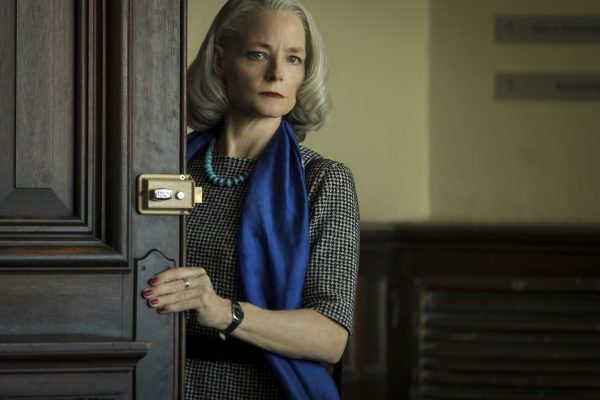
Attorney Nancy Hollander (Jodie Foster) assumes the defense of a suspect falsely accused of involvement in the 9/11 terrorist attacks in director Kevin Macdonald’s latest, “The Mauritanian.” Photo by Graham Bartholomew, courtesy of STX Films.


Meanwhile, as all this legal wrangling played out, Slahi continued to languish in Gitmo. As he mused about his future, he reflected on what he had endured up to that point. Through a series of flashbacks, viewers are witness to the atrocities he underwent, both during interrogations and in the intimidation tactics authorities employed to try to get him to talk. And, through it all, still no charges were filed, again because no revelations emerged to substantiate offenses worthy of prosecution.


The longer this process continued, the more apparent it became that the government didn’t have anything on Slahi and that it was intentionally stonewalling both the defense and the prosecution. Was it because authorities didn’t want to admit they made a mistake? Was it an attempt to maintain a façade aimed at making it look like officials were on top of things in their effort to exact justice in the wake of 9/11? Or was it something more sinister, such as a calculated effort at keeping a lid on secrets that the government didn’t want released? Those were the concerns left to be addressed as this story moved toward its conclusion.


Seeking truth and justice – especially where they’re being intentionally undermined – is arguably one of the most noble pursuits in which we can engage. Such circumstances provide ample fodder for justifiable outrage, particularly when the egregious behavior is sanctioned, condoned and carried out by parties (namely, the U.S. government and its operatives) that claim to adhere to principles to the contrary. And those scenarios are made all the worse when they’re purposely thwarted by obstacles that make getting at the truth that much more difficult.


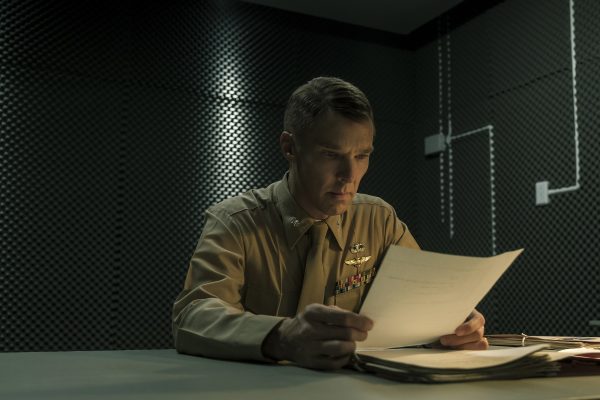
Military lawyer Lt. Col. Stuart Couch (Benedict Cumberbatch) leads the prosecution against a suspected 9/11 terrorist recruiter in “The Mauritanian.” Photo by Graham Bartholomew, courtesy of STX Films.


Those who desire to see such blatant transgressions corrected are obviously the ones best suited to seek their rectification. That’s because they believe – often quite passionately – that these intolerable situations must be changed. And, when they invoke these beliefs, they often succeed, given that these intentions are at the core of the conscious creation process, the philosophy that maintains we draw upon these resources in manifesting the reality we experience, including the righting of these wrongs.


One of the qualities that characterizes the beliefs of these strident individuals is that they’re backed by faith. This is the passion that fuels the magnitude of those beliefs, significantly increasing the likelihood of those intentions being fulfilled. This is apparent in the aspirations of both Hollander and Couch; as advocates for their respective parties, they each seek rulings in favor of their particular causes. That comes as no surprise when they’re on opposite sides of the argument. But, when they both begin to suspect something is amiss, it’s impressive to see their combined power, passion and persistence surface. They both draw upon their faith in the notion that justice will prevail, in whatever form it might ultimately take. Such a commitment by both parties is truly inspiring, to say the least.


Developing such faith requires overcoming whatever fears we might have that would hold us back. For Hollander, that means being willing to go up against a seemingly powerful force like the U.S. government, an authority that possesses the means to stop her in her tracks and keep her indefinitely spinning her wheels if it so desires. And, ironically, the same is true for Couch, whose career could potentially be ruined by the institution he loyally serves if he starts to ask too many questions or delves into areas of inquiry from which he’s purposely being excluded. However, if they hope to see their goals realized, they must set aside whatever feelings of intimidation they might have, adopting courageous attitudes to carry them forward.


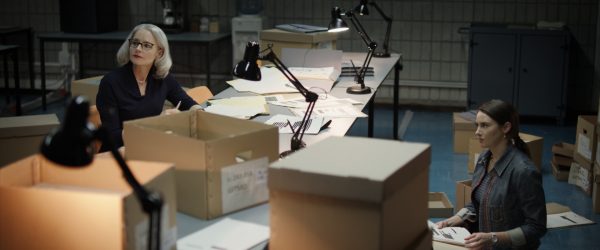
Attorney Nancy Hollander (Jodie Foster, left), aided by her associate, Teri Duncan (Shailene Woodley, right), sort through boxes of discovery materials to uncover evidence exonerating their client, a suspected 9/11 terrorist recruiter, in the fact-based historical drama, “The Mauritanian.” Photo courtesy of STX Films.


Those perspectives are also driven by a healthy belief in being authentic, abiding by their personal integrity and the principles it embodies. In fact, as champions for the truth, they realistically can’t do otherwise if they want to be able to live with themselves. But, perhaps even more importantly, adhering to such a stance greatly increases the likelihood of realizing their objectives. To believe and act otherwise invites results that are distorted or go unfulfilled. One need only look to the outcomes attained by those who intentionally try to obfuscate matters to see what can happen when an insincere approach is employed.           


The attorneys in this story aren’t the only ones whose beliefs reflect these qualities. Slahi does so as well, even if he’s initially discouraged by his chances of clearing his name and obtaining his release. However, once he sees that he has drawn an advocate to his cause, coupled with his fervor for his Islamic faith, he has a powerful mix of beliefs working for him to see his ordeal resolved, despite the efforts to unduly constrain him. The hope he subsequently develops helps him cope with his deplorable circumstances and keeps him focused on attaining the resolution he seeks.


All of the principals in this story thus have an opportunity to live out their value fulfillment, the conscious creation concept associated with being our best, truest selves for the betterment of ourselves and those around us. Even if Hollander, Couch and Slahi have never heard of this principle (or any other conscious creation concept for that matter), they certainly seem to have attained mastery over it. For instance, through their efforts, they have drawn attention to the failings inherent in officialdom’s arbitrary, appalling policies and practices, especially when it comes to the treatment of falsely accused innocents. But perhaps even more important is the attitude that Slahi exhibited in the wake of his incarceration – one rooted in forgiveness, even for those who mistreated him and held him without charge for 14 years, a time during which his most heartfelt wish was to see his beloved mother (Baya Belal), who, regrettably, passed away during his captivity. His outlook toward his captors is an enlightened example we could all stand to follow when it comes to our relations with those who have transgressed against us. It’s an act of value fulfillment from which we could all learn a lot.


Defense attorney Nancy Hollander (Jodie Foster, right) confers with her client, suspected 9/11 terrorist recruiter Mohamedou Ould Slahi (Tahar Rahim, left), at the Guantanamo detention center in director Kevin Macdonald’s latest, “The Mauritanian.” Photo courtesy of STX Films.


This meticulously detailed account of Slahi’s fraudulent and unspeakable detention is a powerful indictment of the sloppy practices of a government more concerned with convicting someone than with serving justice and uncovering the truth. Director Kevin Macdonald’s thorough treatment of the subject clearly reflects his scrupulous proficiency as a predominantly documentarian filmmaker, exposing the cruelty of officially sanctioned interrogation atrocities and recognizing the efforts of both government and legal crusaders who fought to bring them to light. However, as earnest as that intent is, and as infuriating as the film’s reprehensible revelations are, “The Mauritanian” is at times a little too “clinical” and a bit overlong, periodically becoming mired in excessive legal wrangling that waters down the emotional impact of the narrative. Some judicious editing and a less conventional approach to the material would have strengthened this offering, making its story and insights more compelling. To its credit, though, the film does indeed drive home its message, and its superb performances by Golden Globe Award nominee Rahim and Golden Globe Award winner Foster are worthy of their accolades. The film is available for online streaming.


No matter how deeply we may feel we’ve been wronged, there’s no excuse for projecting our pain onto others who had no involvement in such despicable behavior. That’s true from both an individual and collective perspective. Indeed, the hurt we as a nation suffered from the 9/11 attacks is incalculable, and the perpetrators indeed deserved to be brought to justice. But seeking such a result at any cost can’t be justified when it falsely drags innocent parties into the fray, even when there may be a temptation to brand them guilty simply by association with no hard evidence of wrongdoing. Such initiatives often take on a life of their own, too, making it difficult to restrain them. But, with healthy measures of faith, passion and commitment to revealing the truth in place, the result may well prove vindicating and, above all, just.


Copyright © 2021, by Brent Marchant. All rights reserved.
Thursday, April 1, 2021

‘The Forty-Year-Old Version’ logs the quest for personal fulfillment


“The Forty-Year-Old Version”(2020). Cast: Radha Blank, Peter Y. Kim, Oswin Benjamin, Imani Lewis, Haskiri Velazquez, Antonio Ortiz, TJ Atoms, Reed Birney, Andre Ward, Jacob Ming-Trent, Welker White, Stacey Sargeant, William Oliver Watkins, Ashlee Brian, Meghan O’Neill. Director: Radha Blank. Screenplay: Radha Blank. Web site. Trailer.


Waiting for our life to be fulfilling can be a frustrating exercise. We know we have something to say and goals we’d like to accomplish, yet, for whatever reason, things just never seem to materialize. We’re thus likely to sit back in bewilderment, unable to understand why nothing comes together. But, rather than spin our wheels and waste our time in unproductive speculation, we might be better off focusing our introspection on the root cause of the issue – us. Taking stock of our authentic selves and figuring out what it is we were truly meant to do could prove more revealing, as an exasperated middle-aged woman discovers for herself in the insightful new comedy, “The Forty-Year-Old Version.”


Thirty-nine-year-old African-American playwright Radha Blank (Radha Blank) feels unsatisfied. A decade earlier, she had been named a rising star in the New York theater community, becoming one of the city’s distinguished “30 Under 30.” Since then, though, her career has languished; much of her work has gone unproduced, forcing her to take a job teaching playwriting to high school students (and a rather surly and salty crew of pupils at that). Her romantic life is in something of a slump, too, her greatest thrill coming from vicariously listening to her neighbors make love through her bedroom walls. And, to make matters worse, Radha’s mom, an educator and painter, passed away not long ago, a death that weighed heavily on her. So now as she approaches 40 and begins to feel her age, she wonders if she’ll be able to get her life back on track while she still has the chance, hoping in particular to avoid the pitfall of failed potential that befell her talented but underappreciated mother.
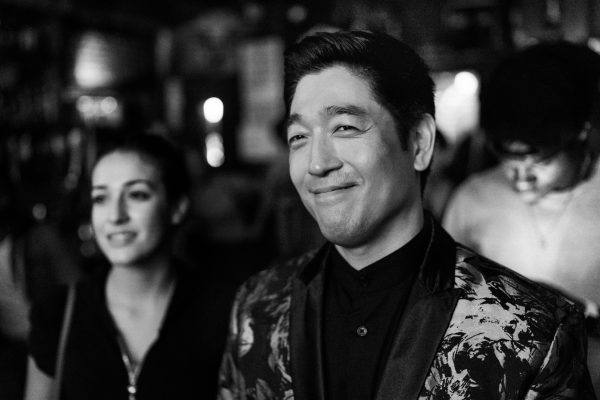


Radha is not without her backers, though. First, there are her students, particularly Waldo (Antonio Ortiz) and Kamal (TJ Atoms), a pair of lovable, albeit oversexed, goofballs; Rosa (Haskiri Velazquez), a streetwise Latina lesbian who openly professes to have an unrequited crush on her teacher; Elaine (Imani Lewis), a talented diamond in the rough in need of discipline and an attitude adjustment; and Avery (Ashlee Brian), a Don Juan wannabe with a thing for older women, Radha included. Then there’s Archie (Peter Y. Kim), Radha’s longtime friend and agent, a flamboyantly gay, middle-aged Korean go-getter who does everything he can to support her projects, even when his time might be better spent promoting other more promising clients.


Thirty-nine-year-old playwright Radha Blank (Radha Blank) seeks to eliminate a decade-long stall in her career in the hilarious new comedy, “The Forty-Year-Old Version,” now available for online streaming. Photo by Jeong Park, courtesy of Netflix.


Radha’s indeed fortunate to have such enthusiastic supporters behind her, if for nothing else than providing much-needed moral support when circumstances go awry. And the need for that moral support comes up often as she seeks to stage her new play, Harlem Ave. She first approaches Forrest (Andre Ward), the eccentric, enigmatic head of a Black theater company who seems more preoccupied with consulting spirits than doing serious work. Moreover, given the shoestring budgets he generally operates with, the prospects don't look promising, leaving Radha discouraged yet again.


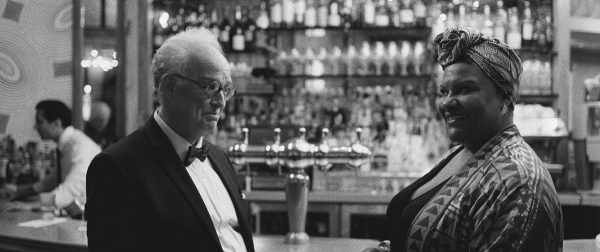
All is not lost, however. Archie invites Radha to a cocktail party with a number of heavy-hitters in the theater community, most notably Josh Whitman (Reed Birney), a colorful, influential, self-important, though often-clueless producer. Archie informs Radha that Whitman is open to new production ideas and that the party may be the perfect opportunity to make a pitch. But, when Radha and Whitman discuss the possibilities, the conversation doesn’t go well (to say the least), leaving her back at square one.


Disheartened, Radha believes that her career as a playwright could be over. It’s time to reinvent herself, and she taps into the anger and frustration she’s been feeling as a springboard. She draws upon those emotions to begin composing rap lyrics, as told from the perspective of a single, plus-sized, economically challenged, “under-serviced” Black woman, and she likes what she comes up with. This could be the start of a whole new career. There’s just one catch: she needs the beats to go with her words. But, thanks to a promising lead, that problem could be solved soon, too.


Radha pays a visit to the apartment of beats creator “D” (Oswin Benjamin), a perpetually stoned, twenty-something man of few words who’s a virtuoso at what he does best. Radha and D don’t hit it off well at first, but, when she sees what his beats do for her lyrics, she sees their collaboration as a good fit. Likewise, D soon becomes impressed with Radha – and for more than just her lyrics. He’s anxious to help showcase her work, and he quietly looks for an opening with her in other ways, too.


Theatrical agent Archie (Peter Y. Kim) can always be counted on to help out an old friend and client whose career has been stuck in a rut for a decade in writer-director Radha Blank’s debut feature, “The Forty-Year-Old Version.” Photo by Jeong Park, courtesy of Netflix.


Unfortunately, thanks to a bit too much pre-performance nerve-settling reefer, Radha’s rap premiere at a club night organized by D proves to be a disaster. After the failed effort, she seeks solace in Archie’s comforting arms, asking herself, “What was I thinking?” Archie provides the requisite reassurance, informing her that, despite her ill-fated meeting with Whitman, the producer is willing to consider giving Harlem Ave. a second look. It’s a chance for Radha to leave her rap experiment behind and go back to what she knows best, an opportunity she willingly pursues.


Upon meeting with Whitman, however, Radha learns that he’s looking to implement a number of alterations to make the play more marketable to theater patrons, such as adding a principal White character (Meghan O’Neill) to a production that originally featured only two African-American leads (Stacey Sargeant, William Oliver Watkins). He also makes promises that he’s unable to keep; instead of fulfilling Radha’s request that he hire a Black director (they’re all already working, he claims), he finds a replacement in a Jewish White woman, Julie (Welker White). And, as the compromises continue to creep into the production, Radha grows increasingly disillusioned.


Fortunately, Radha has a knight in hip hop armor come to her rescue. When D wonders where she disappeared to after her on-stage meltdown, he comes in search of her. And, when he does, the man of few words uncharacteristically speaks his mind, contending that Radha is selling out for the sake of seeing her play produced. He takes it upon himself to immerse her in the rap community, to help her see a world in which he believes she truly belongs. It doesn’t hurt that he then satisfies some of her other long-simmering needs. Indeed, everything he does works wonders to lift her spirits.


Self-important theatrical producer Josh Whitman (Reed Birney, left) listens to a pitch for a new play penned by playwright Radha Blank (Radha Blank, right) in “The Forty-Year-Old Version.” Photo courtesy of Netflix.


But this leaves Radha with a huge dilemma to resolve. Does she continue to work on the radically altered production of Harlem Ave., especially since it now means having to address some additional disagreeable obligations in exchange for the play’s staging? Or does she pursue a revitalized rap career with D, one whose potential and prospects are unknown? It’s a big decision, and, with her 40th birthday right around the corner, she doesn’t have much time to choose if she’s to stick to the timetable she set for herself. It seems she’s got some heavy thinking to do.


To a great degree, that heavy thinking begins with a fairly simple question – What does Radha want to create for herself? As simple as that may seem, however, it may not be an easy question to answer. It requires peering within, taking a good hard look at our true selves, particularly what we believe about ourselves. And that’s important, because what we believe about ourselves, in turn, is reflected in the reality we experience. Such is the core principle driving the conscious creation process, the philosophy that maintains we manifest the existence around us through the power of our thoughts, beliefs and intents.


In making this happen, we invariably have the support of backers behind us. In Radha’s case, that’s apparent in the many people who encourage her to fulfill her dreams. But she also has another powerful, if less obvious supporter in her corner (even if she doesn’t recognize it as such) – our divine collaborator (God, Goddess, All That Is, the Universe, Source or whatever other name best suits you). That collaborator helps to make happen what we seek, and it does so in a supremely loving and supportive way. In fact, in conscious creation terms, it’s often said that “the Universe leans in our direction.” What better assistance could we ask for?


Of course, in making that happen, we must be clear with ourselves and our collaborator about what we truly want. That calls upon us to be authentic with ourselves, to tap into our sense of personal integrity. And clearly this is something Radha struggles with. Is she a playwright who’s ever willing to make compromises to get her productions staged, even if they go against the principles she stands for? Or is she an emerging rapper who speaks her mind through her candid, no-holds-barred lyrics? Only she can decide.


Aspiring rap artist Radha Blank (Radha Blank, left) collaborates with beats creator “D” (Oswin Benjamin, right) to get her career off the ground in “The Forty-Year-Old Version.” Photo by Jeong Park, courtesy of Netflix.


However, as noted previously, she’s not without help in making that decision. Those around her have an uncanny knack for pointing the way toward what she should consider and what she should ignore. D, for example, despite his reluctance to speak up, is an ardent supporter, nudging Radha to listen to her heart and encouraging her to follow what she knows deep down inside is the right course – striking out in a new direction with her singular rap style. The same can be said for her students, all of whom think it’s rad that they have a teacher who is so cool that she’s willing to take such a chance. Even the homeless man (Jacob Ming-Trent) who has taken up residence across from Radha’s apartment building is behind her in his own way, routinely offering colorful, unsolicited guidance on what she should do, acting almost as if he were a sort of latter-day one-man Greek chorus.


At the same time, Archie, and, by extension, Whitman, Julie and everyone associated with the Harlem Ave. production, provide their own special form of backhanded guidance. They’re all eminently enthusiastic about the play as Radha grows ever more disillusioned about it. In a sense, through their continued backing of the play, they feed Radha’s feelings and beliefs that she may be on the wrong path. The question is, of course, can she see that? Can she indeed realize what they’re trying to push her to do?


These various supporters are all the work of Radha’s divine collaborator trying to help her attain clarity on what decision to make. Opportunities on each front arise, and individuals in each camp are there to help steer their pending realizations into being. These seemingly perfectly coordinated “coincidences” – these synchronicities – are designed to help show Radha the way, to help her deduce which path she should follow, the one that’s ultimately most in line with the qualities of her true, authentic self. However, the key consideration here is, can she recognize these signposts for what they are?


All of this, in the end, is an attempt by Radha and her divine partner to help her realize her own brand of value fulfillment, the conscious creation concept associated with being our best, truest selves for the betterment of ourselves and those around us. In a sense, it’s an initiative aimed at helping us to discover our destiny, our reason for being. Would Radha be of better service to the world by being the figurehead of a production that has been significantly altered with watered down versions of the messages she’s trying to convey? Or would she have greater impact by willingly pursuing a career as a rap artist whose words speak for those who have never been given voice to their issues and concerns? Again, there’s a big choice involved here, but, if Radha puts her mind to it, with all of the loving, well-intentioned urging that has come her way, she just might make the decision that best benefits herself and others.


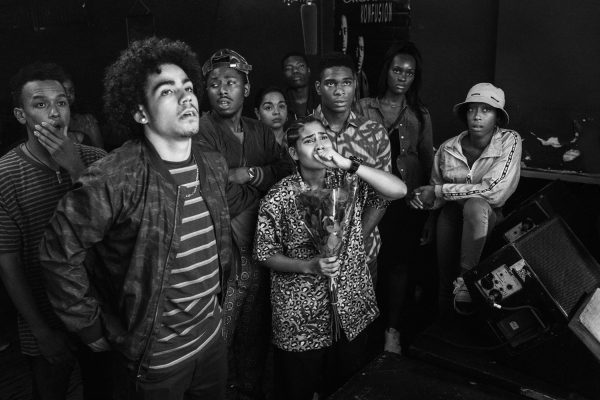
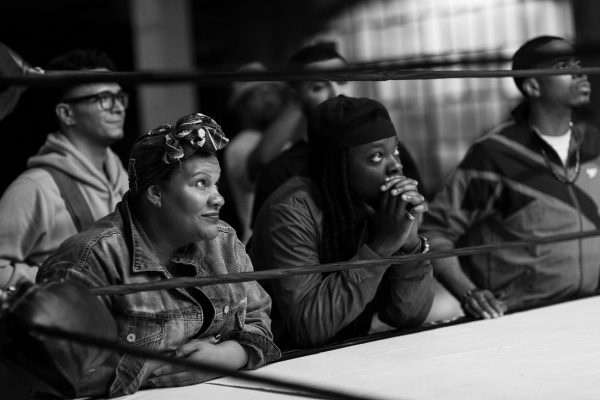
High school playwriting students Waldo (Antonio Ortiz, second from left), Kamal (TJ Atoms, third from left), Rosa (Haskiri Velazquez, center) and Avery (Ashlee Brian, third from right) turn out for a disastrous premiere rap performance by their teacher in “The Forty-Year-Old Version.” Photo by Jeong Park, courtesy of Netflix.


Even though the foregoing plot summary and discussion may make this sound like a deep, philosophical treatise, nothing could be further from the truth, despite the presence of these themes in the picture’s narrative. “The Forty-Year-Old Version,” a title that’s a play on words on the 2005 release “The 40-Year-Old Virgin,” is one of the most consistently funny offerings to have come out in years, serving up brilliant, laugh-out-loud one-liners and hilarious (and I do mean hilarious) situational comedy in rapid-fire succession throughout its two-hour runtime. And, when the story turns thoughtful, the picture knows how to deliver the goods then as well, but it does so without unduly letting them overstay their welcome. Writer-actor-director Radha Blank’s debut semi-autobiographical feature is a real treasure in so many regards that it’s the kind of movie viewers will remember vividly well after the fact. The film presents its material with a refreshing honesty, offering poignant insights about the New York arts community, society at large, being authentic and growing older. Shot mostly in black and white, the film’s gorgeous cinematography beautifully enhances the narrative and shows off the Big Apple in its best light. The narrative becomes admittedly a little stretched out in the second hour, but, with everything else the picture has to offer, who cares? Sensitive viewers are cautioned that the salty language in this one is enough to make a sailor blush, but it only serves to make the laughs even bigger throughout. Blank is off to a tremendous start with this project; let’s hope she keeps it up in future releases. The film is available for streaming online.


“The Forty-Year-Old Version” has scored big with critics, and it has earned a modest degree of attention in this year’s awards competitions (though it deserves more than it received). As one of the National Board of Review’s Top 10 Films of 2020, the picture also captured the organization’s Spotlight Award for Blank’s outstanding achievements with this project. Blank herself has been recognized with a BAFTA Award nomination for best actress, a very deserving honor indeed. In addition, the picture received a nod in the best comedy category of the Critics Choice Awards contest and an Independent Spirit Award nomination for best first feature.


Reaching for the stars is certainly a noble ambition, but we need to make sure we’re grasping for the right ones if we ever hope to feel genuinely fulfilled. Certain pursuits may sometimes feel right, but, when we can see that our efforts aren’t bearing any fruit, it may be time to step back and reassess. We might resist such changes at first, probably because we’re unwilling to admit that the time we spent chasing the wrong goals was a mistake. However, such undertakings – no matter how little success they bring us – are rarely a waste of time. They help us better get in touch with what we were meant to do, ventures that are likely to deliver more satisfying rewards. It may take fashioning a different version of ourselves to reach that point, but, when we consider what’s at stake, the effort is worth it. And, with a sound plan and a good measure of commitment, we just might make it by the time we’re 40.


Copyright © 2021, by Brent Marchant. All rights reserved.