“Judy” (2019). Cast: Renée Zellweger, Jessie Buckley, Finn Wittrock, Rufus Sewell, Michael Gambon, Darci Shaw, Bella Ramsey, Lewin Lloyd, Gemma-Leah Devereux, Royce Pierreson, Richard Cordery, Andy Nyman, Daniel Corqueira, John Dagleish, Adrian Lukis, Tom Durant Pritchard, Gus Barry, Jodie McNee, Ed Stoppard. Director: Rupert Goold. Screenplay: Tom Edge. Play: Peter Quilter, End of the Rainbow. Web site. Trailer.
Everybody loves someone trying to make a comeback, especially when it’s a beloved entertainer. Audiences appreciate the effort, particularly when the talent is genuine and heartfelt. But launching a personal renaissance can be challenging if it’s burdened by baggage from the past, a bittersweet saga detailed in the new, fact-based biopic, “Judy.”
In winter 1968, singer-actress Judy Garland (Renée Zellweger) had fallen on hard times. The inimitable entertainer, who had made a name for herself as an adolescent (Darci Shaw) as the legendary Dorothy Gale in “The Wizard of Oz” (1939) and as the sidekick of Mickey Rooney (Gus Barry) in several of the Andy Hardy movies (1938, 1940, 1941), was experiencing difficulties in both her professional and personal lives. She was having trouble getting auditions, finding a manager and earning a living. That, in turn, led to problems at home, making it hard for her as a single mother to support her two youngsters, Lorna (Bella Ramsey) and Joey (Lewin Lloyd), children from her marriage to businessman/producer Sid Luft (Rufus Sewell), her third husband from her four failed relationships. For someone who had once been a member of Hollywood’s elite and one of its most dynamic talents, this was all quite a comedown. Judy needed a break to get her life back on track, both at home and on stage and screen.
Professionally speaking, that opportunity came along with a chance to play an engagement at The Talk of the Town, one of London’s most prestigious nightclubs. Owner and impresario Bernard Delfont (Michael Gambon) offered Judy a huge contract, one that would significantly help her get back on her feet, especially where supporting her children was concerned. There was just one hitch – she would have to leave Lorna and Joey with Sid while she was gone, something she dreaded doing. Judy adored her kids and wanted so much to care for them, so the thought of having to “abandon” them to be able to support them pained her tremendously.
[caption id="attachment_11016" align="aligncenter" width="300"]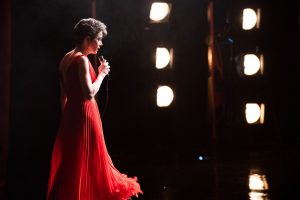 On stage at London’s Talk of the Town nightclub, legendary singer-dancer Judy Garland (Renée Zellweger) attempts a comeback in her career in director Rupert Goold’s new biopic, “Judy.” Photo by David Hindley, courtesy of LD Entertainment and Roadside Attractions.[/caption]
That anguish was offset somewhat when she met a new would-be romantic interest, entrepreneur-promoter Mickey Deans (Finn Wittrock), while attending a party she was invited to by her eldest daughter, actress Liza Minelli (Gemma-Leah Devereux). Mickey helped to brighten her spirits in the time before departing for London, a development that helped to soften the blow.
Upon arrival in the U.K., Judy was welcomed with open arms by her hosts. She was put up in a posh suite at a luxurious hotel and assigned an assistant, Rosalyn Wilder (Jessie Buckley), to attend to her needs – and to keep Judy on track. That last task was important given the reputation Judy had developed for unreliability (part of the reason why she had trouble finding work, representation and income). Having become known for an unpredictable streak, an ongoing struggle with insomnia (and related substance abuse issues) and even a suicide attempt, Judy was something of a risk for anyone willing (some would say foolish) to hire her. But Delfont – and London – wanted her nevertheless, even if that took some serious babysitting.
Judy’s engagement got off to a rocky start. But, as the consummate professional that she was, she soon settled in and did what she was hired to do. That was helped along by the development of an unexpected friendship with a pair of ardent fans, gay couple Dan (Andy Nyman) and Stan (Daniel Corqueira), and a surprise visit from Mickey, who brought his much-needed companionship, the prospect of a lucrative business deal for Judy and a surprise wedding proposal. Things were beginning to look up.
[caption id="attachment_11017" align="aligncenter" width="300"]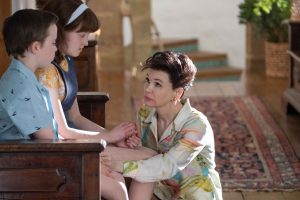 Loving mother Judy Garland (Renée Zellweger, right) adores her children, Lorna (Bella Ramsey, center) and Joey (Lewin Lloyd, left), in the new fact-based biopic, “Judy.” Photo by David Hindley, courtesy of LD Entertainment and Roadside Attractions.[/caption]
Unfortunately, the hope didn’t last, and Judy fell back into her old ways. She was exhausted and burned out, not to mention discouraged, especially when she received distressing news from her children. Try as she might to save face, she seemed overwhelmed by everything that had built up on her over the years. In many ways, these circumstances foreshadowed what was to come, a tragic demise to a life characterized by a seemingly unending string of ups and downs – and an often-frustrating, ever-elusive search for happiness.
Many look upon Judy as a tragic character, a contention that legitimately has some merit. However, as she is portrayed here, Judy has a heroic streak as well, one that, in other contexts, is unfortunately overshadowed by other traits. In many ways, this is a half-empty/half-full glass scenario, one in which our individual perspectives about her are governed by how we see her life overall. But, for Judy’s part, what’s more important to consider is how she saw herself, an outlook governed by her beliefs. And understanding our beliefs is crucial, for they form the basis of the reality we experience as a result of the conscious creation process, the philosophy that maintains we draw upon these metaphysical building blocks to manifest our existence. Even if Judy never heard of this philosophy, it’s apparent that her life was a valiant attempt at learning how to grapple with its principles and to make them work for her.
[caption id="attachment_11018" align="aligncenter" width="300"]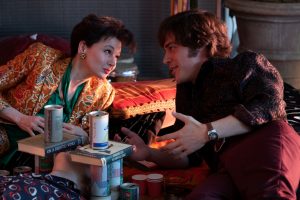 After four failed marriages, actress Judy Garland (Renée Zellweger, left) meets new romantic interest Mickey Deans (Finn Wittrock, right) in “Judy.” Photo by David Hindley, courtesy of LD Entertainment and Roadside Attractions.[/caption]
So how was Judy a hero? Quite simply, she was a fighter, and she had much to combat during her all-too-brief 47 years. After a difficult upbringing, some would say she hit the jackpot when she was discovered by Hollywood. However, once there, Judy faced new challenges from the excessively controlling studio system that tried to dictate virtually every aspect of her personal life, largely because of the impact it was believed it would have on her professional life (and, hence, the studio’s bottom line). In a series of flashbacks, for instance, viewers witness the heavy-handed tactics of studio chief Louis B. Mayer (Richard Cordery), a condescending, demanding father figure who strong-armed Judy not only in career matters, but also in who she could date, how much she should weigh, and even what and when she could eat. And, if she didn’t comply with his wishes, he resorted to other means to get his way, such as plying Judy with diet pills to control her weight and sleeping pills to induce the rest that the diet pills prevented her from getting.
Judy had her share of difficulties in her personal life as well, particularly in her romantic relationships. Given the difficulties she experienced in her professional life, she sought refuge in the comfort of her marriages. Unfortunately, she experienced her share of challenges in that arena as well, especially from spouses who sought to take advantage of her, gestures that necessitated her to fight back once again.
Judy tired of these circumstances quickly, and her rebellious streak surfaced. She fought back. She sought to reclaim her personal power. But, the more she railed against these situations, the more others came down on her. These were the beginnings of her reputation for being “difficult,” even though her actions were primarily intended at looking out for herself (even if she sometimes went overboard in these matters).
[caption id="attachment_11019" align="aligncenter" width="300"]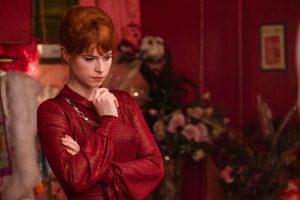 Personal assistant Rosalyn Wilder (Jessie Buckley) is assigned to help – and to keep an eye on – actress-singer Judy Garland during a comeback engagement at London’s Talk of the Town nightclub in the new biopic, “Judy.” Photo by David Hindley, courtesy of LD Entertainment and Roadside Attractions.[/caption]
Learning how to balance these considerations – the ability to look out for herself without shooting herself in the foot – was thus one of Judy’s principal life lessons, both in her life overall, as well as in the time frame depicted in this film. Some would say she got a raw deal and that she had to fight her way back from it. On the other hand, others would argue that she was her own worst enemy in how she handled herself. But to say that it’s all one thing or another is patently unfair. Like most of us, Judy struggled to do the best she could to learn these lessons and to come up with the manifesting beliefs needed to make them work.
Some items she clearly got right, and that’s more than apparent in the film. Her burgeoning talent as an entertainer, for instance, is a direct outgrowth of her belief in herself to be able to put on a show that others would love. Her confidence was at times put to the test, but, when the spotlight was on her, she rose to the occasion. Even when she fell on hard times, she could still captivate audiences with her singing and dancing. She was arguably one of the best of her generation.
[caption id="attachment_11020" align="aligncenter" width="300"]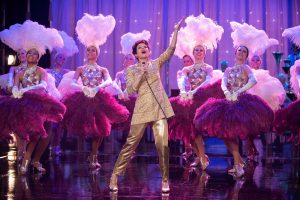 Consummate professional Judy Garland (Renée Zellweger, center) puts on quite a show for audiences at London’s Talk of the Town nightclub in “Judy.” Photo by David Hindley, courtesy of LD Entertainment and Roadside Attractions.[/caption]
Judy also knew how to spread compassion, care and loving tolerance to others. This is obvious, for example, in her love for her children. But it was also apparent in the kindness she showed to others, like Dan and Stan, outsiders who often suffered harsh ridicule from mainstream society. Having often been subjected to the cruelty of others, Judy knew what it was like for those who suffered the same kind of treatment from callous, uncaring segments of society. She offered comfort and reassurance that there was nothing wrong with being oneself, no matter how different one might be, a belief she came to realize for herself and that she freely shared with others.
It’s indeed sad that Judy’s circumstances may have ended up being more than she could bear. But, in combatting those conditions, we should never forget that she fought the good fight, and “Judy” celebrates her courageous battle. Her spirit and gumption are indeed inspiring, qualities guaranteed to move viewers, especially in the film’s concluding sequence. It’s through those images that we should remember what gifts she gave us, having made the world a better place for her presence in it, one adorned by happy thoughts and resplendent rainbows.
[caption id="attachment_11021" align="aligncenter" width="300"]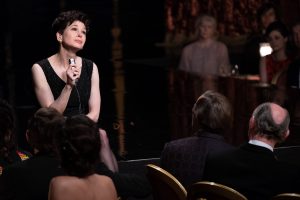 Crooning her signature melody “Over the Rainbow,” singer Judy Garland (Renée Zellweger, center) brings down the house in a touching moment in the moving new biopic, “Judy.” Photo by David Hindley, courtesy of LD Entertainment and Roadside Attractions.[/caption]
Doing justice to an iconic performer can be a tricky proposition, but “Judy” does just that where the legendary singer-dancer-actress is concerned. Renée Zellweger in a comeback performance of her own absolutely knocks it out of the park in a touching, brings-tears-to-your-eyes portrayal of the talented but tragic performer. While some elements might have been handled a little better (such as the pacing in the first 30 minutes), the film more than makes up for any minor shortcomings with Zellweger’s phenomenal singing and acting, capturing Judy’s sensitive but sad essence with heartfelt emotion and a superb rendition of her subject’s character. This may not be a perfect movie, but it’s one that absolutely gets it right where it counts.
The fondness we hold for certain entertainers never seems to fade. That’s especially true when they leave us too soon. There’s a certain unfairness associated with that, one that we have difficulty accepting. But, thankfully, we always have the artistry they leave behind. Judy Garland was one of those iconic performers, and her works have lived on long after she left us. And, through this film, she lives again, allowing us to relive the hope of a place where the dreams that you dare to dream really do come true.
Copyright © 2019, by Brent Marchant. All rights reserved.


Monday, October 7, 2019
‘Judy’ profiles a fighter in search of a comeback


Tuesday, October 1, 2019
Tune in for The Cinema Scribe

Sunday, September 29, 2019
See You at the Festival!
OK, folks, so I purchased my Chicago International Film Festival tickets today! If you want to know about the 15 films I'll be seeing October 17-27, send me an email, and I'll give you the details. Maybe you'll want to come along!

Wednesday, September 25, 2019
This Week in Movies with Meaning


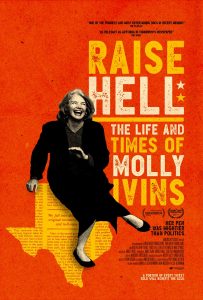
‘Raise Hell’ profiles one writer’s pursuit for truth
“Raise Hell: The Life & Times of Molly Ivins” (2019). Cast: Molly Ivins. Interviews: Dan Rather, Rachel Maddow, Lou Dubose, Jim Hightower, Andy Ivins, Sara Ivins Maley, Carlton Carl, Dave “Moose” McNeely. Archives: George W. Bush, George H.W. Bush, Ann Richards, David Letterman, Morley Safer, John Henry Faulk. Director: Janice Engel. Screenplay: Janice Engel and Monique Zavistovski. Web site. Trailer.
Getting the word out about what’s really going on can be quite a challenge, especially when those in the know may try to conceal the truth, soft-peddle its implications or spin it to their personal advantage. Overcoming that takes a writer-investigator who’s willing to dig deep and to keep from caving in to pressure to doctor the information to fulfill a particular agenda. It also helps to inject a little humor to attract and keep the audience’s attention. So it was for a crafty reporter who managed to pull off all of the foregoing, a career chronicled in the enlightening and entertaining new documentary, “Raise Hell: The Life & Times of Molly Ivins.”
Even in the heyday of newspapers, it was a rather rare feat for journalists in that medium to attain national acclaim. But one who achieved that – and did so by creating a readily distinguishable persona for herself – was Molly Ivins (1944-2007). The outspoken, salty-tongued reporter who channeled those qualities into her work managed to steadily rise up through the ranks of her field. She became a print icon who not only had avid readers, but, more precisely, a constituency, one that hung on her wisecracks and her pearl-handled wisdom.
So what made Molly so charismatic? In essence, readers knew who she was and where she was coming from. She carefully crafted a writing style that set her apart from many of her peers (often penning her stories in first person, for example, a practice generally considered a journalistic no-no), covering topics with her acerbic wit and mastering the art of being able to knock down sacred cows, particularly in the political establishment. But, more than that, she created a distinctive, readily identifiable image for herself, one of a seemingly oxymoronic nature – that of a hard-drinking, pickup-driving Texas liberal.
[caption id="attachment_11001" align="aligncenter" width="300"] Salty-tongued Texas journalist Molly Ivins made quite a name for herself with her wisecracking writing and hard-partying way of life as seen in the candid new documentary, “Raise Hell: The Life & Times of Molly Ivins.” Photo courtesy of Magnolia Pictures.[/caption]
At the risk of overgeneralizing, as contradictory as that label might seem, Molly embraced it to set her apart from the more “conventional” liberal stereotype. By coming across as a typical, tough-talking Texas girl who just happened to adhere to left-leaning sentiments, she won over the hearts and minds of many who may not have otherwise given her the time of day. To readers, she came across more like “one of us” than those who put on airs in making their views known.
Molly’s worldview came out of her upbringing. She indeed loved being from the Lone Star State, but she also questioned the staunchly conservative values that seemed everywhere around her, especially in her family life. Having been born the daughter of “General Jim” Ivins, a strict, authoritarian oil and gas company executive, she was routinely subjected to his rigid right-wing ideologies, ideas that riled her into vociferously expressing her polar opposite viewpoints. This independent streak soon led to study at a prestigious Houston college prep school and then enrollment at the respected liberal arts institution, Smith College, a course of study that included a year abroad in Paris. Through her studies, she developed an aptitude for writing, the springboard for her career.
After graduating from Smith and earning a master’s degree in journalism from Columbia University, Molly launched her life as a writer and reporter by working for The Houston Chronicle and The Minneapolis Tribune. But Molly truly cut her teeth as a journalist by covering Texas politics (most notably the state legislature) for The Texas Observer. Through her reporting of that esteemed yet often-farcical institution, she sharpened her sense for spotting and calling out corruption, self-interest and downright political idiocy. She was off and running.
After leaving the Observer, Molly took her talents to The New York Times, which hired her because of a concern that the paper’s writing style had grown too staid and bland. Ivins was brought aboard to shake things up, but, once there, she was regularly hemmed in by the button-down culture of the Times, preventing her from doing what she was brought on board to do. After a comical falling out with Times editor Abe Rosenthal, Molly packed her bags and returned to Texas, taking a job as columnist for The Dallas Times Herald. Ivins held that job for 10 years, receiving two Pulitzer Prize nominations, before moving on to The Fort Worth Star-Telegram, where she worked until becoming an independent syndicated columnist and published author.
[caption id="attachment_11002" align="aligncenter" width="300"]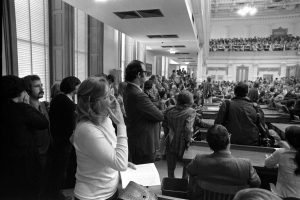 Covering the circus that often is the Texas state legislature, reporter Molly Ivins brought wit and wisdom to her readers as chronicled in director Janice Engel’s smart new documentary, “Raise Hell: The Life & Times of Molly Ivins.” Photo courtesy of Magnolia Pictures.[/caption]
Along the way, Molly became quite acquainted with many of journalism’s elite and with many prominent politicians, both in Texas and nationally. Among those she befriended was Texas Gov. Ann Richards (D), the rollicking keynote speaker at the 1988 Democratic National Convention. Richards and Ivins were kindred spirits cut from the same cloth, especially when it came to their hard-partying ways, a habit that eventually led to both of them seeking assistance for substance abuse.
While Richards recovered from her condition, Ivins, unfortunately, struggled with it. She had convinced herself that alcohol was so much a part of her work and her image that she had difficulty giving it up. She often used drinking as a tool for getting stories out of sources, her ability to hold vast quantities of liquor often enabling her to hold her own during drawn-out tippling sessions with the good ole boys of Texas politics. But, unfortunately, it went beyond that, so much so that, when she went for one of her job interviews, she took her own six-pack with her.
Somehow, though, Molly managed to hold it together well enough as a functional alcoholic to have a storied and successful career. That career, though, ran into a brick wall when she was diagnosed with an aggressive form of breast cancer in 1999. Molly fought the illness for nearly seven years, even drawing upon her signature sarcasm when discussing her circumstances (she named her breast tumor “Newt” in honor of House Speaker Newt Gingrich (R), one of her least favorite politicians). In the end, the disease overpowered the tough-talking Texan, but, in this ordeal, as in the rest of her life and career, she fought the good fight – and nobody could credibly say otherwise.
Over time, Molly could clearly see the nature of her mission in life, and the more practiced she became at it, the more it became entrenched in her thoughts, acts and deeds. And the more she worked at honing this calling, the more effective she became at it. None of that would have been possible, however, without her beliefs in herself and her ability to carry out this task. Such is what comes from the conscious creation process, the philosophy that maintains we manifest the reality we experience through the power of our thoughts, beliefs and intents. It’s not clear whether Molly had ever heard of this practice, let alone made deliberate use of it, but, given the results she attained, it’s apparent she had mastered its principles, whether or not she was aware of it.
Key among the beliefs that enabled her to function so effectively was an absolute fearlessness toward the work she undertook, an outlook she developed under the thumb of her authoritarian father and the state culture under which she grew up. In Texas, where machismo reigns supreme, Ivins refused to be steamrolled by the strong-arm, testosterone-laden attitudes of those who sought to control everything by serving self-interests first and pushing aside anyone unwilling to play their game. Molly hung tough with those seeking to control the agendas and wasn’t afraid to expose their foibles when they reared their ridiculous and ugly heads, something she uncovered quite often. That gave her the confidence to proceed with her mission, while simultaneously reinforcing her beliefs in her ability to do so.
[caption id="attachment_11003" align="aligncenter" width="300"]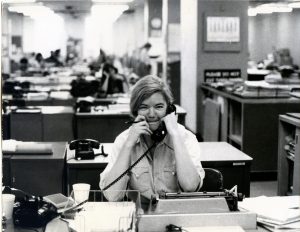 Though brought aboard to shake things up at the staid New York Times, rambunctious journalist Molly Ivins often ran afoul of the paper’s button down culture as explained in the new documentary, “Raise Hell: The Life & Times of Molly Ivins.” Photo courtesy of Magnolia Pictures.[/caption]
This, in turn, allowed Molly to have the courage to be herself, no matter how much her views and outlooks deviated from expected norms. Ivins never hesitated to speak her mind, both in person and in print, despite being part of a liberal minority in an otherwise-conservative state. She championed the causes of civil liberties and helping the downtrodden on both the state and national level, especially when initiatives in these areas were threatened by the tactics of the privileged looking out for themselves. While Republicans were her usual targets in these regards, she was also willing to take on those who claimed to be the friends of the underprivileged, such as she did in 1996, when she criticized President Bill Clinton’s (D) welfare reform plan.
In leveling her criticisms, Molly made frequent use of her signature weapon – humor. She believed it to be a unifying force, one that could uncannily draw smiles from both supporters and opponents of her viewpoints. She was expert at landing zingers, especially against pompous, blowhard politicians, a skill that would allow her to benignly but effectively shine a bright light on blatant boondoggles and rampant incompetence. And, in many instances, her one-liners worked wonders, exposing the fools for who they really were, even if her efforts were linked to circumstances that were ultimately no laughing matters.
Another of Molly’s formidable tools was her intuition, one of the two key components that contributes to belief formation. It enabled her to successfully size up situations for what they were, often allowing her to see things that others would miss. For example, given her extensive experience in covering the backslapping, smoke-filled room dealings of Texas-style politics, she became concerned when Gov. George W. Bush (R) announced his candidacy for President in 2000. She feared that, if Bush were to be elected, it would initiate a roll-out of Lone Star-style politics on a national scale, a prediction that many now contend came true and set a new standard, a legacy that we’re now left to wrestle with. Indeed, for what it’s worth, Molly’s intuition allowed her to see the future.
There’s a potent cautionary tale in that. Ivins sought to send us messages to heed, and their importance is just as significant now as they were at the time she penned them. Many of the issues that she tried to warn us about were in their early stages and have grown more acute since then. We’d be wise to consider going back and reading (or re-reading) what she wrote to sharpen our own insights into what’s happening – and what could happen if we ignore her warnings.
This thus illustrates the nature of Molly’s ultimate destiny, something that she pursued throughout her life and that has carried on even after her death. It’s essentially her expression of the conscious creation principle known as value fulfillment, the concept associated with living our lives as our best, truest selves for the benefit of ourselves and those around us. In this regard, Ivins clearly walked her talk, setting an example for those in her field and for anyone who cares about the kinds of issues she championed. We could use more like her these days; we can only hope that her story inspires others to follow in her footsteps.
This frank, no-holds-barred look at the life of one of the most celebrated straight-shooting professionals in her field provides a rip-roaring look at her career, filled with ample wit and wisdom typical of her signature style. Through an excellent compilation of archive footage and interviews with those who knew her and valued her work, such as journalists Dan Rather and Rachel Maddow, director Janice Engel’s offering provides viewers with an insightful inside look at Molly’s professional and personal life, as well as the legacy she left behind. This film reminds us what journalism can – and should – be, a profession that these days is only a shadow of its former self. Let’s hope this picture helps to inspire the would-be Mollys out there who want to become what she was.
In an age when the powers that be are striving to stifle dissent, it’s more important than ever to raise a little hell when called for. Molly Ivins recognized the importance of that and employed the tactic whenever appropriate, even under prevailing circumstances that were more relaxed than they are now. Given what we’re increasingly up against, we should take her message to heart. So get ready to beat those drums – and laugh our way through it.
Copyright © 2019, by Brent Marchant. All rights reserved.
Monday, September 23, 2019
Tune in for Movies with Meaning
Tune in for the latest Movies with Meaning segment on Frankiesense & More radio on The Good Media Network on Tuesday September 24 at 1:30 pm ET by clicking here. And, if you don't catch it live, hear and watch it later on demand!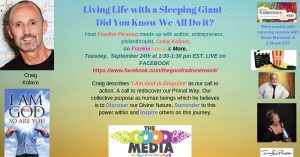



Friday, September 20, 2019
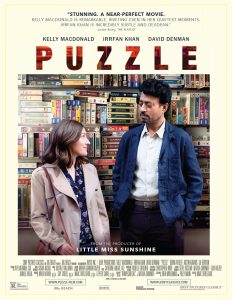
‘Puzzle’ seeks to assemble the pieces of our lives
“Puzzle” (2018). Cast: Kelly Macdonald, David Denman, Irrfan Khan, Austin Abrams, Bubba Weiler, Liv Hewson, Audrie Neenan. Director: Marc Turtletaub. Screenplay: Polly Mann and Oren Moverman. Story Source: Natalia Smirnoff, “Rompecabezas” (“Puzzle”), 2009 Argentinian film. Web site. Trailer.
Many of us look at our lives and see them as complete – only to discover not long thereafter that they’re not. Pieces may seem missing or out of place, realizations that we might view as frustrating, mystifying or even troubling. We could be tempted to ignore those shortcomings, hoping they’ll go away or resolve themselves on their own, but those “solutions” seldom work out as hoped for. It’s times like that when we must make a concerted effort to determine what’s gone awry and take steps to make repairs, a process detailed in the thoughtful domestic drama, “Puzzle,” now available on DVD and streaming services.
Middle-aged homemaker Agnes (Kelly Macdonald) is something of a walking anachronism. The forty-something wife and mother leads a modest existence that resembles something more out of the 1950s than the present day. She lives a quiet, traditional life in an immigrant community of Yonkers, having never ventured far from home (even to nearby New York) nor taken the time to pursue any interests of her own. Instead, she’s dutifully fulfilled the obligations of housewife, caretaker and humble parishioner, spending virtually all of her days cooking, cleaning and, like the good Catholic girl she was raised, helping out at the church. She even does all the preparations for her own birthday party, fixated more on the needs of her guests than enjoying herself.
[caption id="attachment_10986" align="aligncenter" width="300"] Having long lived a secluded life in Yonkers, middle-aged housewife Agnes (Kelly Macdonald, center) discovers a big wide world while on a trip to nearby New York in the nuanced domestic drama, “Puzzle,” available on DVD and streaming services. Photo by Linda Kallerus, courtesy of Sony Pictures Classics.[/caption]
Agnes’s biggest obligation, though, is taking care of the men in her family, her husband, Louie (David Denman), and two teenage sons, Gabe (Austin Abrams) and Ziggy (Bubba Weiler). It’s a continuation of a tradition that began with looking after her widowed father, setting a pattern that has persisted unquestioningly into adulthood. To be sure, Agnes’s guys take good care of her, especially Louie, who is a devoted, loving protector, albeit a bit oblivious to recognizing and addressing her needs.
However, as Gabe and Ziggy approach their own adulthood, Agnes is facing the impending empty nest stage and begins to wonder about her life. Has she gotten everything out of it that she wants? And what will she do for her future if the role she has traditionally played changes? That’s hard to say, because even Agnes doesn’t have ready answers to these questions, having never taken the time to ponder these notions, let alone given herself permission to find out what pleases her.
That changes, though, when she opens her birthday presents. Agnes receives a jigsaw puzzle as a gift, and she’s captivated by it. She relishes the process of assembling the pieces to create a completed picture, especially when she discovers she’s quite good at it – not to mention fast. Simple as it might seem, Agnes suddenly has a new passion, and this time she decides to pursue it, even if somewhat discreetly. Given how she’s lived most of her life, she seems to feel a need to keep it under wraps, especially when it impacts her obligations to her family.
[caption id="attachment_10987" align="aligncenter" width="300"] The men in the life of a middle-aged housewife – husband Louie (David Denman, center) and teenage sons Ziggy (Bubba Weiler, left) and Gabe (Austin Abrams, right) – are virtually her entire world, as seen in director Mark Turtletaub’s “Puzzle,” now available on DVD and streaming services. Photo by Linda Kallerus, courtesy of Sony Pictures Classics.[/caption]
After assembling the puzzle she received as a gift, Agnes craves more. She ventures into New York to visit the store from which her gift was purchased, and she’s like a kid in a candy shop, picking up several new puzzles. While there, she also spots a notice about a competitive puzzler who’s seeking a partner to collaborate for a doubles tournament. Agnes takes the contact information and pursues the opportunity, a decision that’s very much out of character but that she nevertheless acts on, following her impulses with little hesitation.
Before long, Agnes meets her prospective puzzling partner, Robert (Irrfan Khan), a wealthy, divorced, bored, semiretired inventor. Her initial visit to his well-appointed New York townhouse is somewhat awkward, but there’s a definite, if uncomfortable, chemistry between the two of them. Puzzling may be the interest they share overtly, but there’s clearly more going on between them underneath the surface.
In his own way, Robert wants to help Agnes liberate the pent-up passion for living that she’s been suppressing for so many years. He’s aware that she has much to offer others, but he’s anxious to see her devote more of her energies to fulfilling her own wants and needs. It’s as if he sees her as a volcano on the verge of erupting if only she’ll allow herself to do so.
At the same time, Agnes seeks to help Robert re-engage with the world, coaxing him to emerge from the reclusive existence he’s slipped into in the wake of his divorce. She tries to show him that there’s more to life than just assembling puzzles, the only activity in which he seems to show any interest. Until now, he’s had little incentive to change, given that the ample financial resources he amassed from his technological expertise have enabled this comfortable, if isolated, lifestyle. She believes he has much more to offer the world, including in the career he’s allowed to atrophy, if only he’ll apply his talents as he once did.
[caption id="attachment_10988" align="aligncenter" width="300"] Middle-aged and long-sheltered housewife Agnes (Kelly Macdonald, left) discovers a new personal passion as a competitive jigsaw puzzler with her tournament partner, Robert (Irrfan Khan, right), as seen in the heartfelt domestic drama, “Puzzle.” Photo by Linda Kallerus, courtesy of Sony Pictures Classics.[/caption]
As the relationship develops, it begins to involve more than just assembling puzzles. But, metaphorically speaking, this is a fitting backdrop as Agnes and Robert struggle to see how the pieces of their connection fit together. In addition to sorting out their joint dealings, they each have their own individual considerations to address. For instance, Agnes has the future of her marriage to consider. She truly loves Louie, but she can’t help but wonder whether his limited view of their relationship and his inattentiveness to her needs are enough for her now that she’s begun to broaden her horizons. She wrestles with what to do, keeping her thoughts and feelings contained and even going so far as to make up stories about how she’s spending time that she’s having trouble accounting for.
So how will it all shake out? That’s what remains to be seen. Given everything that’s going on with Agnes, Robert and Louie, there are multiple directions in which matters can unfold. It all depends on the picture the principals each want to create for themselves, developments that are direct outgrowths of the conscious creation process, the philosophy that maintains we manifest the reality we experience through the power of our thoughts, beliefs and intents.
In many respects, this various threads of this story offer us an excellent look at how our beliefs construct our reality. The nature of each character’s existence is a clear reflection of their individual beliefs, and, as their beliefs begin to evolve, their respective realities become altered in kind, direct reflections of the thoughts and intents that brought these changes into being. It’s as if the film is giving us a primer on how this all works, presenting viewers with undeniably clear examples of the unfolding of the manifestation process. As beliefs change, so, too, do the realities that flow from them.
For example, as Agnes opens up to possibilities she hadn’t previously considered, her existence provides her with tangible options for experience and enjoyment that previously weren’t available to her. Similarly, as Robert chooses to reconnect with aspects of life other than his puzzles, he rejuvenates his enthusiasm for living, re-engaging with other elements of his existence, more so than he has done so for quite some time. And, as Louie begins to see his relationship with Agnes change, he realizes the need to become more cognizant of how he relates to her and how to address her wants and needs. None of this occurs instantaneously; it’s a gradual process but one that’s quite obviously tied to the evolution of the beliefs of those who bring their realities into being.
[caption id="attachment_10989" align="aligncenter" width="300"] Louie (David Denman), a hard-working and protective but sometimes-oblivious husband, becomes bewildered about the state of his marriage when his long-predictable wife begins behaving in ways out of character as seen in “Puzzle,” now available on DVD and streaming services. Photo by Linda Kallerus, courtesy of Sony Pictures Classics.[/caption]
In each of these cases, the characters change their beliefs by disposing of those that no longer serve them and replacing them with rewritten notions more in line with what they want and need. Again, the process unfolds piecemeal, but it’s deliberate and thoughtful, even if the replacement beliefs aren’t immediately apparent.
For instance, Agnes comes to realize that she needs more out of life than simply attending to the well-being of the men in her life, that she requires personal fulfillment that has been stifled for decades, something that her passion for puzzles helps to illuminate. Robert, meanwhile, understands that he can no longer continue to hide in the comforts of his townhouse, alone and without meaningful connection to others and to a purposeful calling in life. And Louie sees that, if wants his marriage to continue, he must do more for Agnes than just provide the means for giving her a roof over her head and putting food on her plate; he must be more perceptive about her wants and needs and then take action to attend to them, an effort that requires him to believe that simply bringing home the bacon is not enough to make his marriage work.
To instigate this process, a catalytic spark is required. The catalysts in this story facilitate the evolution of the characters’ beliefs and enable the process to unfold. As the film illustrates, puzzles provide a fitting metaphor by urging the principals to see how the pieces of their transforming lives fit together. The puzzle assembly process symbolically prompts Agnes and Robert to take a different view of their lives, providing them with new perspectives of their existence. And this works not only for completing the pictures of their finished puzzles, but also for composing the picture of their lives.
[caption id="attachment_10990" align="aligncenter" width="300"] What begins as a competitive puzzling partnership takes unexpected turns over time as collaborators Robert (Irrfan Khan, left) and Agnes (Kelly Macdonald, right) discover in the nuanced domestic drama, “Puzzle.” Photo by Linda Kallerus, courtesy of Sony Pictures Classics.[/caption]
Admittedly, this process may require some trial and error to sort things out. Given that these characters have long lived rather limited forms of existence, they may well be uncomfortable stepping into unfamiliar territory, unsure of what suits them or even what they want. This process might also involve the practice of learning various life lessons, something that may not work out perfectly on the first attempt (or even multiple attempts). However, since this is part and parcel of our personal growth and development, this is not unexpected. We’d be wise to simply embrace this as an integral aspect of our evolution, one that we should hope will ultimately lead to greater degrees of awareness and enlightenment. Where Agnes, Robert and Louie are concerned, we can only hope that they find their way, that they discover lives that bring them the satisfaction and fulfillment they seek – something to which we should all aspire.
Life’s pieces don’t always fit together as well as we’d like, and “Puzzle” shows us just that, albeit a little too well at times. Based on the 2009 Argentinean film “Rompecabezas” (“Puzzle”), this feature successfully incorporates all the elements of a realistic, superbly nuanced picture, especially when it comes to reflecting the story’s central theme. However, director Mark Turtletaub’s offering could nevertheless use a little more narrative “glue” to hold the pieces together more effectively. At the same time, though, the heartfelt performances of Macdonald, Denman and Khan truly make this offering worth watching, but don’t be surprised if you sometimes find yourself just as frustrated as the characters themselves.
To say that life is sometimes “puzzling” is indeed an understatement. We may wonder why events transpire as they do, often leaving us with questions that seem unanswerable. But, with a little effort on our part, that need not be the case. By taking the time to assess our beliefs – both for what they are and for what we would like them to be – we can begin to put the pieces together to fashion a clear picture, one that we can hope is beautiful – and to our liking.
Copyright © 2019, by Brent Marchant. All rights reserved.