“Luce” (2019). Cast: Naomi Watts, Octavia Spencer, Tim Roth, Kelvin Harrison Jr., Norbert Leo Butz, Andrea Bang, Marsha Stephanie Blake, Omar Brunson, Noah Gaynor, Astro, Christopher Mann, Hannah Cabell. Director: Julius Onah. Screenplay: J.C. Lee and Julius Onah. Play: J.C. Lee, Luce. Web site. Trailer.
What is truth? That’s a question scholars, philosophers and theologians have wrestled with for eons. But, after all these many centuries, it still lingers, nibbled at by many deep thinkers though never satisfactorily answered. Perhaps that’s because it can’t be adequately nailed down, be it due to an undefinable or transitory nature, a plethora of conflicting opinions, or some other inscrutable quality. For what it’s worth, however, the quest continues, this time on the stage of a highly charged contemporary drama as seen in the gripping new release, “Luce.”
If ever there were a textbook example of an “honor student,” Luce Edgar (Kelvin Harrison Jr.) would be it. The Eritrean-born onetime-child soldier whose first name means “light” was adopted by his upper middle class parents, Amy (Naomi Watts), a pediatrician, and Peter (Tim Roth), a financier. With no children of their own, Amy and Peter wanted to use their considerable resources to give a fighting chance to someone who might not otherwise get one. Together they put everything they had into raising the African orphan, who has grown up to be a stellar high school senior, expert debater, star track athlete and fiercely loyal friend.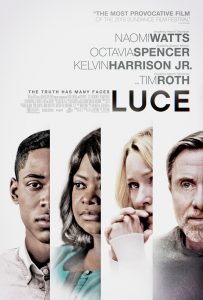
With a pedigree like that, Luce seems well on his way to a bright future, one aptly befitting of his name. But one day, quite unexpectedly, a bombshell goes off. Amy is called to Luce’s school to confer with his history teacher, Harriett Wilson (Octavia Spencer), who shares some troubling news. Miss Wilson is concerned about Luce’s work on a classroom essay assignment in which he and his fellow students were tasked with writing a paper in the first-person voice of a historic figure. For his composition, Luce chose to pen a manifesto by Frantz Fanon, a radical Black revolutionary who advocated violence as the only means to achieve political reform. The incendiary paper was filled with disturbing, inflammatory rhetoric, so much so that it shocked the project’s assignor. And, to see if there was more to this than just his provocative prose, Miss Wilson had Luce’s locker searched, an investigation that uncovered the presence of illegal fireworks, an amount capable of setting off a sizable explosion.
Needless to say, Amy can’t believe what she’s hearing. Given her son’s impeccable reputation, how could he possibly be caught up in something like this? She’s upset about the invasion of her son’s privacy, and she seriously doubts Miss Wilson’s accusations, citing the nature of the assignment to explain its content. She leaves the conference highly skeptical. However, just in case there might be something to the teacher’s claims, she decides to get to the bottom of things with her son but without directly confronting Luce with the alleged evidence. She refuses to level the same unsubstantiated charges against him without fully getting his side of the story.
[caption id="attachment_10911" align="aligncenter" width="300"] Honor student and star athlete Luce Edgar (Kelvin Harrison Jr., center) is seen as a remarkable young man by his mother, Amy (Naomi Watts, right), despite some serious skepticism by history teacher, Harriett Wilson (Octavia Spencer, left), in the taut new psychological thriller, “Luce.” Photo courtesy of Neon.[/caption]
In questioning Luce, however, Amy finds her son to be somewhat evasive. He admits his relationship with Miss Wilson is somewhat strained, given that she often seems to have it in for him. He notes that she’s highly judgmental with limited views of what she considers acceptable behavior, particularly for minority students, such as Luce’s classmates DeShaun Meeks (Astro) and Stephanie Kim (Andrea Bang). That’s somewhat ironic, given that Miss Wilson comes from a minority background herself. This aside, though, the lack of definitive answers leaves Amy with doubts, something she didn’t expect to happen. Yet, considering her love for her son and the implicit trust she has long placed in him, she tends to give him the benefit of the doubt, even though she can’t help the onset of vacillation that seems to be creeping into her feelings.
To say more would reveal too much, but suffice it to say that matters grow progressively more complicated when a variety of other issues arise. An incident with Miss Wilson’s drug-addicted sister, Rosemary (Marsha Stephanie Blake), an internal investigation led by the school’s principal, Dan Towson (Norbert Leo Butz), a home break-in, accusations of possible sexual assault, and an incident involving the aforementioned fireworks take the situation to whole new level. And, with so much on the line, none of these events brings anyone closer to the truth – if there even is such a thing as a solitary truth.
Yet getting to the truth is what most everyone wants, no matter how elusive it might be. But, if that’s truly the case, why is it so hard to pin down? That’s because truth is often relative, based more on perceptions, perspectives and beliefs and less on objective criteria that go unquestioned. That lack of absolute certainty probably makes many of us quietly uncomfortable, but perceptions, perspectives and beliefs are by their nature variable from one person to another. And, given the role they play in the manifestation of our individual realities, their impact is formidable. In fact, they’re at the core of the conscious creation process, the philosophy that maintains these metaphysical building blocks are responsible for shaping the existence we experience.
[caption id="attachment_10912" align="aligncenter" width="300"]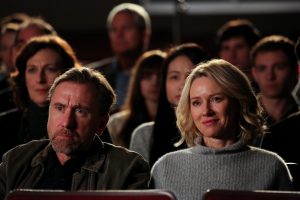 Proud parents Peter and Amy Edgar (Tim Roth, left, and Naomi Watts, right) wrestle with some disturbing news about their adopted honor student son in director Julius Onah’s gripping new psychological thriller, “Luce.” Photo courtesy of Neon.[/caption]
When those principles are applied to the scenario at work in this film, it’s easy to see how multiple versions of “the truth” emerge. The view each character holds about Luce determines how they each see him. And this doesn’t even take into account the perspective he holds about himself. What’s more, as new revelations continually arise, the sands underlying these perceptions tend to shift, making apparent that “the truth” can readily change over time with changing circumstances.
To many of us, this probably seems obvious. However, this is a reaction coming from an outside perspective. When we find ourselves embroiled in situations like the one depicted here, we may lose that objective outlook; instead, we tap into our own subjective views but somehow convince ourselves that they must be taken as gospel, intrinsically inviolable truths. Such circumstances thus demonstrate the power of beliefs and how we can imbue them with an unshakable certainty, despite the fact that they are readily alterable, even if we’d rather not see them as such. Indeed, if we draw upon these resources to create the reality we experience, they’re going to vary from individual to individual, a condition that accounts for differences in outcomes.
It’s also worth bearing in mind that things seldom arise as all or nothing scenarios. The proverbial “black and white” situations tend not to emerge as readily as we think they do; those murky in-between shades of gray are often more prevalent, and it’s those hues that we should look at most closely. Yet, for what it’s worth, that’s not the case in this story. As Luce himself pleadingly protests when the heat gets turned up, “I only get to be a saint or a monster.” Is he either of those, an upstanding citizen or a sociopath? Or is he more accurately characterized as something in between?
[caption id="attachment_10913" align="aligncenter" width="300"] Asian-American high schooler Stephanie Kim (Andrea Bang, center) is upset that her history teacher holds her to a different standard of accountability compared to non-minority students as seen in the stunning new drama, “Luce.” Photo courtesy of Neon.[/caption]
This is an important point to bear in mind in today’s culture. Given the polarization seen in contemporary society, it might be easy to fall prey to beliefs that occupy opposite ends of the spectrum. That’s particularly true when it comes to an issue like race, a question that comes front and center in this story. Is it fair, for example, for Miss Wilson to hold minority students to a higher standard of accountability? Is she purposely being hard on them to help prepare them for the challenges they’re likely to face in an often-unfair and imperfect world? Or could it be that she’s projecting personal resentment onto them based on the experiences she underwent as she was attempting to stake her place in the world? The answers to these questions aren’t easy, but they’re almost assuredly based on the underlying beliefs on which they rest.
This riveting psychological thriller is filled with endless twists and turns that leave audiences guessing right up until the very end. What’s more important, though, is that the film forces us to face some thorny questions about race, redemption, privacy, trust, perception and prejudice, all the while showing us that things may not be as simple or clear cut as they seem. The picture’s superb script by playwright J.C. Lee and director Julius Onah, its fine film editing, and its excellent ensemble cast (most notably Spencer, Watts and Harrison) make for one of the best offerings of 2019, a release that sincerely deserves serious consideration come awards season. It already earned a Grand Jury Prize nomination in the dramatic category at the Sundance Film Festival earlier this year.
[caption id="attachment_10914" align="aligncenter" width="300"] Is he a saint or a sociopath? That’s one of many thorny questions viewers must ask themselves when it comes to high school honor student Luce Edgar (Kelvin Harrison Jr.) as seen in the gripping new drama, “Luce.” Photo courtesy of Neon.[/caption]
No matter how earnestly we search, truth may be something that ever eludes us. The answers we come up with may be incomplete, unsatisfactory or even totally off-base. As this story illustrates, the quest may even leave us with more questions than we had at the outset of our inquiries. The important thing, though, is that we never stop searching, for we grow with each step we take along the way, and there’s no telling where that may end up taking us.
Copyright © 2019, by Brent Marchant. All rights reserved.


Monday, August 19, 2019
‘Luce’ ventures into the search for truth


Saturday, August 10, 2019
This Week in Movies with Meaning


Friday, August 9, 2019
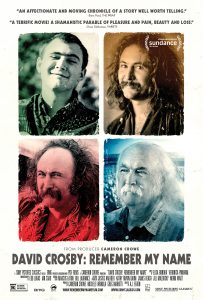
‘David Crosby’ celebrates an icon’s quest for creativity, redemption
“David Crosby: Remember My Name” (2019). Cast: Interviews: David Crosby, Jan Crosby, Roger McGuinn, Cameron Crowe, Henry Diltz. Archives: Graham Nash, Stephen Stills, Neil Young, Jackson Browne, Glenn Frey, Bob Dylan, Paul McCartney, John Lennon, George Harrison, Ringo Starr, Cass Elliott, Joni Mitchell, Christine Hinton, Jimi Hendrix, Dick Cavett, Jerry Garcia, Don Everly, Phil Everly. Director: A.J. Eaton. Web site. Trailer.
It’s amazing how someone can embody both the best and worst of what we’re capable of. These qualities, polar opposites to be sure, seem incompatible with one another, yet, on occasion, they sometimes wind up residing within a single individual. Learning how to reconcile these extremes can thus prove to be quite a challenge for those of us who want to do our best but find that there are times when it’s difficult to control ourselves. Such is the experience of a legendary musician as seen in the enthralling new documentary, “David Crosby: Remember My Name.”
Singer-songwriter David Crosby has led quite a storied life. Over his decades-long career, he’s been both a golden boy and a bad boy of the music business. And now, after years of living large, partying hard and burning more than his share of bridges, he’s come into the home stretch of his life with many accolades and numerous regrets.
So how does one deal with such a curious mixture of high praise and heavy baggage? That’s what the 76-year-old musician is attempting to do these days. There’s a sense of quiet urgency associated with this, too, given Crosby’s failing health. Having experienced several heart attacks, the implantation of eight cardiac stents, a liver transplant and the onset of diabetes, he realizes he could depart this world at any time. Which is why he’s trying to make sense of his life (and himself) with what time he has left.
[caption id="attachment_10888" align="aligncenter" width="300"]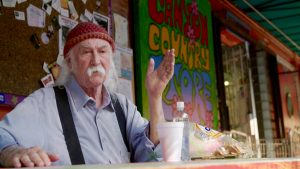 Legendary singer-songwriter David Crosby pays a visit to Laurel Canyon, his old stomping grounds and home to many up-and-coming musicians during the 1960s, as seen in the revelatory new documentary, “David Crosby: Remember My Name.” Photo by Edd Lukas and Ian Coad, courtesy of Sony Pictures Classics.[/caption]
“David Crosby: Remember My Name” is more than just a nostalgic stroll down memory lane. To be sure, the film does cover the many diverse aspects of his career, including his often-stormy stint with the 1960s rock band the Byrds, his phenomenally successful collaborations with Stephen Stills, Graham Nash and Neil Young, and his legendary appearance at the Woodstock Music Festival. It also explores his professional and personal relationships with other high-profile musicians of the ʼ60s and ʼ70s, such as Jerry Garcia, Bob Dylan, Joni Mitchell, Cass Elliott and Jimi Hendrix. And it looks at his many romances, including those with Mitchell, with longtime girlfriend Christine Hinton (who was tragically killed in a traffic accident) and with his current wife, Jan.
But, despite his many successes, Crosby has also had his share of downfalls. In addition to his health problems and his long-lasting despair over Christine’s death, he has undergone serious bouts of addiction and prison time. He got himself fired from the Byrds for his unpredictable, unreliable and irresponsible antics, a number of them occurring while on stage and involving highly inflammatory political messages at the height of the social turbulence of the 1960s. And then there were his very public disputes with former collaborators like Byrds founder Roger McGuinn and all of his CSNY bandmates.
But, then again, Crosby has achieved accomplishments few others have attained. He’s been inducted into the Rock ʼn Roll Hall of Fame twice, first as a member of the Byrds in 1991 and then as a member of Crosby, Stills and Nash in 1997. And then, at age 72, when many of us begin kicking back and settling down, he launched head first into a prolific creative resurgence, producing four solo albums over four years, with more apparently to come.
[caption id="attachment_10889" align="aligncenter" width="300"] Guitarist David Crosby rocks out during a concert featuring Crosby, Stills, Nash and Young (CSNY) as seen in director A.J. Eaton’s new documentary, “David Crosby: Remember My Name.” Photo by Neal Preston, courtesy of Sony Pictures Classics.[/caption]
To many of us, such extreme contrasts probably seem incongruous. By Crosby’s own admission, they even seem that way to him. He’s not even sure how he’s managed to live as long as he has, given the passings of so many of his contemporaries, including some who lived less recklessly than he has. However, he’s made every attempt to be honest with himself about his behavior, acknowledging his shortcomings and realizing that his failings are of his own making and no one else. While he hopes that reconciliations with his former collaborators might be possible – an accomplishment he’s been able to achieve with most of his family members – he’s also cognizant enough to realize that such reunions are unlikely and that he’s the cause for that. In light of that, he accepts his feelings and responsibilities, hoping for redemption but nevertheless moving on, continuing to concentrate on what he does best – making music.
For better or worse, creative expression is something that often requires acquiring a range of experiences, both positive and negative. Were it not for that, artists might well not be able to produce their best work. While that certainly involves the heights of elation, it may also call for firsthand knowledge of painful despair, something most of us would rather eschew but that may be unavoidably integral to the successful unleashing of our inner muse.
That may help to account for Crosby’s experience. For what it’s worth, having gone through such ups and downs could help to explain his creative success, experiences made possible by the conscious creation process, the philosophy that maintains we manifest the reality we experience through the power of our thoughts, beliefs and intents. Although he lived through the free-thinking times of the 1960s counterculture, an era in which such alternative notions emerged from obscurity and gained a firm foothold in the culture, it’s unclear whether he became aware of or availed himself of this philosophical outlook. But, even if not, much of his life experience reflects many of the principles underlying this metaphysical mindset.
[caption id="attachment_10890" align="aligncenter" width="300"]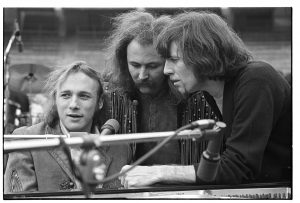 Musician David Crosby (center) performs with longtime collaborators Stephen Stills (left) and Graham Nash (right) in the new documentary, “David Crosby: Remember My Name.” Photo by Henry Diltz, courtesy of Sony Pictures Classics.[/caption]
When looking at Crosby’s creative output in conjunction with the events of his life, one can see parallels between his personal experience and his artistic expressions. The “inspiration” provided by such incidents helped make that possible, both positively and negatively and in both his individual and collaborative efforts. Would that have happened if he had not drawn those experiences into his existence? That’s hard to say with certainty, but we have seen it with an array of other artists (including in a number of recent films) involving everyone from painters to musicians to actors. By having something to draw upon, these creatives have tapped into source material that helped them manifest their works, developments that might not have otherwise happened.
That’s important, too, for it’s crucial to one’s value fulfillment, the conscious creation principle that maintains we should strive to become our best, truest selves for the betterment of ourselves and those around us. Music has been Crosby’s destiny ever since he learned to sing and play the guitar, and, fortunately for him (and us), he was perceptive enough to recognize this ability and to make the most of it. His inventive melodies, blissful harmonies and thoughtful lyrics have given us much to savor, creations that have truly made the world a better place for him having been a part of it. One need only look, for example, at his involvement with the stirring protest song “Ohio,” a composition written by CSNY collaborator Neil Young in response to the 1970 Kent State University shootings, to see the impact his contributions have made on the national culture and psyche. His art helped unite us at a time when we needed it, leaving a legacy that has lasted ever since.
With that kind of impact, it’s easy to see how one’s influence on the culture can extend far and wide. The often-outspoken Crosby, for instance, helped shape the social and cultural landscape of the 1960s. He even unwittingly left an imprint on the art and politics of the time, as seen in a post-Woodstock appearance on The Dick Cavett Show in which he made his views as plain as day, helping bring radical new ideas to the mainstream. He even had impact on fashion and style, as evidenced by the looks, mannerisms and attitudes exhibited by the character played by Dennis Hopper in the radical cinematic epic “Easy Rider” (1969). When one can wield that kind of wide-ranging influence, it’s possible to reshape the world, even in matters of critical importance and individual style.
[caption id="attachment_10891" align="aligncenter" width="300"] On stage at the peak of their career (from left) Neil Young, Graham Nash, David Crosby and Stephen Stills (CSNY) appear before a packed stadium audience as seen in the candid new documentary, “David Crosby: Remember My Name.” Photo by Joel Bernstein, courtesy of Sony Pictures Classics.[/caption]
Crosby didn’t remain static throughout all this, either. He constantly evolved and changed, an expression of the conscious creation concept that we’re all in a constant state of becoming. This is reflected in his diverse musical repertoire, as well as his other artistic ventures, including occasional forays into acting and “modeling” for rock photographer Henry Diltz. It’s also apparent in the various roles he’s played in his vocation, having been everything from a peer collaborator to a solo act to a mentor for a new generation of musicians. That’s quite a range for multiple lifetimes, let alone one.
Given where Crosby is now, however, he’s most focused on certain goals, using his creative powers to fulfill as many of them as he can with the time he has left. Most of them center on the concept of redemption, both personally and artistically. It’s commendable that he recognizes this, too, for it’s a healthy approach to try to rectify our missteps. All too often we feel reconciled to our failures, convinced we’ll never be able to redeem ourselves. But, as the saying goes, nobody’s perfect, and we all make mistakes in the course of our individual journeys.
Oftentimes these missteps involve valuable life lessons that don’t always go perfectly on our initial attempts. But we don’t get only one attempt; we can always start anew if we allow ourselves to do so. Conscious creation makes it possible to try again, invoking different beliefs and trying different approaches, new and improved initiatives that, one can hope, will work. That certainly seems to be what Crosby is doing now. Let’s wish him the best.
[caption id="attachment_10892" align="aligncenter" width="300"] With wife Jan (right), guitarist David Crosby (left) shares a private moment in the new documentary, “David Crosby: Remember My Name.” Photo by Edd Lukas and Ian Coad , courtesy of Sony Pictures Classics.[/caption]
Hands down, this is one of the best music/celebrity biographical documentaries I have ever seen. In many ways it’s a personal confession, providing an unflinchingly candid look at someone who wants to bare his soul, make reparations for whatever he can and leave the world with as much of his gift as he’s able to create. Through uncensored interviews with the artist and those who know him, as well as a wealth of archive photos and footage, viewers are treated to an honest, introspective look at one of the most influential musicians of the ʼ60s and ʼ70s. Director A.J. Eaton and executive producer Cameron Crowe have put together one helluva picture here, a Grand Jury Prize nominee in the documentary category at the Sundance Film Festival. Don’t miss this one.
Time passes us by quickly with no regard for how we feel about that. As a consequence, it’s up to each of us to manage this resource as best we can, making the most of it and certainly not squandering it. But, should we screw up, all is not lost; we always have a chance to make up for our errors, even when the clock is running out. The key, though, is taking charge of our efforts and invoking beliefs that will bring about what we hope to achieve while we have time left. David Crosby provides us with an excellent example of how to go about this, showing that it’s never too late to make amends – or a little music.
Copyright © 2019, by Brent Marchant. All rights reserved.
Wednesday, August 7, 2019
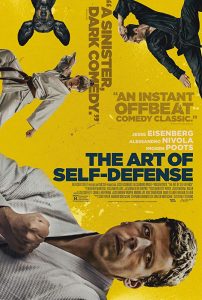
‘The Art of Self-Defense’ warns about the perils of fanaticism
“The Art of Self-Defense” (2019). Cast: Jesse Eisenberg, Alessandro Nivola, Imogen Poots, Steve Terada, Phillip Andre Botello, David Zellner, Hauke Bahr, Davey Johnson, Nicholas Hulstine, Scott Goodman, Justin Eaton. Director: Riley Stearns. Screenplay: Riley Stearns. Web site. Trailer.
Crossing the line from passion to obsession is a dangerous step. One need only look at the many high-profile examples found in our world these days. But this phenomenon is by no means limited to the events we see on the nightly news; it can crop up anywhere, even in seemingly innocuous places, a troubling subject explored in the edgy new dark comedy, “The Art of Self-Defense.”
Thirty-something office worker Casey Davies (Jesse Eisenberg) could seriously stand to grow a pair. The easily bullied milquetoast cowers in fear about nearly everything, but, considering how often and how readily he’s picked on – by virtually everyone he encounters, from co-workers to coffee house patrons to strangers in parking lots – his reaction is understandable. And what’s worse is that he keeps taking it. But that all changes one night; while walking home after running out to buy dog food for his pet dachshund, he’s mugged by a renegade motorcycle gang, leaving him seriously injured.
[caption id="attachment_10880" align="aligncenter" width="300"] Frequently bullied office worker Casey Davies (Jesse Eisenberg, foreground) decides to learn how to protect himself by enrolling in karate school, a move that gets him more than he bargained for, as seen in the new dark comedy, “The Art of Self-Defense.” Photo courtesy of Bleecker Street.[/caption]
While recuperating, Casey decides he needs to do something to protect himself. He opts to buy a handgun, but, as he fills out the background check paperwork, he begins having reservations. He leaves the store ambivalent about the idea and goes for a walk, stumbling upon a karate studio. He enters and watches a class in session – and is instantly captivated.
When class is over, Casey approaches the dojo’s ultra-cool Sensei (Alessandro Nivola), expressing a keen interest in learning the ancient art. He professes that he wants to become one of the people who routinely taunt him, a revelation that prompts the Sensei to assertively court the wannabe student. Casey eagerly agrees to enroll, but with no idea of what he’s about to get himself into.
To say more would reveal too much, but suffice it to say that Casey is steadily overwhelmed by his circumstances. While he appears to have quite a knack for karate – a proficiency that empowers the new student and impresses the Sensei – he soon finds himself embroiled in a dark and sinister situation. The uber-masculine, quasi-misogynistic, testosterone-dripping Sensei carries his attitude, practices and instruction more than a little too far, leading the gullible, impressionable Casey down some very questionable paths involving his personal behavior, his professional life and his home life. A macabre and tangled web of deception gradually emerges involving an off-limits equipment room, a female brown belt instructor regularly passed over for advancement to black belt (Imogen Poots) and the aforementioned motorcycle gang. And, as the story unfolds, Casey has a lot more to worry about than just protecting himself from being bullied.
[caption id="attachment_10881" align="aligncenter" width="300"]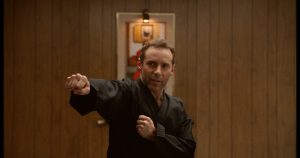 The enigmatic Sensei (Alessandro Nivola) of a karate studio practices more than a few unconventional tactics in the offbeat new dark comedy, “The Art of Self-Defense.” Photo courtesy of Bleecker Street.[/caption]
Most of us would agree that there’s nothing wrong with being passionate about something, be it a hobby, a sport or some other innocent endeavor. But, when we carry things too far, when we venture into the realm of fanaticism, we could face a number of problems, some potentially serious. That can be compounded, too, if we drag others along with us, spreading the possibility of pain and anguish to unwitting accomplices.
But how do such matters get out of hand? In essence, it comes down to how we view these undertakings and what we come to believe about them. There can be a fine distinction between diversion and obsession. But, in both cases, they’re fueled by the power of the beliefs that underlie them. And that is what ultimately makes things materialize as they do, a consequence of the conscious creation process, the philosophy that maintains we manifest the reality we experience through the power of our thoughts, beliefs and intents.
In a situation like the one portrayed here, one might wonder how a fervent but benign interest in martial arts can transform into something much more menacing. To understand this, we need to look not only at the beliefs driving the interest in karate, but also any associated beliefs related to it – its defining characteristics, its intended purpose, how and why we put it to use, and so forth, the particular traits that come to distinguish how each of us practices the sport and for what reasons. On the surface, it all may just look like karate, but, upon closer examination, we might see one person practicing a competitive activity while someone else is engaged in something clandestine with a frightening agenda. And, when scenarios like the latter one take root, we run the risk of fanaticism taking over.
[caption id="attachment_10882" align="aligncenter" width="300"]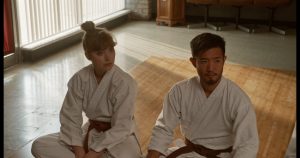 Brown belt karate instructor Anna (Imogen Poots, left) regularly gets passed over for elevation to black belt status, a source of frustration for the accomplished practitioner, as seen in the absurdist dark comedy, “The Art of Self-Defense.” Photo courtesy of Bleecker Street.[/caption]
As this story plays out, viewers witness the Sensei’s true nature emerge. It becomes apparent that he’s not teaching a noble martial art but, rather, preaching a gospel of intimidating hyper-masculinity, modestly tinged with veiled homoeroticism and an undeniable hostility toward weakness or anything feminine. These ancillary aspects of his own particular brand of instruction are far from the traditional teachings of the ancient masters, yet there they are, firmly rooted in his class sessions, fanatical lessons that he seeks to pass along to his students.
This naturally begs the question, “Why?” In the conscious creation treatise The Individual and the Nature of Mass Events, author Jane Roberts explains that fanaticism often arises from experiences in which an individual believes in a need to make a point while simultaneously attempting to make up for personal failings, frequently by overcompensating in the process. When applying that principle to the Sensei’s efforts at extolling his macho, chauvinistic dogma, it’s not too hard to figure out where the “inspiration” for his current actions may have come from. And the fact that his teachings focus more on punishing one’s enemies rather than practicing self-defense speaks volumes. Whatever experiences he may have had that prompted these beliefs, they were obviously significant enough to establish intents that have become firmly entrenched and are now freely materializing, questionable though they may be.
Given Casey’s personal experiences, it’s not too difficult to imagine how he might be intrigued by the Sensei’s charisma. In many ways, the Sensei is who Casey wants to be – at least initially. However, when he begins to see the Sensei for who he really is, he realizes that he may be dealing with yet another bully, especially as the nefarious nature of his schemes is revealed. How Casey responds to this scenario is his new challenge, and that response will depend on his beliefs. Can he succeed at becoming who he claims he wants to be?
[caption id="attachment_10883" align="aligncenter" width="300"]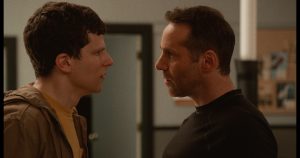 As the relationship between karate student Casey Davies (Jesse Eisenberg, left) and his Sensei (Alessandro Nivola, right) becomes strained, the tension between them grows significantly as seen in “The Art of Self-Defense.” Photo courtesy of Bleecker Street.[/caption]
Interestingly, while the film focuses on the relationship of the two principals, in many regards the story is a microcosmic metaphor for the wider world. Given the current sociopolitical situation of the nation (some might say the entire world), many of us are being intimidated, or even attacked, by a plethora of bullies. Those doling out the threats and injuries are not unlike the Sensei, a chilling symbol representative of the individuals and institutions who are trying to put us under their thumbs. Will we succumb to the pressure? Or do we believe in ourselves enough to rise to the occasion, even if it means having to take on those who falsely claim they want to help us? That’s a tall order, for sure, but, as Casey discovers for himself, that may be just what we need to do, too. Ironically, he may end up being an unlikely role model not only for himself, but also for the rest of us.
Of course, everything depends on whether we believe we can accomplish our aspirations. That goes for Casey, as well as the rest of us. If we look deeply enough, though, there’s a good chance we’ll find the inner strength and fortitude needed to realize those goals – provided we give them a chance to reveal themselves. Along the way, though, we must also heed the message of this cautionary tale and keep ourselves from employing the same kinds of tactics in taking on the fanaticism that confronts us.
This rivetingly funny but edgy dark comedy, reminiscent of “Fight Club” (1999), is certain to make viewers both laugh – and squirm – in their seats. Eisenberg and Nivola are perfect foils for one another, each turning in fine performances in which they serve up ample helpings of neuroticism and creepiness in their respective roles, an intriguing combination that never disappoints. The picture’s extensive use of deadpan humor evokes frequent unexpected laughs, getting plenty of mileage out of intrinsically absurd situations and not having to rely on one-liners alone. The film admittedly has a few plot holes and requires leaps in believability along the way, but they also add to the somewhat surreal quality of this satire, which doubles as both an intriguing story of its own and a less-than-veiled social-political commentary. Director Riley Stearns’s second feature offering is definitely one of the funniest, strangest and most decidedly twisted offerings of the year.
No one likes bullies, but, in facing them down, we must be careful not to inadvertently become who we oppose. This calls upon us to take a good, hard look at the beliefs – all of them – that play a role in a venture like this. We don’t want to fall prey to that which we detest. That calls for us to get creative in our approaches to addressing these matters, using whatever we have at our disposal, including in unheard-of ways, forms of self-defense that truly are an art.
Copyright © 2019, by Brent Marchant. All rights reserved.
Tuesday, August 6, 2019
This Week in Movies with Meaning


Tune in for The Cinema Scribe
Tune in for the latest Cinema Scribe segment on Bring Me 2 Life Radio, Tuesday, August 6, at 2 pm ET, available by clicking here. And, if you don't hear it live, catch it later on demand!
Monday, August 5, 2019
‘The Farewell’ explores how to arrive at the best outcome
“The Farewell” (2019). Cast: Awkwafina, Shuzhen Zhou, Diana Lin, Tzi Ma, Han Chen, Aoi Mizuhara, Yongbo Jiang, Lu Hong. Director: Lulu Wang. Screenplay: Lulu Wang. Web site. Trailer.
When it comes to caring for the well-being of others, is total honesty necessarily the best policy? Isn’t it possible that there could be something to be said for “blissful ignorance?” But then isn’t it unconscionable to intentionally leave someone in the dark? These are thorny questions, much of which depends on one’s perspective, both individually and as part of a collective, issues that are among those addressed in the touching new comedy-drama, “The Farewell.”
Grad student Billi Wang (Awkwafina) leads a full life In New York. While anxiously awaiting word on a fellowship application, the Chinese-born émigré and would-be writer spends much of her time trying to figure out how to make ends meet, a challenging task to be sure. And, when not looking for ways to keep her head above water financially, she visits with friends and her parents, Jian, her mother (Diana Lin), and Haiyan, her father (Tzi Ma), who brought the family to America more than 20 years ago when he landed a translator’s job.
As much as Billi tries to stay upbeat, however, she’s pressed to remain positive when she learns she’s been turned down for the fellowship. And, if that weren’t enough, she receives more bad news when she visits her parents. Word has come from China that the family matriarch, Billi’s grandmother, Nai Nai (Shuzhen Zhou), has been diagnosed with Stage 4 lung cancer. Needless to say, Billi is devastated by the news. She adores her grandmother, particularly for the words of love and encouragement she routinely doles out during their frequent phone conversations.
But Billi is even more upset by some additional disturbing news: She learns from her parents that the extended family has no plans to inform Nai Nai about the severity of her condition. It’s a practice commonly employed by relatives with terminally ill patients in China, a belief based on the notion that there’s no point in unduly burdening the dying, particularly those in otherwise-good spirits. The thinking goes, “Why spoil their mood, especially if they have little time left?”
The family thus intends to keep Nai Nai in the dark, a plan that Billi has major problems with. Having spent most of her life in the U.S., she’s accustomed to Western ways, including full disclosure under such circumstances. Her protests are dismissed, though, her parents insisting that she’s not say a word to Nai Nai. They explain to her that their plan is the Eastern way, one that Nai Nai herself used when she learned that her husband was dying years earlier. Billi’s told that she’s expected to comply, given that all of the other members of the extended family have agreed to go along with it.
Billi also learns that the plan will get put to the test at an upcoming family gathering. Billi’s cousin, Hao Hao (Han Chen), who lives with his family in Japan, recently announced his engagement to his fiancée, Aiko (Aoi Mizuhara). They decided to marry in China, using the occasion as a front for a reunion that will likely double as a veiled farewell to Nai Nai. Everyone will be in on the secret except, of course, the guest of honor, who has been carefully conditioned to suspect nothing, leading her to believe that she’s in perfect health, that all of her recent medical test results came back as benign.
Unsure how she’ll hold up under this pretense, Billi has reservations about the cover story – and whether she’ll be able to go along with it. It’s something the family has anticipated, too. No sooner does Billi express her concerns when Jian and Haiyan tell her that they don’t want her to attend the reunion, fearful that she’ll crack under the pressure and let something slip. Given her love for Nai Nai, though, she disregards the request and makes the trip, albeit with great trepidation.
When Billi arrives in the family home of Changchun, everyone is astounded to see her. Haiyan, Jian, Hao Hao and Aiko, along with Billi’s uncle, Haibin (Yongbo Jiang), and grandma’s younger sister, Little Nai Nai (Lu Hong), are shocked when the unexpected guest arrives. They’re all worried enough that they will not be able to keep up a good front, but now they have concern that their Americanized relative will be able to keep mum, too.
The one most perplexed by this, of course, is Nai Nai herself. Unaware that anything is going on, she’s her usual cheerful self. She’s pleased that the whole family is together again, something that hasn’t happened for a long time. And she eagerly goes about planning the wedding reception, paying close attention to every last little detail. But, at the same time, she senses something may be amiss – the long faces and melancholy moods of her relatives suggest something is wrong, even if she can’t identify specifically what.
As this scenario plays out, the family experiences a number of close calls. Little Nai Nai and brothers Haiyan and Haibin do their best to run interference, but tricky situations arise often, placing the entire plan on the verge of falling apart. And, ironically enough, Billi is seldom the cause for concern in these instances. With the wedding approaching, the family’s subsequent departure pending and Nai Nai’s health showing signs of further deterioration, it remains to be seen whether everyone will be able to successfully hold things together. The desire to say a cloaked but heartfelt farewell comes into conflict with the need to say a proper goodbye, a challenge made more difficult by emotions that are continually being amped up.
Those of us accustomed to Western ways will likely side with Billi when it comes to her view of full disclosure. The sense of staring down the truth, no matter how difficult, is undoubtedly an outgrowth of the concept of rugged individualism, a trait especially ingrained in the American psyche. The idea of tackling challenges – even those likely doomed to futile failure – permeates our “take it like a man” culture, regardless of gender.
In the East, however, it’s often a different story. Despite living in the Westernized cultures of America and Japan, much of Billi’s family still clings to the old traditions, especially those that involve collective efforts. Indeed, as Billi’s Uncle Haibin observes, in the ways of the Old World, one’s life is not necessarily one’s own, that individuals are part of a collective in which everyone is expected to participate and cooperate for the well-being of the whole, even if such efforts go against one’s personal views and particularly if they contribute to the betterment of society or the well-being of others (especially family members).
So which view is right? That’s difficult to say, since both are fundamentally governed by beliefs, the building blocks of the conscious creation process, the philosophy that maintains we draw upon these tools to manifest the reality we experience. And, since conscious creation makes essentially anything possible, there’s no single answer that is intrinsically right or wrong. For those of us in the West, the individualistic perspective is most likely preferred, while Easterners may invariably opt for the collective view, regardless of what issue is up for consideration. Neither is inherently right or wrong; they’re just different, and each is made equally possible by the manifestation process.
No doubt adherents to each view will argue in favor of his or her perspective, and each would likely make good cases for the beliefs that underlie their outlooks. A Western individualist, for instance, might say that disclosure would provide a terminally ill patient with the knowledge to decide how he or she wants to spend whatever time is left, be it for getting affairs in order, saying what needs to be said to loved ones or even fulfilling items on a bucket list. At the same time, someone with an Eastern perspective who believes in sparing someone’s feelings might contend that such knowledge could be unduly deflating, plunging a dying individual prematurely into the depths of despair and ruining whatever time is left, perhaps even derailing any efforts aimed at fulfilling the foregoing goals.
By contrast, those who believe in shielding the infirmed might argue that this practice can help preserve the attitudes of those with a positive mood, a particularly valuable asset for those looking to make the most of their lives, regardless of whether or not they’re aware of how much time they have left. Indeed, some might say, “Why upset Grandma if she’s enjoying herself? Maybe her happiness will prolong her time with us.” However, the devil’s advocates out there could say this is akin to a cruel, patronizing joke, one in which condescension is the impetus behind such efforts. Such opponents might claim that this is essentially saying “There, there, don’t worry, you’re going to live forever anyway.”
As these examples illustrate, there are good arguments – and reservations – on both sides, and each have their own particular validity. We should remember, though, that the affected individual has his or her own say in the matter as well; after all, we each create our own reality, and our own belief input will ultimately be most determinative. We will be the ones who determine our outcomes, so our own beliefs will carry the greatest weight. One need only look to Nai Nai’s belief in her perfect health to see how it not only affects her attitude, but also her physical constitution. For someone with Stage 4 lung cancer, she certainly seems remarkably vital, a result that undoubtedly arises from her resolute belief in that notion.
However, this is not to suggest that “outside” input won’t factor into matters. The impressions they leave on us will invariably help to shape our beliefs. So, if we hope to impact the intents of others, we had better make sure we’re sincere in our efforts, for others may well sense its absence. This becomes apparent, for instance, when Nai Nai questions the long faces and somber attitudes of her family members at what should be a happy occasion. If the integrity required to make this believability work is absent, all bets could be off.
This scenario also provides an intriguing look at co-creation, where our collective efforts combine to bring about a particular result, no matter what contributions we each make toward realizing the eventual outcome. There’s naturally the group effort put forth by the extended family, all of whom are working toward what they believe are Nai Nai’s best interests. And then there’s the matriarch’s own individual endeavors, most of which would fundamentally seem to mirror the intents of her relatives, even if driven by a different set of manifesting beliefs. In sum, though, they’re all working toward Nai Nai enjoying a happy and fulfilling life, no matter how much time she may have, and, in the end, that’s what really counts. With that at work, we may even surprise ourselves at just how much success we can achieve.
Director Lulu Wang’s excellent comedy-drama about how to handle an impending family tragedy is one of the most capably made, thoroughly satisfying films of this or any other year. With excellent performances by Awkwafina and Shenzhen Zhou and a superb, smartly written script, the picture takes viewers on an emotional rollercoaster, from laughter to tears to heartfelt warmth and back again. There’s so much to like here that it’s difficult to get one’s hands around everything it has to offer. Let’s hope this one is remembered come awards season.
Billed as being “based on an actual lie,” “The Farewell” presents a thoughtful look at difficult and touchy questions, many of whose answers might not be as definitive or clear-cut as many of us would like to believe. It gives us much to ponder, not only for circumstances like this, but also in realizing that there may be multiple approaches available for addressing any kind of difficult situation. By taking a reasoned, open-minded approach to such scenarios, we may find we have a variety of options open to us to arrive at the best, most satisfying outcomes, and who could argue with that?
Copyright © 2019, by Brent Marchant. All rights reserved.