“Beatriz at Dinner” (2017). Cast: Salma Hayek, John Lithgow, Connie Britton, David Warshofsky, Amy Landecker, Jay Duplass, Chloë Sevigny, John Early, Enrique Castillo. Director: Miguel Arteta. Screenplay: Mike White. Web site. Trailer.
Some say that, fundamentally, we’re all connected, even if we don’t realize it. In an age and in a society in which seemingly inherent division and separation are taken for the norm, we may not be aware of our interrelatedness, perhaps even denying it when others attempt to point it out to us. But, if we’re ever to resolve this misguided sense of disconnectedness, we need to be reminded – perhaps even cajoled – about our innate linkage. Examples of such reminders surface in highly pointed ways in the new, dark, sociopolitical satire, “Beatriz at Dinner.”
Healer and massage therapist Beatriz (Salma Hayek) gives her all to her patients. She freely offers up her ample compassion to others, spontaneously hugging everyone she meets, be they clients, strangers or the pets she so lovingly adores. But, when it comes to the fulfillment of her own needs, she’s totally without demands or expectations, willingly deferring to whatever others have to give and gratefully expressing her thanks for their offerings.
Beatriz sincerely appreciates whatever blessings come her way. Having emigrated to California after growing up under harsh conditions in Mexico, she’s thankful for her current life, which accounts for the boundless generosity she readily dispenses. She’s highly adept at bestowing her therapeutic gifts, something she believes is essential for healing not only her charges but also a planet much in need of such restitution. She sees it as essential for a world whose disconnected residents must overcome their sense of isolation to realize that they’re all part of a larger, integrated whole. That’s difficult, however, when others don’t share that view, as Beatriz is about to discover when she’s unexpectedly extended an invitation to an upscale social event.
Healer and massage therapist Beatriz (Salma Hayek) feels somewhat out of place when invited to an upscale dinner party by one of her clients in the new dark satire, “Beatriz at Dinner.” Photo by Lacey Terrell, courtesy of Roadside Attractions.
While on a house call to massage one of her regulars, wealthy Newport Beach socialite Kathy (Connie Britton), Beatriz experiences car trouble, effectively stranding her at her client’s estate. Beatriz is flustered, but Kathy comes to her aid, offering her assistance, including dinner and even a place to stay for the night if needed. Dinner, however, is more than just a casual meal; it’s a high-brow, elegant dinner party thrown by Kathy and her husband, Grant (David Warshofsky), to celebrate the closing of a lucrative business deal. However, because of differences in class, social standing, background and outlooks, Grant is concerned that Beatriz will be out of her element, even suggesting that she should eat by herself, away from the festivities. But Kathy insists that Beatriz be allowed to attend given everything that she has done for her and her family, including lovingly caring for their teenage daughter when she successfully battled cancer.
After the guests arrive, however, Grant’s apprehensions would seem to be borne out. Those in attendance include high-powered hotel developer Doug Strutt (John Lithgow) and his trophy wife, Jeana (Amy Landecker), and Grant’s attorney, Alex (Jay Duplass), and his ambitious spouse, Shannon (Chloë Sevigny). And, of course, there’s Beatriz, who’s often ignored or mistaken as one of the help by the other guests. Ever the gracious hostess, Kathy does her best to make sure Beatriz feels welcome and included in the conversation. But, given her vastly different background and sensibilities, the unexpected dinner guest quickly feels out of place, despite her valiant efforts to fit in.
High-powered hotel developer Doug Strutt (John Lithgow) brags about his success and many dubious accomplishments in the new sociopolitical satire, “Beatriz at Dinner.” Photo by Lacey Terrell, courtesy of Roadside Attractions.
As dinner progresses, the differences Grant was concerned about begin to surface, with the event gradually turning into a battle of wits between the haves and have-nots. For example, in crassly boasting about his accomplishments and the sometimes-drastic measures necessary to bring them into being, Doug manages to offend Beatriz at every turn, especially when she suspects that he may have been responsible for some of her own past hardships. She does her level best to express her views about the need to take a holistic approach to life and community, but she’s summarily rebuffed before she’s able to fully explain her viewpoint. With the ante perpetually amped, tensions continually rise, eventually making the event anything but a party.
The dinner thus becomes a microcosm of the current state of our culture, with implications that have impact socially, politically and economically. It aptly reflects the animosity that exists at the opposite ends of these spectra, providing us with a clear reflection of where we’re at, one that’s sure to make many of us squirm uncomfortably in our seats. It also raises ideas about how to respond to these circumstances: Do we give in to violence and revenge? Or do we pursue alternative paths, courses aimed at promoting healing and helping to bring about a much-needed sense of reconnection? In doing so, the film shines a bright light on our power of choice, how we might consider employing it and what it means for all of us based on the options we select.
To celebrate the closing of a lucrative business deal, high-powered hotel developer Doug Strutt (John Lithgow, right) shares the moment with his trophy wife, Jeana (Amy Landecker, second from right), along with his business partner, Grant (David Warshofsky, left), and his wife, Kathy (Connie Britton, second from left), in “Beatriz at Dinner.” Photo by Lacey Terrell, courtesy of Roadside Attractions.
Most importantly, however, the film draws attention to our lost sense of connectedness, one of the guiding principles in conscious creation practice, the philosophy that maintains we manifest the reality we experience through the power of our thoughts, beliefs and intents. Our prevailing failure to recognize this, supported by entrenched beliefs that perpetuate it, place us in an increasingly precarious position in numerous ways, an argument that Beatriz desperately seeks to put forth to the assembled guests. Unfortunately, her message falls largely on deaf ears, and even those who are paying attention offer little more than lip service.
Interestingly, several of the guests, like Doug, recognize that we truly manifest our own destiny, that we’re the ones responsible for bringing what we experience into being. But how we direct the focus of our beliefs determines what results. Most of those present have chosen to employ this practice for personal gain and wholly self-serving ends. They pay little heed to the needs of the collective, sometimes even inflicting harm on others if that’s what it takes to get what they want. Some would call that disgraceful, but, then, that shouldn’t come as any surprise for those who fundamentally fail to recognize our intrinsic connectedness or to formulate beliefs that support such a notion.
Needless to say, this leaves Beatriz frustrated. What is she to do to get the blind to see? If she adopts beliefs that call for drastic, forceful measures, is she really any different from those whose actions and viewpoints she so thoroughly loathes? But, if she does nothing, she’s not doing anything meaningful to rectify the prevailing circumstances, either. So what’s the answer?
Whenever we face conditions like this, if we want to come up with an effective solution, we must do precisely what this materialization philosophy calls for – getting creative. We need to think in terms that we’re unaccustomed to, searching for and then envisioning possibilities we may have never tried or even considered. Some of those options might seem a bit extreme compared to what we’ve typically done, perhaps even calling for acts of self-sacrifice. But, if they help to get us the results we seek, we should give them serious consideration, especially when it comes to such crucial issues as reshaping the paradigm that promotes our awareness and adoption of our inherent unity. And, given the potent force that Beatriz is, she just might come up with what we all need to achieve that goal.
Healer and massage therapist Beatriz (Salma Hayek, second from right) feels somewhat out of place at an upscale dinner party hosted by one of her clients, Kathy (Connie Britton, left), along with her well-to-do guests Shannon (Chloë Sevigny, second from left) and Jeana (Amy Landecker, right), in the new dark satire, “Beatriz at Dinner.” Photo by Lacey Terrell, courtesy of Roadside Attractions.
At times brilliant, at times frustrating, “Beatriz at Dinner” gives viewers much to ponder both practically and metaphysically, a rare fusion for a film these days. This dark, satirical comedy-drama also manages to maintain a fair amount of suspense at an event that would seem an unlikely setting for such a narrative quality. (Who would have thought that a dinner party would give us so much to think about?) Hayek gives one of the year’s best lead actress performances thus far, more than adequately backed by a superb ensemble of supporting players, especially Lithgow. Admittedly, it’s a little disappointing that the film draws upon a plot device that’s been used before to wrap things up, even if it’s employed in a way not previously seen. But, this disappointment aside, “Beatriz at Dinner” gives us much to think about at a critical juncture in our country’s – and our reality’s – history.
Losing sight of our innate bonds to everyone and everything is something we do at our peril. Thankfully, though, there are souls like Beatriz to remind us of this and the need to restore our awareness of it. It’s a message we’d be wise to take seriously lest we pay a high price for our own willful ignorance.
Copyright © 2017, by Brent Marchant. All rights reserved.
Thursday, June 29, 2017
Wednesday, June 28, 2017
This Week in Movies with Meaning
Reviews of "Beatriz at Dinner," "Maudie" and "The Family Fang" are all in the latest Movies with Meaning post on the web site of The Good Radio Network, available by clicking here.
Tuesday, June 27, 2017
‘Tanna’ meditates on the power of love
“Tanna” (2015 production, 2016 release). Cast: Mungau Dain, Marie Wawa, Marceline Rofit, Charlie Kahla, Albi Nagia, Lingai Kowia, Dadwa Mungau, Linette Yowayin, Kapan Cook, Mungau Yokay, Mikum Tainakou. Directors: Martin Butler and Bentley Dean. Screenplay: Martin Butler, John Collee and Bentley Dean. Web site. Trailer.
Who we love is something we should be able to decide for ourselves, but it hasn’t always been that way, especially in many of the world’s traditions-based cultures. With arranged marriages the norm – relationships frequently driven by considerations having nothing to do with love – those who choose to step outside that custom engage in what’s looked upon as radical or even taboo. But, given the power of love, sometimes even tradition can’t withstand such pressure. What it means to take such a drastic step – and the consequences that come from it – provide the focus of the fact-based, Oscar-nominated romance, “Tanna,” now available on DVD, Blu-ray disk and video on demand.
On the Melanesian island of Tanna in the remote Pacific nation of Vanuatu, time seems to have stood still. The ancient tribal nature of the local culture continues to thrive to this day, one of the few places in the world where such a way of life has managed to persist. And, for the Yakel people of this South Seas island, these longstanding traditions apparently suit them just fine. But, in the late 1980s, those customs were called into question when it came to a fundamental aspect of life – marriage.
Having long practiced the tradition of arranged partnerships, tribal members learned to live with it, hoping that love would eventually emerge out of such arrangements, even if it wasn’t present at the outset. Such predetermined relationships generally had little to do with romance and everything to do with practicality. They were often set up to settle disputes between combative clans, a means of imposing peace by a bond of blood.
The forbidden relationship of Wawa (Marie Wawa, left) and Dain (Mungau Dain, right) threatens the peace among two rival tribes in the Oscar-nominated romance, “Tanna.” Photo courtesy of Lightyear Entertainment.
So it is in the film, when a young woman, Wawa (Marie Wawa), is offered up by her tribe to Kapan (Kapan Cook), a member of a rival faction, as a means to promote peace between the two groups. The tribes’ chiefs (Mungau Yokay, Mikum Tainakou) agree to the arrangement and are apparently happy with the plan. But no one ever bothers to ask Wawa, who is deeply in love with Dain (Mungau Dain), a member of her own tribe. And that’s a problem.
As plans proceed to hand over Wawa to her new husband, she’s plainly unenthused, showing little interest in the idea, an attitude that concerns her parents (Lingai Kowia, Linette Yowayin) and grandmother (Dadwa Mungau), particularly when she reveals the reason for her indifference. They tell her that they sympathize but insist that she carry through with her responsibility, given the stakes involved. But that pressure has little effect, especially when she quietly disappears for a tryst with Dain, a gesture that she’s convinced will so offend Kapan that he’ll summarily reject her when he hears of her allegedly disgraceful act. But, in the interest of preserving the agreement, Wawa’s family and her tribe’s leaders seek to keep that incident secret. And, to add an extra level of insurance, they banish Dain from the tribe. What they don’t count on, however, is Wawa disappearing, too, to follow her man – and her heart.
Those who dare question the status quo often open themselves up to serious scrutiny and dire consequences. However, sometimes those risks must be endured to follow what we know is right. Coming up with the means to make such situations work out is the aim of the conscious creation process, the philosophy that maintains we manifest the reality we experience through the power of our thoughts, beliefs and intents. And, in a context as highly personal and intimate as this one, the desire to succeed is often strong. But it also requires commitment, determination and a will to make it happen.
Following her heart carries serious implications for Wawa (Marie Wawa) when she’s unwittingly caught up in a conflict between two tribes in the Oscar-nominated romance, “Tanna.” Photo courtesy of Lightyear Entertainment.
In circumstances like this, we must frequently draw upon everything we’ve got in terms of our envisioning skills. By forming beliefs about what we want to achieve and the means for making it happen, we stand a good chance of making our dreams come true. This usually requires us to consider options that we’ve never entertained before or that even go beyond any tried and true methods we’re aware of. If Wawa ever hopes to be with Dain, this is something she’ll certainly need to do.
However, if we’re willing to push past those barriers, there’s no telling what we might be able to accomplish, both for ourselves and others who are similarly situated. By setting such a confident and defiant example, we can change conditions that have sweeping implications, perhaps even altering the nature of the culture itself. This is a prime example of the conscious creation notion that we’re all in a constant state of becoming, ever evolving to something new in a continual process of self-discovery.
What’s more, whenever we help to bring about such beneficial new developments, we engage in the practice of value fulfillment, the conscious creation principle associated with being our best, truest selves for the betterment of ourselves and those around us. For something as fundamental as having the freedom to choose our own significant other in a culture that has typically prohibited such a practice, that’s a radical change indeed. Those who benefit from the implementation of something as heartfelt and personal as this owe much to those who helped usher it into place.
Violating local custom carries serious consequences for a lover who follows his heart (Mungau Dain) in the Oscar-nominated romance, “Tanna,” available on DVD, Blu-ray disk and video on demand. Photo courtesy of Lightyear Entertainment.
“Tanna” clearly demonstrates what it means to be in love and the lengths we’ll go to for it. This innovative production was filmed on location on a shoestring budget with a skeleton crew and only the most basic cinematic technology. What’s more, the filmmakers drew entirely upon members of the Yakel tribe for the cast, none of whom had ever even seen a movie, let alone acted in one. Nevertheless, the result is an excellent offering reminiscent of time-honored classics like Romeo and Juliet set in a lush tropical paradise, with an array of surprisingly good performances and gorgeous cinematography. To be sure, there are times when the film plays a little like a National Geographic documentary, but, thankfully, those sequences are minimal and don’t detract from the picture’s overall quality. For its efforts, the Australian production earned a very deserving Oscar nomination for best foreign language film, whose dialogue is presented entirely in the native Nauvhal language.
Sometimes it takes a radical act to bring about change, even when it comes to something as basic as who we choose to share our lives with. Traditions can be challenged and without necessarily incurring undue consequences. But, should we attempt to stifle the heart, we may pay a heavy price, both for ourselves and the community at large. And, in that regard, the lessons of “Tanna” should serve as a potent cautionary tale to us all.
Copyright © 2017, by Brent Marchant. All rights reserved.
Thursday, June 22, 2017
‘Logan Noir’ puts purpose into focus
“Logan Noir” (2017) Cast: Hugh Jackman, Patrick Stewart, Dafne Keen, Boyd Holbrook, Stephen Merchant, Elizabeth Rodriguez, Richard E. Grant, Eriq La Salle, Elise Neal, Quincy Fouse. Director: James Mangold. Screenplay: Scott Frank, James Mangold and Michael Green. Story: James Mangold. Source Material: John Romita Sr., Len Wein, Herb Trimpe, Craig Kyle and Christopher Yost. Trailer.
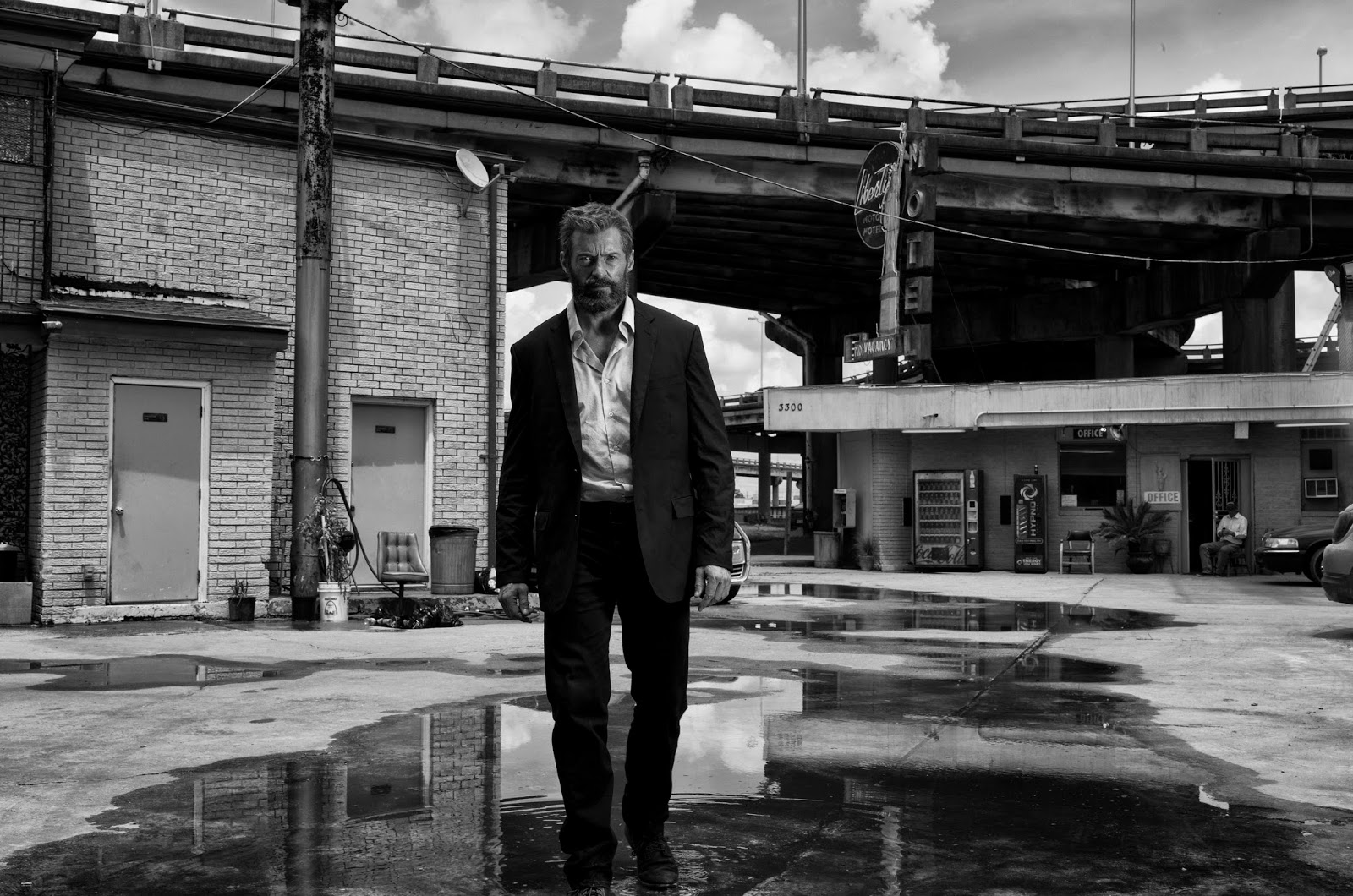
What a difference cinematography can make. Thanks to a single production change, a good movie has been elevated to a great one, a film that carries far more meaning and impact than what was conveyed in its original incarnation. Such is the case with a new, limited edition, black-and-white version of the latest offering in the Wolverine films in the wildly popular X-men franchise, “Logan Noir,” now playing in theaters.
Released in theaters earlier this year in a full-color format and now available for home viewing on DVD, Blu-ray disk and video on demand, “Logan” (web site) is the latest – and last – film in this X-men spinoff series featuring its original protagonist (Hugh Jackman) and his wise though sometimes-challenged mentor (Patrick Stewart). Even though it’s part of an ongoing series, the movie stands alone well enough so that viewers need not have seen previous installments to follow the story in this offering. And now that it’s been released in this special black-and-white version, “Logan Noir” has taken its inspiring, moving narrative to a whole new level.
Logan (a.k.a. Wolverine) (Hugh Jackman), one of the original mutant X-men, faces the greatest challenge of his life as a superhero in a special, limited edition, black-and-white version of the latest film in this popular franchise, “Logan Noir,” now playing in theaters. Photo by James Mangold, courtesy of Twentieth Century Fox Film Corporation.
Set in 2029, the film follows the life of an aging Logan (a.k.a. Wolverine) (Jackman), one of the original mutant X-men, whose steely claws have handily done in more than a few villains. With the mutant population diminished and his glory days behind him, he’s largely retreated from his superhero ways, now spending his days as a limousine operator for a ride service. His health is obviously failing, a condition made worse by his binge drinking and other unhealthy habits. But, despite these circumstances, he still manages to care for his elderly mentor, Prof. Charles Xavier (Stewart), who’s also suffering from his share of health and psychological maladies. Logan hopes to raise enough money from his work to buy a yacht on which he and Charles can quietly sail away into the sunset. But those hopes dim when conditions change that call him back to his old life, something he thought he had left behind for good.
When approached for help by a desperate woman, Gabriela (Elizabeth Rodriguez), and a child she claims is her young daughter, Laura (Dafne Keen), both of whom appear to be on the run from unseen but menacing forces, Logan tries to shrug off their request. But, when circumstances quickly go south, he finds he can’t turn his back on them, especially when Charles advises him that he has been envisioning the young girl’s appearance. He insists that, as part of a new generation of specially gifted mutants, Laura must be saved from the evildoers pursuing her, making it possible for her talents to grow and flourish. And, when those nefarious forces confront the unlikely trio of Logan, Charles and Laura, they’re forced to flee, hitting the road for a mysterious sanctuary known as Eden.
While traveling north from Texas toward the Canadian border, a number of revelations emerge about Laura’s background and her previously unknown connection to Logan. At the same time, a number of troubling developments occur related to the health of her two protectors. And, all along the way, Logan, Charles and Laura face new challenges from those who would rather not see them succeed.
As the story plays out, viewers witness a number of incredible transformations. Logan, for example, initially allows his cynical, embittered, self-absorbed side to govern his actions, qualities that gradually vanish as he lets his noble self resurface. Laura, meanwhile, evolves from a belligerent, uncontrollable wild child to a more disciplined, compassionate soul who learns when it’s appropriate – and when it’s not – to let loose with her special gifts. A new sense of maturity and purpose slowly emerges from both of them, traits that serve them well as they resolve to live out their destinies, recognizing that their higher callings are far more important than fulfilling any personal aspirations.
In embracing these new undertakings, Logan, Charles and Laura begin making effective use of their conscious creations skills, the means by which they manifest the reality they experience through the power of their thoughts, beliefs and intents. This is particularly true when it comes the practice of their value fulfillment, the principle associated with using our beliefs to create an existence that enables us to be our best, truest selves for the benefit of ourselves and those around us. There’s a tremendous degree of nobility and purpose behind this concept, an embodiment of the destiny that we’re each meant to fulfill in life.
While the foregoing themes are certainly present in the picture’s originally released full-color version, the noir filmmaking style greatly accentuates them. The stark contrast afforded by the film’s black-and-white treatment gives the story a significantly heightened sense of drama, an urgency and importance that the full-color edition simply doesn’t capture as effectively. In essence, it takes an entertaining bubble gum action-adventure and effectively elevates it to the level of a serious screen drama. But, then, that’s what the noir approach helps to make possible, especially when it’s applied to a narrative well suited to it, as is the case here.
With his characteristic claws exposed, Logan (a.k.a. Wolverine) (Hugh Jackman), one of the original mutant X-men, prepares to do battle with forces whose unspeakable plans threaten the future of the planet in a special, limited edition, black-and-white version of the latest film in this popular franchise, “Logan Noir,” now playing in theaters. Photo by Ben Rothstein, © 2017 Marvel and © 2017 Twentieth Century Fox Film Corporation.
In my opinion, this is the version of “Logan” that should have originally been released. In addition to the aforementioned attributes, the noir approach makes the landscape shots positively gorgeous (a la Ansel Adams) and adds depth and dimension to the performances of Jackman, Stewart and Keen that weren’t previously apparent, taking them beyond being stars in a superhero movie and making them actors in a film worthy of note. It also magnifies the epic quality of this particular story within the context of the Wolverine mythology, given that this is the last installment in the series. That’s quite an accomplishment achieved with such a simple change in production. Admittedly, like the originally released version, the film still drags a bit in the middle, and some of the violence borders on being a tad gratuitous for sensitive viewers, but, these shortcomings aside, “Logan Noir” is truly a film worth seeing, not only for action-adventure fans, but also for cinema lovers of all stripes.
Living out one’s destiny is dramatic enough in itself. But, when the story behind that accomplishment is given the kind of treatment that elevates it to the level of legend, its impact is allowed to come through in all its magnificence. So it is with this special edition of the concluding segment in this cinema series. And, personally, I can’t think of a more fitting and more emotive way of finishing it off.
Copyright © 2017, by Brent Marchant. All rights reserved.
Wednesday, June 21, 2017
This Week in Movies with Meaning
Reviews of "Logan Noir" and "Florence Foster Jenkins" and a magazine article preview are all in the latest Movies with Meaning post on the web site of The Good Radio Network, available by clicking here.
Monday, June 19, 2017
Connecting Through the Movies
Ever feel like you were completely on your own, isolated and disconnected from everyone and everything? Yet, often within a short time after the onset of those feelings, we find ourselves comfortably connected to others. Movies help to remind us of this in those times of doubt. Find out more about our inherent sense of connection in "The Ties That Bind Us," my latest article in New Consciousness Review's Conscious Cinema series, available by clicking here and in the summer edition of the HAPI Guide, available by clicking here.
Tuesday, June 13, 2017
This Week in Movies with Meaning
Reviews of "I, Daniel Blake" and "Mia Madre" and a new movie book preview are all in the latest Movies with Meaning post on the web site of The Good Radio Network, available by clicking here.
Subscribe to:
Posts (Atom)