“Gavagai” (2016 production, 2018 release). Cast: Andreas Lust, Mikkel Gaup, Anni-Kristiina Juuso. Director: Rob Tregenza. Screenplay: Kirk Kjeldsen and Rob Tregenza. Web site. Trailer.
The road of life is full of twists and turns, many of them unexpected. How we address them is crucial, for they help to shape the individuals we become, which, in turn, further shape the lives we continue to experience. But, in the midst of the hubbub of everyday existence, sometimes we lose sight of this, thereby drawing attention to the need to consider what we hope will come out of life’s challenges. Such is the experience of a pair of unlikely traveling companions in the meditative new release, “Gavagai.”
Affluent German businessman Carsten Neuer (Andreas Lust) has a heavy burden weighing upon him. Having recently lost his wife, a translator of the works of famed Norwegian poet Tarjei Vesaas, he feels compelled to honor her memory by finishing a project she started, translating the poet’s verse from its native tongue into Chinese. Given the significant language differences, the undertaking is considered virtually impossible. However, Carsten believes that completing his late wife’s work is the best way to pay respects to her, no matter how difficult the venture might be.
To seek inspiration for this, Carsten decides to travel to rural Norway, Vesaas’s birthplace, hoping that walking in the poet’s footsteps will help to put him in a proper frame of mind for finishing this translation. However, there are a few challenges with that. Logistically speaking, the poet’s birthplace is somewhat remote, so simply getting there takes some effort. To make the journey easier, Carsten hires a guide/driver, Niko (Mikkel Gaup), to take him there. Although Niko is initially reluctant, he quickly relents when he learns of the hefty fee Carsten is willing to pay him, money that will come in handy in light of the pittance he’s earning from his business as a wildlife tour operator.
[caption id="attachment_10504" align="aligncenter" width="300"] German businessman Carsten Neuer (Andreas Lust) seeks to come to terms with his grief over the loss of his wife while on a trip to rural Norway in the thoughtful new cinematic tone poem, “Gavagai.” Photo courtesy of Shadow Distribution.[/caption]
This challenge pales in comparison to Carsten’s bigger issue – he misses his wife terribly, and his despair seriously distracts him from carrying out his mission, despite his apparent heartfelt sincerity for wanting to see it through. She’s constantly on his mind, diverting his attention from the project and keeping him from finding the peace of mind he so desperately seeks. Even being in the poet’s homeland doesn’t help to inspire him as much as he thought it would. However, his journey does evoke thoughts and images of a mystical nature, even though they’re not the sort he was expecting or hoping for. Instead of visions and insights that remind him of the author, he’s flooded with memories and apparitions of his late wife, distracting him even more and hampering his work.
To complicate matters, Carsten is quietly irritated by his guide. Niko and his client are anything but compatible. The lively, burly, affable Niko frequently tries to engage him in conversation and camaraderie, something in which the sullen Carsten has no interest. In fact, were it not for their business arrangement, Carsten would otherwise probably have nothing to do with him. But, as their journey together unfolds, it becomes apparent that they benefit from one another’s company as each of them needs a friend. Carsten can use a consoling companion to help him work through his grief, while Niko needs someone to help him come to terms with the news that his girlfriend, Mari (Anni-Kristiina Juuso), is pregnant with his child.
Through their travels together, Carsten and Niko seek to make peace with their issues – and with one another – so that they can move on in their lives. In doing so, they deal with the big issues – love, loss, life, death, friendship, maturity and the motivation to carry on under changing circumstances. The visions and insights that come to them during their journey help to provide them with the means to address these issues, both practically and philosophically. The experiences may be difficult, even painful, but they’re also transformative, helping them to realize what they need to do to get through their respective transitions.
In telling this story, director Rob Tregenza employs a quiet, meditative approach, cinematically fusing what’s going on in both the characters’ lives and minds. The imagery is complemented by narrated excerpts of Vesaas’s works, showing how the poet’s verse reflects the thoughts and impressions of the protagonists. When combined with the picture’s beautiful cinematography and its ethereal score, the film takes viewers on a vicarious metaphysical journey of their own, one designed to provoke thought and provide them with examples of how they can maneuver their way through the challenges of their own lives.
The cinematic merging of actions with underlying thoughts, as well as depictions of alternate paths of existence to the ones on which we find ourselves, makes for an inspired metaphysical tutorial. This is particularly true when it comes to illustrating the conscious creation process, the philosophy that maintains we manifest the reality we experience through the power of our thoughts, beliefs and intents. And, given that Carsten and Niko are each going through significant life changes, such instruction can be invaluable to them, as well as to those of us who are going through comparable circumstances.
Given where Carsten and Niko are at in life, they’re faced with significant changes to the lives they’ve known. They’re each trying to figure out why these alterations are happening and how they might cope with their new circumstances. And, considering the scope involved, they’re each up against formidable challenges in their attempts to move forward. But, before they proceed with developing the beliefs needed to formulate new plans, they must first come to terms with what they’re leaving behind – and believe that it is, in fact, time to let go of their old lives.
Like a butterfly emerging from a cocoon, the protagonists each struggle with their respective losses – Carsten of the passing of his beloved, Niko of the passing of his carefree days of independence – and their attempts at envisioning what lies ahead. For Carsten, this means a fresh start; he’s a relatively young man in good health and has the second half of his life ahead of him. And, as for Niko, this means finally settling down and taking responsibility for his life, especially now that his existence will be tied up in the lives of two others. Those represent significant adjustments to what they’ve known, so allowing themselves the time and space needed to accept and grow comfortable with these changes is thus crucial to let go of their pasts and turn the pages of their lives.
[caption id="attachment_10505" align="aligncenter" width="200"] The beauty of the rural Norwegian landscape provides the backdrop for two unlikely traveling companions in the meditative new release, “Gavagai.” Photo courtesy of Shadow Distribution.[/caption]
As they work through this process, they each come upon some intriguing realizations. For instance, their lives are, like the nature of the story, innately poetic. The voiceovers interspersed throughout the film illustrate this fittingly, showing how the characters’ beliefs, outlooks and actions are aptly reflected in the realities surrounding them. Is it any wonder, then, how anyone could doubt that our lives are indeed poetic representations of our minds?
Some specific elements of the story draw particular attention to this. For example, Carsten makes his journey to complete his wife’s work on a translation of Vesaas’s verse from Norwegian into Chinese, a project that that he freely acknowledges is virtually impossible. He clearly grapples with the task, reaching for words that can’t possibly do proper justice to the original sentiment. It really is the proverbial square peg and round hole conundrum. But, for Carsten, this is a quandary that he struggles with in more ways than just trying to complete a poetry translation. His quest to make the impossible possible also applies to his longing for his wife; he wants to be with her again, but it’s a quest that’s simply not achievable, no matter how much he seeks its fulfillment.
Coming to grips with the realization that certain impossibilities are genuinely unattainable is thus essential to Carsten’s odyssey of letting go and moving on. Only by accepting that fundamental truth and sincerely believing in its veracity can he make himself ready for the next chapter. The poetry project serves as a subtle but significant allegory of this notion, one based on beliefs he’s devised and must now come to understand and appreciate. This is far from easy, but it’s truly necessary to make the break he needs to move on.
Throughout all of this, the concepts of birth, death and rebirth are undeniably conspicuous in each of the protagonists’ lives, both literally and metaphorically. These big issues of life are something we seldom take the time to seriously ponder – that is, until events seemingly force our hand into doing so. Yet, given that our reality springs forth from our thoughts, beliefs and intents, these contemplative forays into our consciousness actually originate with us as well, often in the form of co-creations between us and others (in this case between Carsten and his wife, between Niko and his girlfriend, and, in its own way, between Carsten and Niko).
As we go about the business of daily life, most of us would probably just as soon not think about such matters. But, since they’re all inevitable parts of our existence, it would behoove us to take the time to give them some consideration, for how we address them in the here and now will ultimately have influence over how we experience them in the hereafter – and beyond. Getting our heads – and our beliefs – right about such issues is undoubtedly a productive use of our time, something we should make a practice of doing on occasion, and “Gavagai” serves as helpful reminder of this practice.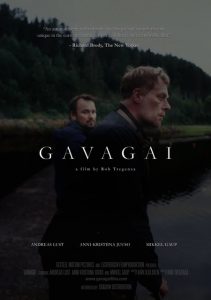
Of course, in finding meaning on such matters, we must each determine this for ourselves, given that there’s no universal, one-size-fits-all concept or explanation that applies to all of us. To assume otherwise is fruitless, and trying to make it happen in life (and death) is akin to what Carsten and his wife have attempted to undertake in their poetry translation. The inherent inscrutability in such ventures – be it in explaining the meaning of life or translating something from one language to another – is at the heart of what “gavagai” means, both as a made-up word from a nonexistent language and in the central message of this film. But, then, as conscious creators are well aware, finding our own meaning through our own beliefs is also at the heart of what it takes to manifest our individual realities and what constitutes them.
If it’s not apparent by now, “Gavagai” is not a picture to be viewed casually. Director Tregenza’s ambitious attempt at getting a handle on such heady issues as these is certainly commendable. Telling a meditative tale of life, love, death, loss, friendship and carrying on in the context of a road trip buddy movie in the wilds of the Norwegian countryside is certainly inventive, one that in many ways is reminiscent of the thoughtful cinematic tone poem “Columbus” (2017). However, the film’s sometimes-cryptic narrative and cinematography weave a story that often feels padded and somewhat underdeveloped. Nice sentiments and heartfelt emotions permeate the film, but sometimes they’re depicted through photographic sequences that would benefit from some much-needed editing to make them more manageable -- and meaningful. Enjoy this one as much as you can, and take time to appreciate the thoughtfulness it encourages in each of us, but don’t be surprised if it also starts to try your patience after a while.
Life goes by fast, sometimes a lot more quickly than we realize. Needless to say, it’s a precious resource we should never squander, one that we should appreciate and make the most of. But, to do that, sometimes we need to stop and take some time to assess it – what’s happened, what we’d like to happen and where we’re going. Periodically giving thought to the big issues that shape it, particularly the bookends that define it, would be in our best interests. Indeed, we should hope that, by doing so, we can avoid that regretful outcome of which Pink Floyd once sang so eloquently, “The time is gone, the song is over. Thought I’d something more to say.”
Copyright © 2019, by Brent Marchant. All rights reserved.


Monday, February 11, 2019
‘Gavagai’ thoughtfully examines life’s big issues


Thursday, February 7, 2019
Who Will Win This Year’s Oscars?
It’s that time of year again – time for my predictions of the winners at the upcoming annual Academy Awards. Handicapping this year’s winners has been a little more difficult than usual, since there don’t appear to be any clear-cut front runners in several categories, and the nominees in many of the contests leading up to the Oscars have been inconsistent at best. Nevertheless, with that said, here are my picks for who will likely take home statues in the top six categories this year:
Best Actor
[caption id="attachment_10269" align="alignnone" width="300"]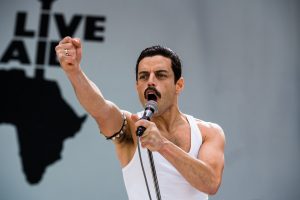 Oscar nominee portrays Rami Malek portrays Freddie Mercuty, lead singer of the legendary rock band Queen, in “Bohemian Rhapsody.” Photo by Alex Bailey @ 2018 Twentieth Century Fox Film Corporation.[/caption]
The Field: Christian Bale, “Vice”; Bradley Cooper, “A Star Is Born”; Willem Dafoe, “At Eternity’s Gate”; Rami Malek, “Bohemian Rhapsody”; Vigo Mortensen, “Green Book”
Who Will Likely Win: Rami Malek. This is one of the more difficult categories to call, since most of the awards bestowed in the run-up to the Oscars have been split between Malek and Christian Bale for “Vice” (and it’s not inconceivable that Bale could walk away with the statue on Oscar night). Both actors are portraying real-life characters, which stands them in good stead with Academy voters, since they usually cast their ballots for historic figures over fictional ones if given a choice. And both performers have turned in outstanding portrayals of their characters. However, when it comes to comparing the likability factor of the charismatic Freddie Mercury (Malek’s character) to the curmudgeonly Dick Cheney (Bale’s character), Malek gets an edge, since Hollywood prefers to honor performances of nice, inspiring individuals over glum, self-absorbed sorts. Also, considering the wider range of actions and activities required to portray Mercury – singing, stage antics, not to mention acting – compared to the mostly sedentary Cheney, this gives Malek another plus in his favor. I think this one could come right down to the wire, but I would give the edge to Malek over Bale. Then again, I could be wrong.
Who Should Win (Based on the Nominees): I would be happy with any of the nominees in this field taking home the Oscar with one exception – Bradley Cooper. His portrayal is commendable though weaker than those of his peers, showing once again, in my view, that he’s a capable, but largely one-note, actor. Malek, Bale, Dafoe and Mortensen are all superb, eminently worthy of their nominations – and potential wins.
Who Should Win (Based on All Eligible Candidates): As much as I greatly enjoyed the work of Malek, Bale, Dafoe and Mortensen, my favorite lead male performance of the year was Ethan Hawke in “First Reformed.” Hawke turned in a gut-wrenching, emotionally charged portrayal whose impact was palpable, one that I could feel viscerally as I watched it. When the film was first released last summer, Hawke was generating a lot of buzz for this performance, with many critics rightly calling it the best of his career, and I heartily concurred. Sadly, however, this role was mostly forgotten by awards season, picking up nominations in only two major competitions, the Critics Choice Awards and the Independent Spirit Awards. It’s regrettable that this work has gone largely overlooked.
Possible Dark Horse: Viggo Mortensen. Admittedly, Mortensen is very much a long shot at this point, but he can’t be completely ruled out, given that he won the best actor award presented by the National Board of Review. However, since he has not earned any additional awards since then, it appears that whatever momentum he once had has since been lost.
Also-Rans: Willem Dafoe, Viggo Mortensen and Bradley Cooper. These three performers should be content with the nominations (especially Cooper, who doesn’t belong here in my opinion).
Who Should Have Been Left Out: Bradley Cooper, as noted above. This slot should have gone to any number of other more deserving performances, as discussed below.
Who Else Should Have Been Considered: 2018 was a good year for lead actor performances, so much so that it must have been difficult narrowing down the field to five candidates. In addition to Ethan Hawke (see above), others whom I believe merited consideration include Lucas Hedges for both “Boy Erased” and “Ben Is Back,” Joaquin Phoenix for both “Don’t Worry, He Won’t Get Far on Foot” and “You Were Never Really Here,” John C. Reilly and Steve Coogan both for “Stan & Ollie,” Robert Redford for “The Old Man & the Gun,” Ben Mendelssohn for “The Land of Steady Habits,” Lakeith Stanfield for “Sorry To Bother You,” John David Washington for “BlacKkKlansman,” Ben Foster for “Leave No Trace,” Hugh Jackman for “The Front Runner,” Stephan James for “If Beale Street Could Talk” and Zain Al Rafeea for “Capernaum” (“Chaos”).
Best Actress
[caption id="attachment_10116" align="alignnone" width="300"]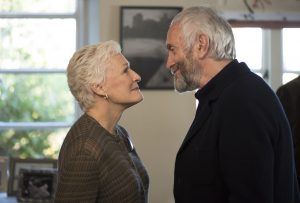 Oscar nominee Glenn Close (left) portrays a loyal, king-making spouse to a Nobel Prize-winning author (Jonathan Pryce, right) in “The Wife.” Photo by Graeme Hunter, courtesy of Sony Pictures Classics.[/caption]
The Field: Yalitza Aparicio, “Roma”; Glenn Close, “The Wife”; Olivia Colman, “The Favourite”; Lady Gaga, “A Star Is Born”; Melissa McCarthy, “Can You Ever Forgive Me?”
Who Will Likely Win: Glenn Close. The veteran performer has been at the front of the pack since this film was released at the beginning of awards season, and this is one of the few categories over which a nominee would appear to have a virtual lock. As a sentimental favorite who has now been nominated seven times without a win, there seems to be a widely held but mostly unspoken attitude that she’s owed an Oscar and that this is the opportunity to bestow one upon her. But is being overdue for an award a legitimate reason for giving one to a previously unrecognized performer? I’m always troubled when the Oscars do that, and it happens more often than it should. To her credit, this is the best of Close’s nominated performances, showing more of a range here than in her other portrayals. But is that enough? Having won virtually everything in this category up to this point, Close appears to be a shoo-in for the award. Look for her to take home the statue on Oscar night.
Who Should Win (Based on the Nominees): Olivia Colman. This is an outstanding performance, and it’s high time that this journeyman actress has finally received a plum part in which she can really show off what she can do. She received the Golden Globe Award for best actress in a comedy for this performance, but, given the Close juggernaut, it doesn’t look like she’ll be able to overtake the front runner.
Who Should Win (Based on All Eligible Candidates): As with the lead actor category, 2018 offered us a huge pack of viable nominees in this category. I would have a difficult time narrowing it down to one candidate. I’d lean heavily toward Colman, though good cases could be made for other contenders, including fellow nominee Melissa McCarthy, as well as a number of other actresses who were not nominated, such as Rosamund Pike for “A Private War,” Susan Sarandon for “Viper Club,” Julia Roberts for “Ben Is Back” and Emily Blunt for “Mary Poppins Returns.”
Possible Dark Horse: Lady Gaga. Actually, the term “dark horse” is something of an understatement where this nominee is concerned, since she is the one contender who might have a chance – and a fairly good one at that – to knock Close off her pedestal. Having won the National Board of Review’s award for best actress and tying with Close in this category at the Critics Choice Awards, she just might have enough clout to pull off a win over the favorite. Such upsets don’t happen often, but they’re not unknown, and this could be one of them.
Also-Rans: Olivia Colman, Melissa McCarthy and Yalitza Aparicio. It’s unfortunate to think of Colman and McCarthy as also-rans, but, unfortunately, that’s likely how they’ll end up, despite the strength of their performances. And, as for Aparicio, it’s hard to fathom how she even scored a nomination considering her utterly lackluster performance, but it’s a portrayal that has also-ran written all over it (more on this below).
Who Should Have Been Left Out: Yalitza Aparicio. Considering how she mumbled her way through the role, Aparicio has no place in this field of contenders. As for how she made the cut, I believe she benefitted from the “Roma” juggernaut, getting swept up into its haul of nominations, regardless of whether or not it was deserved (which it clearly is not). There are so many other more deserving actresses who were left out that her inclusion was a huge Oscar gaffe.
Who Else Should Have Been Considered: In addition to Pike, Sarandon, Roberts and Blunt (as discussed above), other worthy candidates include Charlize Theron for “Tully,” Elsie Fisher for “Eighth Grade,” Saoirse Ronan for “Mary, Queen of Scots,” Felicity Jones for “On the Basis of Sex,” Nicole Kidman for “Destroyer” and Joanna Kulig for “Cold War” (“Zimna wojna”).
Best Supporting Actor
[caption id="attachment_10302" align="alignnone" width="300"]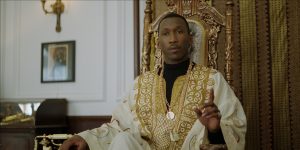 Mahershala Ali portrays pianist Dr. Don Shirley who embarks on a concert tour of the Deep South in 1962 in the fact-based biopic, “Green Book.” Photo courtesy of Universal Pictures, Participant Media and DreamWorks.[/caption]
The Field: Mahershala Ali, “Green Book”; Adam Driver, “BlacKkKlansman”; Sam Elliott, “A Star Is Born”; Richard E. Grant, “Can You Ever Forgive Me?”; Sam Rockwell, “Vice”
Who Will Likely Win: Mahershala Ali. If there’s anyone in the acting categories who already has an award sown up, it would be Ali for his stellar performance in “Green Book.” He’s won virtually everything leading up to the Oscars, and I don’t see anyone else in the field who can stage a realistic challenge.
Who Should Win (Based on the Nominees): Mahershala Ali. As good as this field of nominees is, Ali is hands down the best. Even though he won a supporting actor Oscar for “Moonlight” just two years ago, his performance here is even better, and he truly deserves the award.
Who Should Win (Based on All Eligible Candidates): Mahershala Ali. Are we seeing a trend here? Again, even though there were many worthy performances in this category – nominated or not – Ali truly is at the top of the pack among eligible supporting actors.
Possible Dark Horse: Sam Elliott. Elliott is the only actor to have defeated Ali in any of this year’s competitions, having captured the National Board of Review award for his excellent performance in “A Star Is Born.” As a sentimental favorite who has turned in years’ worth of solid work and has never even been nominated before (let alone won), there’s a slight chance he might pull off an upset, though I wouldn’t bet on it. He should be content with his nomination as his award.
Also-Rans: Adam Driver, Richard E. Grant and Sam Rockwell. It seems a shame to call them also-rans given the strength of their performances, but these three actors, unfortunately, don’t have enough momentum behind them to take home the statue. Driver and Grant are indeed excellent in their roles, though they don’t have the oomph they need to propel them to victory. Rockwell is superb as well, though having just won in this category a year ago for “Three Billboards Outside Ebbing, Missouri,” it’s highly unlikely that Oscar voters will honor him again so soon after his previous win.
Who Should Have Been Left Out: No one! Everyone who is in this category deserves to be here. There are others who are worthy as well (see below), but, with a field limited to five nominees, not everyone who’s deserving can make the cut.
Who Else Should Have Been Considered: There were many excellent supporting actor performances in 2018, and, as good as the nominees are, there are others who merited attention, including Jonathan Pryce and Christian Slater both for “The Wife,” Timothée Chalamet for “Beautiful Boy,” Michael B. Jordan for “Black Panther,” Lin-Manuel Miranda for “Mary Poppins Returns,” Steve Carell for “Vice,” Joel Edgerton for “Boy Erased,” Robert Forster for “What They Had,” Bruce Dern for “Chappaquiddick,” Cedric Kyles for “First Reformed,” Jack Black for “Don’t Worry, He Won’t Get Far on Foot” and Rufus Jones for “Stan & Ollie.”
Best Supporting Actress
[caption id="attachment_10403" align="alignnone" width="300"]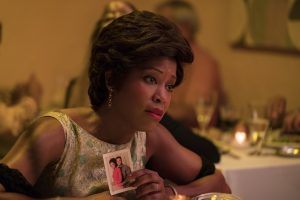 Concerned mother Regina King does her best to help out her daughter and son-in-law-to-be in the screen adaptation of author James Baldwin’s “If Beale Street Could Talk.” Photo by Tatum Mangus/Annapurna Pictures © 2018 Annapurna Releasing, LLC.[/caption]
The Field: Amy Adams, “Vice”; Marina de Tavira, “Roma”; Regina King, “If Beale Street Could Talk”; Emma Stone, “The Favourite”; Rachel Weisz, “The Favourite”
Who Will Likely Win: Regina King. Having won Golden Globe, Critics Choice and National Board of Review honors in this category, she appeared perched to steamroll her way through awards season, and she’s still probably the front runner in this race. However, having not even been nominated in the Screen Actors Guild and BAFTA contests, the last two major competitions before the Oscars, it could be that her support is softening and that a change is in the offing for the February 24 ceremony. To an extent that’s understandable, given that this is a good though not great performance. Nevertheless, in a year when this category’s pool of nominees was unusually weak (truly out of character for the supporting actress award), King’s portrayal is one of the more solid performances in the field. I think she still has enough momentum to hold on for the win, but, if that changes, all bets would quickly be off (see below).
Who Should Win (Based on the Nominees): Emma Stone or Rachel Weisz. In my view, they turned in the best supporting actress performances of 2018, both among nominees and the total universe of contenders, and they are both truly deserving, either individually or in one of Oscar’s rare ties. However, given that both have already earned Oscars – Weisz for “The Constant Gardener” (2005) and Stone for “La La Land” (2016) – it’s unlikely that they would be honored again so soon. Also, considering that multiple nominees from the same film often tend to cancel each other out, this works against them as well. Nevertheless, they truly were the best of the bunch and really deserve the accolades.
Who Should Win (Based on All Eligible Candidates): Emma Stone or Rachel Weisz, for the reasons noted above.
Possible Dark Horses: Conceivably, anyone who isn’t Regina King. If King’s support in this category truly is softening, that opens up the rest of the field as potential prize winners, and good cases could be made for each of them. For Stone and Weisz, arguments could be made in their favor based strictly on the strength of their performances, though the mitigating factors noted above would probably rule them out. Marina de Tavira, though largely unknown (and un-nominated in every other major competition), could come out of nowhere again and ride the crest of the wave that’s likely to carry “Roma” to other awards (see the discussions for best director and best picture below). But the best case for an upset probably rests with Amy Adams. As a six-time nominee and perennial favorite who has never won, she could don the sentimental favorite mantle and walk away as a big (though generally undeserving) surprise winner (more on this below).
Also-Rans: Conceivably, the entire field. If King manages to hold on to her momentum, then everyone besides her would become an also-ran. However, if King’s momentum vanishes, then the playing field would be flattened, putting everyone on a virtually equal footing for becoming a winner or an also-ran. That certainly makes for intriguing possibilities in this category.
Who Should Have Been Left Out: Marina de Tavira and Amy Adams. de Tavira’s nomination is, to me, a fluke; in my view, it’s no accident that she hasn’t picked up any additional nods in other major competitions. And, as for Adams, as much as I typically love her work, her performance in “Vice” was mediocre, lacking the spark that usually typifies her work. However, given the weakness of this year’s supporting actress pool, it shouldn’t come as a surprise that she managed to land a slot in a field where the pickings were rather slim. Some could make a similar argument for King, too, but, then, I guess somebody had to be nominated.
Who Else Should Have Been Considered: As I’ve already noted, there wasn’t much to pick from in this category in 2018, and those who were left out weren’t especially stellar. Nevertheless, there were other supporting actresses whose work could have been considered, some of whom were better than some of the existing nominees, including such obvious contenders as Claire Foy for “First Man,” Nicole Kidman for “Boy Erased,” Thomasin McKenzie for “Leave No Trace,” Emily Blunt for “A Quiet Place” and Margot Robbie for “Mary, Queen of Scots,” as well as some lesser-known performances, such as those turned in by Blythe Danner for “What They Had,” Vera Farmiga for “The Front Runner,” Kathy Bates for “On the Basis of Sex,” Helena Bonham Carter and Anne Hathaway both for “Ocean’s 8,” and
Nina Arianda and Shirley Henderson both for “Stan & Ollie.” In addition, Meryl Streep turned in a fine performance in her one-scene appearance in “Mary Poppins Returns,” though it’s difficult to consider such a cameo worthy of a supporting actress nomination. What’s more, her exclusion from the nominees thankfully eliminated “the Streep problem” this year, an issue I’ve written about on several occasions in previous years’ prediction blogs.
Best Director The Field: Spike Lee, “BlacKkKlansman”; Pawel Pawlikowski, “Cold War” (“Zimna wojna”); Yorgos Lanthimos, “The Favourite”; Alfonso Cuarón, “Roma”; Adam McKay, “Vice”
Who Will Likely Win: Alfonso Cuarón. He seems to have this one in his pocket, having won the Golden Globe, Critics Choice and Directors Guild Awards, all of which stand him in good stead to take home the Oscar. I don’t expect that momentum to let up, especially since his film tied with “The Favourite” for the most nominations, in itself an apparent validation of his work.
Who Should Win (Based on the Nominees): Yorgos Lanthimos. As one of the most inventive directors in the business, Lanthimos has proved his worth once again through his work on “The Favourite,” a dark comedy extraordinaire. He truly deserves recognition for this accomplishment.
Who Should Win (Based on All Eligible Candidates): Alex Garland. Nope, he’s not a nominee, and his film, “Annihilation,” was barely seen by anyone, having been overshadowed by “Black Panther” and “Avengers: Infinity War.” However, the director of 2014’s “Ex Machina” took a quantum leap in his filmmaking with this beautiful and profound sci-fi/smart horror movie. With the exception of a sole Critics Choice Award nomination, this picture has been criminally overlooked for recognition overall, and the directing category is no exception. As my top film of 2018, “Annihilation” deserves a wider audience than it has received. Thankfully, it’s beginning to find one through home viewing options, though it’s a picture that’s truly best viewed on as big a screen as possible, one that faithfully shows off Garland’s superb work.
Possible Dark Horse: Pawel Pawlikowski. I’m way out on a limb with this one, and I must admit I don’t expect this result to pan out. However, the fact that Pawlikowski nabbed a nomination over a number of other more likely candidates speaks volumes about voters’ view of his work. Having won the best director award at the 2018 Cannes Film Festival and a BAFTA Award nomination in the same category, the auteur behind “Cold War” (“Zimna wojna”) and “Ida,” the 2013 Oscar winner for best foreign language film, could have a little-known stockpile of clout backing his bid that could turn into an upset victory. Again, I doubt this will happen, but Oscar sometimes serves up surprises, and this would be an intriguing one, to be sure.
Also-Rans: Anyone who isn’t Alfonso Cuarón. Given the front runner’s status, he appears unlikely to be toppled on Oscar night. Spike Lee, Adam McKay, Lanthimos and Pawlikowski should consider their nominations their awards.
Who Should Have Been Left Out: Alfonso Cuarón. So how is it that the favorite should have been left out? It’s simple: His film leaves much to be desired. Despite the picture’s exquisite cinematography, which truly is beautiful to look at, the film has little else going for it, decidedly undeserving of a nomination in this (and virtually any other) category. “Roma” obviously is a passionate personal project of the director, but, as one critic observed, it’s a film that Cuarón is likely to be the one most in love with it. I concur. He doesn’t belong here.
Who Else Should Have Been Considered: As has been the case on several occasions in recent years, the field of nominees in this category hasn’t necessarily reflected the best of the universe of candidates. While the field is not bad, I believe it could have been better. For example, while Adam McKay’s work on “Vice” was capable, it didn’t match his superior effort on 2015’s “The Big Short,” nor was it on par with the efforts of some of those who were left out. And then there’s Cuarón, who clearly should have not made the cut (see above). In addition to Alex Garland (see above), others who should have been considered here include Peter Farrelly for “Green Book,” Barry Jenkins for “If Beale Street Could Talk,” Joel Edgerton for “Boy Erased,” Bo Burnham for “Eighth Grade,” Matthew Heineman for “A Private War,” Peter Hedges for “Ben Is Back,” Marielle Heller for “Can You Ever Forgive Me?,” Paul Schrader for “First Reformed,” John Krasinski for “A Quiet Place” and Nadine Labaki for “Capernaum” (“Chaos”).
Best PictureThe Field: “Black Panther,” “BlacKkKlansman,” “Bohemian Rhapsody,” “The Favourite,” “Green Book,” “Roma,” “A Star Is Born,” “Vice”
What Will Likely Win: “Roma.” Even though I believe this film will end up the winner, I’m far from certain of that outcome. The reason? This year’s awards season competitions have been so variable in their winners for the big award that any number of candidates could walk away with the top prize. Indeed, “Roma” earned best picture at the Critics Choice Awards, a contest that’s often an accurate predictor of the Oscar outcome. But, in other competitions, other films came up the big winner. “Green Book” took top honors from the National Board of Review and won the Golden Globe Award for best comedy picture. “Bohemian Rhapsody” earned the Golden Globe Award for best dramatic picture. And “Black Panther” came up a surprise winner at the Screen Actors Guild Awards for best ensemble cast, the event’s most prestigious honor and frequently a harbinger of the best picture winner at the Oscars. However, despite the wins by these three films, I don’t believe they’ll be able to defeat “Roma” for several reasons: (1) Having earned 10 nominations, “Roma” tied “The Favourite” with the most nods, and pictures that lead the pack of nominees often (though not always) come out on top if one of their nominations is in the best picture category; (2) “Roma” is a “safe” choice among the leading contenders, reflecting admirable themes like tolerance and cross-cultural understanding, and it’s less “controversial” than fellow nominees like “Vice” and “BlacKkKlansman”; (3) writer-director-producer Alfonso Cuarón is something of a Hollywood darling, and Oscar voters may be looking to at last honor him with the big prize, an accomplishment topping even that of the seven wins by his previous production, “Gravity” (2013), which failed to take the top prize despite receiving a nomination for it; (4) the film is beautiful to look at and at times has the feel of being one of those grand sweeping epics that Hollywood likes to recognize (and that it likes to think is typical of the kinds of releases it makes all the time); and (5) as controversial and cynical as this might sound, “Roma” is a Mexican production that’s being released in a political climate in which many in liberal Hollywood believe that the country and its citizens are being unduly and unfairly criticized, which makes the film an ideal candidate for Oscar voters to honor to make a political statement, something that they have done on occasion in the past. However, two closing caveats: (1) While I believe these are the reasons why “Roma” will win, I can’t say I agree with them (so please don’t shoot the messenger if you agree with me), and (2) as noted above, I could be completely wrong about my prediction in light of the successes of some of the other contenders. I guess we’ll just to wait and see what happens on Oscar night.
What Should Win (Based on the Nominees): “Green Book.” This is the best of the field and deserves to take home the top prize. The National Board of Review and the Golden Globes got this one right. I’d like to see the Oscars follow suit.
What Should Win (Based on All Eligible Candidates): “Annihilation.” Of course, a film can’t win if it’s not nominated, so the creators of this film will have to settle for dreams of “if only….” Still, it truly was the best picture of 2018 and should not have been passed over (see the best director discussion above).
Possible Dark Horses: “Black Panther,” “Bohemian Rhapsody” and “Green Book.” Based on the strength of their prior victories, these three films are potentially capable of pulling an upset. In my view, “Green Book” and “Bohemian Rhapsody” would make worthy winners. But “Black Panther,” despite its technical achievements and its box office power (most likely the real reason it was nominated), would not, given the picture’s various shortcomings (particularly its numerous narrative issues), problems that I believe make its very nomination in this category questionable (see below).
Also-Rans: “The Favourite,” “Vice,” “A Star Is Born” and “BlacKkKlansman,” As good as “The Favourite” is, it’s likely to be seen as too dark (and at times too cryptic) to be given top honors. “Vice,” despite the strength of the performances of Christian Bale, Sam Rockwell and Steve Carell, is a work seriously in need of judicious editing. “A Star Is Born,” despite the hype that surrounded it at the start of awards season, has generally been underperforming in previous competitions, a trend I expect to continue at the Oscars. And even though Spike Lee’s “BlacKkKlansman” is arguably the best film the director has made in years, it still suffers from some of the signature issues that have plagued many of his other works, such as his penchant for overstatement, which is clearly reflected here in the picture’s coda. These films should consider their nominations their awards.
What Should Have Been Left Out: “Black Panther,” “A Star Is Born” and “Vice.” As noted above, box office performance should not a best picture nominee make, and I can’t help but think that’s the rationale that earned “Black Panther” its nod. “A Star Is Born” is a great showcase for Lady Gaga, who can now probably write her own ticket, but, beyond her performance and that of Sam Elliott, I can’t say that this one impressed me (especially since this is the fourth time this story has been made into a film, and this one didn’t make significant changes from the 1976 version). And “Vice,” despite its solid performances and good intentions, is a bloated production that seems a little too enamored with itself. I liked these films, but I didn’t love them by any means. These pictures should consider their nominations their awards.
What Else Should Have Been Considered: In addition to “Annihilation,” as discussed above, there are other pictures that should have been considered, including “If Beale Street Could Talk,” “Boy Erased,” “A Private War,” “Eighth Grade,” “Ben Is Back,” “Can You Ever Forgive Me?,” “First Reformed” and “Capernaum” (“Chaos”). I can only hope that these pictures find audiences for themselves despite their lack of Academy recognition.
The Oscars will be handed out in televised ceremonies on Sunday February 24. I’ll post my report card on these predictions thereafter. Enjoy the show!
(Oscar® and Academy Award® are registered trademarks of the Academy of Motion Picture Arts & Sciences.)
Reviews of some of the leading contenders are available at the following links:
“At Eternity’s Gate”
“Black Panther”
“BlacKkKlansman”
“Bohemian Rhapsody”
“Can You Ever Forgive Me?”
“The Favourite”
“Green Book”
“If Beale Street Could Talk”
“Vice”
“The Wife”
Reviews of other films noted above are available at the following links:
“Annihilation”
“Beautiful Boy”
“Ben Is Back”
“Boy Erased”
“Capernaum” (“Chaos”)
“Cold War” (“Zimna wojna”)
“Destroyer”
“Eighth Grade”
“First Reformed”
“The Front Runner”
“The Land of Steady Habits”
“Leave No Trace”
“Mary Poppins Returns”
“The Old Man & the Gun”
“On the Basis of Sex”
“A Private War”
“Sorry To Bother You”
“Stan & Ollie”
“Tully”
“Viper Club”
Copyright © 2019, by Brent Marchant. All rights reserved.
Tuesday, February 5, 2019
Check Out the Top and Bottom 10 of 2018
Check out my picks for the top and bottom 10 movies of 2018 on the latest edition of Frankiesense & More on The Good Media Network. Join host Frankie Picasso and me as we discuss our faves and least faves for the year, available by clicking here.
Monday, February 4, 2019
Tune in for The Cinema Scribe

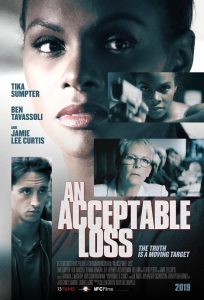
‘Destroyer’ makes the case for making amends
‟Destroyerˮ (2018). Cast: Nicole Kidman, Toby Kebbell, Tatiana Maslany, Bradley Whitford, Sebastian Stan, James Jordan, Zach Villa, Scoot McNairy, Beau Knapp, Jade Pettyjohn, Toby Huss, Shamier Anderson. Director: Karyn Kusama. Screenplay: Phil Hay and Matt Manfredi. Web site. Trailer.
The school of life can hand us some pretty tough lessons. If we fail in our efforts, we may come away from such experiences dejected. Those feelings can be particularly difficult to bear if we’re aware that our failings stem from wrongdoings that we might have (or should have) avoided, incidents that leave us wearing a badge of shame. And rectifying those missteps may prove quite the challenge as a downtrodden law enforcement professional discovers for herself in the gripping new crime thriller, “Destroyer.”
Los Angeles Police Detective Erin Bell (Nicole Kidman) looks like she’s been on the losing end of one too many altercations. The hard-drinking, overworked, sleep-deprived investigator comes across as being one step away from becoming a walking corpse. Yet, somehow, she manages to keep going, often following her own rules and keeping others, like her law enforcement partner (Shamier Anderson), out of the loop. Her renegade work habits have earned her a reputation among her peers. But, then, that’s due in part to what she did in the past and not just her current routine.
Sixteen years ago, when Bell was new to the job, for her first assignment, she was tasked to work an undercover operation with an experienced FBI agent, Chris (Sebastian Stan). They were charged with infiltrating a gang that roamed the nearby California desert engaging in assorted criminal activities, most notably bank holdups. The duo went in with the best of intentions but soon found themselves in over their heads, both in terms of the temptations all around them and the undeniable personal attraction that developed between them. A recipe for trouble was clearly in the offing – and on multiple fronts.
Those troubles didn’t end when the assignment concluded, either. Bell suddenly found herself the mother of a daughter, Shelby (Jade Pettyjohn), who has since grown up to be a rebellious wild child. Erin has virtually no relationship with the rambunctious adolescent; she has defiantly chosen to live with her mother’s ex-boyfriend, Ethan (Scoot McNairy), and routinely goes out of her way to irritate mom by spending most of her time with her older, surly, blatantly disrespectful squeeze, Jay (Beau Knapp). This scenario gives new meaning to the term “dysfunction.”
[caption id="attachment_10487" align="aligncenter" width="300"]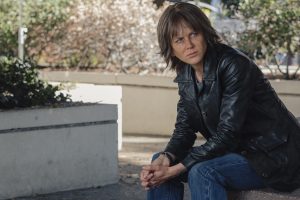 Los Angeles Police Detective Erin Bell (Nicole Kidman) seeks to make amends for mistakes made on a case 16 years ago in director Karyn Kusama’s latest release, “Destroyer.” Photo by Sabrina Lantos, courtesy of Annapurna Pictures.[/caption]
But, if that weren’t bad enough, ghosts from that first fateful assignment have now come back into Bell’s life, dredging up painful memories and lingering regrets. One by one, she runs into former gang members (James Jordan, Zach Villa, Tatiana Maslany), some of whom have gone straight while others have continued their lawless ways. However, rather than allowing herself to be undone by these developments, Bell decides to take matters into her own hands, using these old contacts to help her make amends for her past. They put her in touch with a crooked attorney (Bradley Whitford) who can lead her to what she seeks most – the gang’s evil kingpin, Silas (Toby Kebbell). It’s a quest that Erin hopes will enable her to redeem herself for the events of so many years ago.
Thus begins the detective’s hard-fought odyssey to set matters to right. Through a series of flashbacks and the film’s main narrative, viewers discover how Bell arrived where she’s at, as well as why it’s so important for her to rectify past missteps. It’s a gritty path, to be sure, but it also holds the potential to be transformative and redemptive, considerations that Erin would like to see realized while she still has a chance.
When we stumble in life, we may think there’s no way to make up for it, that we’re fated to suffer unending and unforgiveable consequences. That can be especially true when we know we screwed up – and knew we were doing so at the time – leading us to believe that there may be no escape from our self-imposed loathing. But such is not the case. We always have an opportunity to right our wrongs to redeem ourselves. “Destroyer” shows us what it means to make the effort at doing just that. It may not be an easy process, as Erin finds out firsthand here. However, with the right intentions and a little determination, we’re likely to achieve what we set out to do, and there’s a lot to be said for that.
How well we succeed at this depends upon the beliefs we hold at the time we embark on such a journey. And that’s important given that our beliefs, thoughts and intents are the building blocks of the conscious creation process, the philosophy that maintains we draw upon these resources in shaping the reality we experience. If we believe we can succeed, there’s a good chance we will; but, if we have doubts, then the likelihood of a desirable outcome dwindles.
When it comes to Erin’s approach, she seems suitably motivated to press on to reach her goal, even in spite of her depleted condition. Years of not taking care of herself – most likely driven by beliefs in the regrets she’s been holding onto – have definitely taken their toll. Such conditions have also been exacerbated by the harsh conditions of her job. It’s a combination that has left her beaten down, the sort that would probably prompt most of us to just give up. But not Detective Bell; she know she’s got a job to do, and she’s set her mind on seeing it through.
This is true for Erin both professionally and personally. She fully realizes she hasn’t been the best mother to Shelby, and she sees the result of that in the relationship (or lack thereof) that she has with her daughter. She wants to make up for this, though that’s a tall order, given that she has to undo a lot of the damage that she caused over the years. Whatever success she attains will depend not only on her efforts, but also on how well this co-creation plays out, given that Shelby is just as much a part of what materializes as her mother is. Each will have to evaluate their beliefs about one another and whether or not they have a future together.
When faced with prospects such as these, we can always hold out hope that there’s a chance for redemption. And hope can be a potent belief in and of itself, one that can blossom into a powerful force if we allow it to express itself in fully manifested forms. For her sake, Erin had better put her faith in this notion while the opportunity presents itself.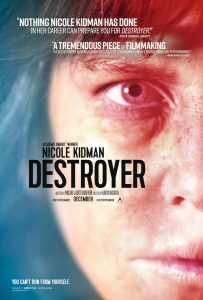
Although a bit sluggishly paced at times, this crime saga about the search for justice and redemption is a surprisingly good thriller with an excellent Golden Globe-nominated lead performance by Kidman in a decidedly different role. The clever storytelling format, coupled with a no-holds-barred approach to the action sequences, combine for an intriguing (and at times shocking) saga, made all the better by inventive editing, an eclectic but well-orchestrated mix of cinematography styles and a carefully measured sequence of revelation. Director Karyn Kusama’s latest has been getting an undeserved bad rap in some critical circles, but, thankfully, an increasing number of reviewers have been coming around on this one. Go see it for yourself and make up your own mind; you may well come away pleasantly surprised.
What we make of our second chances depends on how we approach them, particularly when it comes to recognizing the opportunities they represent. If we’re paying attention at all, we should realize that such breaks may not come our way all that often and that it would be in our best interests to jump on them when they appear. They just may make it possible for us to take off that badge of shame, something that should be especially important to someone who wears a badge for a living. Here’s wishing her (and us) luck.
Copyright © 2019, by Brent Marchant. All rights reserved.
‘Stan & Ollie’ celebrates persistence, reinvention
‟Stan & Ollie“ (2018). Cast: John C. Reilly, Steve Coogan, Shirley Henderson, Nina Arianda, Danny Huston, Rufus Jones, Susy Kane, Richard Cant. Director: Jon S. Baird. Screenplay: Jeff Pope. Book: A.J. Marriot, Laurel and Hardy: The British Tours. Web site. Trailer.
It’s hard to keep a good man – or a good team – down. Those who are determined to carry forward with their plans, no matter what they may be, are usually difficult to contain. And, when you add the power of a collaborative effort to the mix, the ability to hold them back may be nearly impossible. So it was for a comedy duo seeking to revive their career in their waning days as seen in the entertaining new biopic, “Stan & Ollie.”
In 1937, Stan Laurel (Steve Coogan) and Oliver Hardy (John C. Reilly) were the biggest comedy duo in the entertainment business. Their films were screened throughout the US and around the world, and virtually no one in Hollywood was bigger than they were. But, in the ensuing years, that all began to change.
Because Laurel and Hardy were under separate contacts with studio chief Hal Roach (Danny Huston), they weren’t operating on a level playing field, a source of frustration and consternation for Laurel individually (he wasn’t getting his due) and for the pair collectively (they didn’t have the creative clout they sought that a joint contract would afford). What’s more, during his contract dispute with Laurel, Roach paired up Hardy with comedian Harry Langdon (Richard Cant) for a film called “Zenobia” (1939), an incident that rubbed Laurel the wrong way. And, even though Laurel and Hardy resumed working thereafter, their career was strained – and waning.
[caption id="attachment_10479" align="aligncenter" width="300"] The comedy duo of Stan Laurel (Steve Coogan, left) and Oliver Hardy (John C. Reilly, right) perform a series of stage shows to help generate interest in an upcoming new film production as seen in the entertaining new biopic, “Stan & Ollie.” Photo by Nick Wall, courtesy of Sony Pictures Classics.[/caption]
In an attempt to revive their partnership in 1953, Laurel and Hardy began work on a comic film version of “Robin Hood” with a British production company, an organization somewhat shrouded in mystery. But, because Laurel and Hardy no longer captured widespread attention the way they once did, the producers believed that they needed to raise their visibility level. So, to renew interest in the duo and to help support fundraising for the picture, Stan and Ollie were asked to do a series of stage shows throughout Britain and Ireland, a tour organized by the producers’ representative, Bernard Delfont (Rufus Jones).
Laurel and Hardy gladly agreed to the tour, but, once they began, they found it to be less than what they hoped for. They were relegated to playing small theaters where the houses didn’t even sell out. On top of that, Ollie’s health was failing, making it difficult for him to perform as he used to, particularly when it came to a number of his more physically demanding routines, such as dancing and the duo’s signature slapstick gags. Things were not looking promising.
[caption id="attachment_10480" align="aligncenter" width="300"]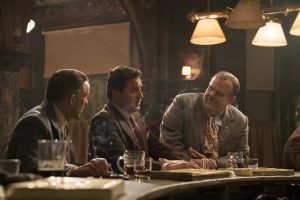 Working with British production company representative Bernard Delfont (Rufus Jones, center), the comedy duo of Stan Laurel (Steve Coogan, left) and Oliver Hardy (John C. Reilly, right) organize a series of stage shows to help promote a comic version of “Robin Hood” as seen in the entertaining new biopic, “Stan & Ollie.” Photo by Aimee Spinks, courtesy of Sony Pictures Classics.[/caption]
To make up for this, Laurel and Hardy were asked to do a number of public promotional appearances to generate interest in the shows, a move that was believed would help garner more attention for the upcoming film. They were now working harder than ever. But, at least where the stage shows were concerned, these little stunts helped earn them sold-out dates at bigger and more prestigious venues, such as a two-week stint at London’s Lyceum. Things were at last looking better.
With success now coming their way, Stan and Ollie were joined in England by their wives, Ida (Nina Arianda) and Lucille (Shirley Henderson), respectively. They were experiencing what should have been the pinnacle of their careers, but such turned out not to be the case. Old resentments surfaced, Ollie’s health continued to worsen and shocking new surprises emerged, all of which conspired to potentially tear the duo apart.
But can an established, committed team like this one truly be split up by outside forces? That’s hard to do, even in the face of the most formidable circumstances, especially when those opposing forces are up against the strength of the bond uniting the partners. In a professional context like this, it might indeed sound strange to call the element that binds the collaborators what it genuinely is – love – but that’s what it is nevertheless. “Stan & Ollie” thus shows us what it means to employ this power in a forum other than romance. Whether or not we’re aware of it, it ultimately makes all kinds of tremendous creations possible. And, no matter what it’s used to produce, we should be forever grateful that we have it at our disposal for whatever creative purposes we choose to explore.
[caption id="attachment_10481" align="aligncenter" width="300"] With their wives Lucille (Shirley Henderson, left) and Ida (Nina Arianda, right), respectively, the comedy duo of Oliver Hardy and Stan Laurel enjoy the good life while on a stage show tour of England and Ireland in “Stan & Ollie.” Photo by Nick Wall, courtesy of Sony Pictures Classics.[/caption]
Of course, the power of love is driven by a belief in it, and beliefs are the cornerstone of the conscious creation process, the philosophy that maintains we manifest the reality we experience through them, as well as our thoughts and intents. In the case of Laurel and Hardy, they loved what they did, and this belief drove their success. It also formed the basis of their collaborative relationship, a force that became apparent in the results they produced, material that not only entertained their contemporaries and has lived on to this day. That’s quite a powerful force, and one that’s not easy to put down.
Laurel and Hardy also showed us the possibilities associated with reinvention. Even when their heyday was supposedly past, they managed to adapt and evolve. Their success may not have been immediate, but they learned how to make adjustments in their thinking – and the manifestations that came from it – to enjoy a renaissance of their own making. By pushing past supposed limitations, new outcomes are attainable, even when they retain elements of the past, including those that brought them their initial success. Their experience shows that all may not be lost, even when the chips appear down.
[caption id="attachment_10482" align="aligncenter" width="300"] With his career fading and his health failing, comedian Oliver Hardy (John C. Reilly) does his best to carry on performing in the new biopic, “Stan & Ollie.” Photo by Aimee Spinks, courtesy of Sony Pictures Classics.[/caption]
It’s comforting to know that we always have the power to shift gears and rejuvenate what we’ve thought we’ve lost. All we need do is believe in the possibility. Laurel and Hardy did, and we should be grateful that they had to the wisdom to do so.
While capably made, “Stan & Ollie” is nevertheless a somewhat “safe” and formulaic biopic that some might see as mediocre were it not for the positively outstanding performances of Reilly and Coogan, as well as several delightful supporting characters. The leads are so convincing that one might swear they’re channeling their historic characters. The period piece production values are also top notch across the board. However, in telling the story of this legendary duo, the film would have been more balanced had it included more about the pair’s rise to comedic greatness and not focused almost exclusively on their sunset years. All in all, this is a decent cinematic outing but one that probably could have (and should have) been better to do justice to the legacy of Laurel and Hardy.
[caption id="attachment_10483" align="aligncenter" width="220"]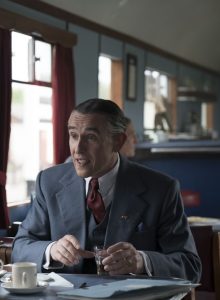 Comedian Stan Laurel (Steve Coogan) does his best to hold his comedy duo together in the face of difficult odds in “Stan & Ollie.” Photo by Aimee Spinks, courtesy of Sony Pictures Classics.[/caption]
The film has fared well in awards competitions, earning three BAFTA nominations as Outstanding British Film, for Coogan’s lead performance, and for achievements in hair and makeup. The film also earned a Golden Globe nod for Reilly as best actor in a comedy.
Decades after their deaths, Laurel and Hardy still know how to make us laugh, as the re-creations of their routines show in this film. That illustrates the timelessness of their work, as well as the brilliance of those who created it. They truly loved their craft and the spirit of collaboration that they brought to it, an indomitable force that couldn’t be denied, even in the face of growing difficulties. Thank goodness they persevered so that their gift to the world can still be enjoyed to this day.
Copyright © 2019, by Brent Marchant. All rights reserved.
Friday, February 1, 2019
‘Cold War’ charts the rocky road to peace of mind
‟Cold War” (“Zimna wojna”) (2018). Cast: Joanna Kulig, Tomasz Kot, Borys Szyc, Agata Kulesza, Cédric Kahn, Jeanne Balibar, Adam Woronowicz. Director: Pawel Pawlikowski. Screenplay: Pawel Pawlikowski, Janusz Glowacki and Piotr Barkowski. Story: Pawel Pawlikowski. Web site. Trailer.
Even when we get all the breaks, sometimes life just doesn’t satisfy us. We pursue the opportunities that present themselves, but somehow they inevitably fail to live up to their billing (and our expectations), leaving us feeling unfulfilled. And, if this pattern continues unabated, at some point, we may grow despondent, perhaps engaging in various forms of unproductive or even self-destructive behavior. So it is for an entertainer who has a chance to have it made and ends up sabotaging herself at every turn, a saga chronicled in the melancholic new Polish drama, “Cold War” (“Zimna wojna”).
In 1949 Poland, not long after the fall of the Iron Curtain over the Soviet satellite states of Eastern Europe, the government commissions a pair of professional entertainers, musician Wiktor Warski (Tomasz Kot) and choreographer Irena Bielecka (Agata Kulesza), to scour the country in search of candidates for a troupe of singers, dancers and musicians to give high-profile public performances at home and in foreign lands celebrating traditional Polish folk art. While Wiktor and Irena have some freedom to choose who they want, their work is closely scrutinized by their government sponsor, Lech Kaczmarek (Borys Szyc), who’s concerned that the candidates selected are suitable artistically, politically and ethically, upstanding model citizens of contemporary Communist Polish society.
One aspiring singer, Zula Lichon (Joanna Kulig), captures everyone’s attention. During her audition, the beautiful young vocalist reveals her angelic singing voice. But she also appears to possess a wealth of other qualities that intrigue Wiktor, both personally and professionally. As musical director of the troupe, he takes a special interest in her, seeking to mold her into a featured performer. There’s just one problem: She carries some heavy baggage, having been charged with stabbing her father and being placed on probation. It’s not the kind of reputation that sets well with Kaczmarek, who fears that, if her secret were revealed, it might disgrace the troupe and its prospects for the future.
[caption id="attachment_10470" align="aligncenter" width="300"] Polish émigré Zula Lichon (Joanna Kulig) delivers cool but steamy renditions of numbers from her homeland in Parisian nightclubs in director Pawel Pawlikowski’s award-winning new offering, “Cold War.” Photo by Lukasz Bak, courtesy of Amazon Studios.[/caption]
Wiktor, however, believes that he can manage Zula and keep her skeletons barricaded in the closet. He convinces Kaczmarek to let her become a member of the troupe, and, as the troupe begins touring, Zula is a stand-out sensation, contributing significantly to its popularity and artistic accomplishments. What’s more, the more Wiktor works with Zula over time, the closer they become personally, eventually striking up a torrid but somewhat clandestine romance.
At the same time, Kaczmarek, who also quietly longs for Zula, secretly strikes a deal with her to spy on Wiktor, a condition of her probation aimed at ensuring her loyalty (and, hence, her continued participation in the troupe). Kaczmarek’s interest in keeping tabs on Wiktor stem from suspicions about the director’s commitment to the government’s objectives for the troupe. For instance, Kaczmarek takes note of Wiktor’s less-than-enthusiastic response to a government “suggestion” that the troupe begin performing pieces other than just traditional Polish folk songs, namely, propaganda-based compositions dealing with subjects like land reform and wealth redistribution. Also, given that Wiktor is assumed to be somewhat more free-thinking because of his artistic sensibilities, Kaczmarek can’t help but wonder whether the musical director can truly be trusted.
[caption id="attachment_10471" align="aligncenter" width="300"]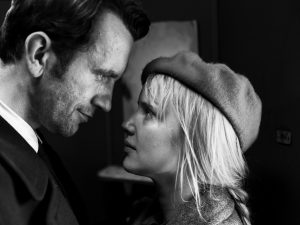 Singer Zula Lichon (Joanna Kulig, right) and musical director Wiktor Warski (Tomasz Kot, left) engage in a torrid romance across Europe in the Oscar-nominated feature from Poland, “Cold War.” Photo by Lukasz Bak, courtesy of Amazon Studios.[/caption]
As it turns out, Kaczmarek has good reason to have his doubts. During a concert date in East Berlin in the days before the Wall was built, Wiktor hashes out a plan to defect to the West, and he asks Zula to join him. Because of her renegade ways and the feelings he believes she holds for him, Wiktor assumes she’ll join him without question. And, when the time comes to carry out his plan, he successfully makes his move, eventually finding his way to Paris. But Zula surprisingly stays behind, continuing her performances with the troupe. It’s a decision she later regrets, prompting her to find a way to emigrate to Paris, a goal she eventually fulfills.
Thus begins an on-again/off-again romance across a divided continent in which Zula and Wiktor each spends some time in the West and some time in the East, ever searching for the elusive happiness they seem to crave but are never able to find, both personally and professionally, not to mention romantically. Along the way, they have involvements with other partners – Wiktor with a French poet (Jeanne Balibar), Zula with a French filmmaker (Cédric Kahn) and even with Kaczmarek – but they always seem to come back to one another, only to part ways again, that is, until they come up with a unique solution to their unhappiness.
[caption id="attachment_10472" align="aligncenter" width="300"]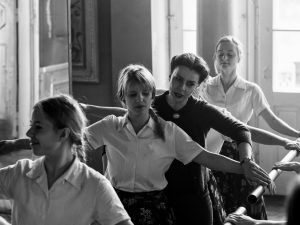 Aspiring performer Zula Lichon (Joanna Kulig, second from left) takes director for choreography instructor Irena Bielecka (Agata Kulesza, second from right) in “Cold War.” Photo by Lukasz Bak, courtesy of Amazon Studios.[/caption]
“Cold War” is, at times, a frustrating film to watch. One can’t help but hope that Wiktor and Zula will find what they’re looking for, but the picture shows what it means to search for what one wants and never finding it. The protagonists try to claw their way through a maze of self-destructive behavior, some of it understandable, some of it completely inexplicable. It might be tempting to chalk things up to the oppressive conditions under which they live in Communist Era Poland, but, when they’re in the freedom that Paris affords, they seem just as unsatisfied as they were in Warsaw. In many ways, this is a sort of personal hell from which escape seems impossible. There must be a way out, though finding it may be more of a challenge than either of them realizes.
How do such circumstances arise? As in any scenario, they come from our thoughts, beliefs and intents, the building blocks of the conscious creation process, the philosophy that maintains we use these tools to manifest the reality we experience. And, based on what Zula and Wiktor create, they obviously don’t have a handle on what they want for themselves. The conflicted nature of their beliefs becomes apparent in the conflicted nature of their existence.
Clearly, Zula and Wiktor are unable to define what makes them happy, a deficiency reflected in their beliefs and resulting life experiences. One would think that the freedom of the West would be ideal to individuals living under the restricted conditions of the East. However, when someone who is accustomed to rigidly controlled certainty is suddenly presented with unlimited choices, the range of available opportunities can be overwhelming, making it virtually impossible to decide what to select. For Zula, these types of circumstances even predate those that came into effect with the Communist takeover of her homeland; given the household in which she grew up, she obviously suffered the controlling influence of a domineering father, one whose ways eventually led her to lash out at him, as evidenced by the stabbing incident.
[caption id="attachment_10473" align="aligncenter" width="300"]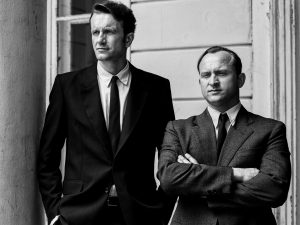 The efforts of Wiktor Warski (Tomasz Kot, left), musical director of a Polish performing troupe, are scrutinized by government official Lech Kaczmarek (Borys Szyc, right) to ensure that he adheres to expected official dictates in the new award-winning drama, “Cold War.” Photo by Lukasz Bak, courtesy of Amazon Studios.[/caption]
When such a fractured outlook becomes ingrained, sooner or later it’s not out of the question for it to lead to questionable behavior, such as the inexplicable acts in which Zula and Wiktor each engage. It’s sad that they’re unable to find a solid footing for their beliefs, because, as conscious creators well know, the process can indeed make any outcome possible as long as we’re focused on what we hope to achieve. But, when one is unable to grasp that fundamental understanding, the result can be chaotic and disappointing, conditions that may lead to desperate measures to find happiness and peace of mind.
Interestingly, the relationship between Zula and Wiktor in many ways parallels the rocky relationship between the West and the East that was going on around them, that they, too, were experiencing a “cold war” of their own on a much smaller but equally turbulent level. Wiktor, who’s all too ready to defect to the West and the possibilities it presents, symbolizes the realm to which he wishes to escape. Zula, on the other hand, who seems more comfortable with controlling influences governing her, represents the authoritarian regime of the East, one that seeks compliance from its constituents regardless of what they may want personally (even if they can figure that out). When you take two individuals with such polarized sensibilities and put them together, is it any wonder that they would have difficulty forging a successful relationship? And, when you combine with that an ability to choose what would make them happy, it’s easy to see why Zula and Wiktor had such an on-again/off-again romance.
[caption id="attachment_10474" align="aligncenter" width="300"]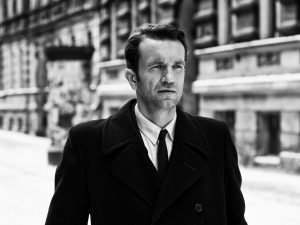 Seeking artistic freedom during the early 1950s, Wiktor Warski (Tomasz Kot), musical director of a Polish performing troupe, seeks to make his escape to the West while on a concert date in East Berlin in “Cold War.” Photo by Lukasz Bak, courtesy of Amazon Studios.[/caption]
For better or worse, such a result is also a product of conscious creation, even if the characters themselves are unaware of it. The beliefs they hold about themselves and the society of which they’re a part permeates their being and every aspect of their daily lives. It’s tragic, though, that they never seem to be able to get it together. Let’s hope we can learn from this cautionary tale and find for ourselves the fulfillment that seems to ever elude them.
This gorgeously filmed, sublimely cool story of troubled romance pays fitting homage to European art films of the 1950s and ʼ60s with a narrative somewhat reminiscent of the French drama “Betty Blue” (1986). Beautifully shot in black and white, director Pawel Pawlikowski’s bittersweet tale features an outstanding performance by Kulig, both in her musical numbers and her diverse dramatic scenes. However, after a strong beginning, the picture begins to meander somewhat toward the middle, as if the director didn’t quite know how to bridge the opening to a conclusion that he already had in mind. It feels like all the makings of a great film are here but that they don’t quite gel as well as they might have in the finished product. See it for the gorgeous cinematography and Kulig’s outstanding performance, but don’t be surprised if you come away from it feeling somewhat like the unsatisfied protagonist.
Despite these shortcomings, the film has been lavished with praise in recent award competitions. At the 2018 Cannes Film Festival, “Cold War” won the award for best director and earned a Palme d’Or nomination, the event’s highest honor. Subsequent to that, the picture was named best foreign language film by the National Board of Review. And, in upcoming contests, this offering has captured three Oscar nominations (best foreign film, director and cinematography) and four BAFTA Award nods (best foreign film, director, original screenplay and cinematography). Previously the picture also received a Critics Choice Award nomination for best foreign language film.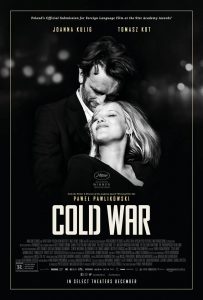
It's regrettable, perhaps even tragic, when we’re unable to see the good fortune that blesses us. But, for what it’s worth, sometimes that’s not enough to give us what we believe we need to make us feel happy and fulfilled, be it in our love lives, our vocational callings and our very appreciation of life. Stories like those depicted in “Cold War” may sadden us, but one would hope that they leave us grateful for what we have – and make it possible to wish the same to others.
Copyright © 2019, by Brent Marchant. All rights reserved.