Sunday, May 14, 2023

‘Slava Ukraini’ praises hope and unity

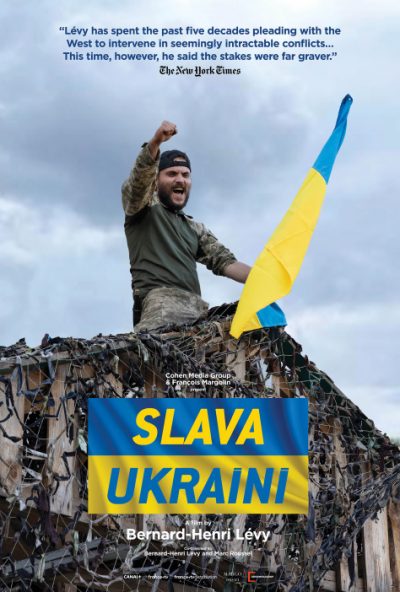
Slava Ukraini(“Glory to Ukraine”) (2023). Cast: Bernard-Henri Lévy. Director: Bernard-Henri Lévy. Screenplay: Bernard-Henri Lévy. Web site. Trailer.


When a group takes on a formidable task, it helps to have a sense of solidarity in tackling it. It’s also beneficial to have a suitable attitude toward it, one full of optimism and hope. And, of course, a healthy dose of commitment can cement the effort, taking events in the desired direction. Achieving those results may not be easy and there may be disappointments or even tragedies along the way. But success tends to multiply itself, an outcome that leads to uplifting, inspiring results, an approach that has given new life to the people of Ukraine in their conflict against aggressor Russians, a development chronicled in the compelling new firsthand, on-the-ground documentary, “Slava Ukraini” (“Glory to Ukraine”).


Most media coverage about the war in Ukraine – where most of us get our news about the combat – comes down to a recitation of facts and figures, with the biggest and most dramatic stories receiving virtually all of the attention. But how does the war impact the nation’s citizens at the personal level? What’s more, we hear so much about the unity of Ukraine’s residents in combatting their Russian foes, but in what ways does that commitment actually materialize? Those are the questions that French writer-director-philosopher Bernard-Henri Lévy has sought to address in this thoughtful new film.


As a sequel to a previous work, “Why Ukraine?,” which was created for European television, this latest effort seeks to dive deeper into what has been transpiring in the war-torn nation since the conflict’s onset in February 2022. Told as a sort of travelogue through the nation’s various hot spots, including many on the front lines, Lévy chronicles what has happened across Ukraine from the start of the war, oftentimes brought down to a touching, intimately personal level. We witness the pain that the country’s citizens have endured through the brutal, often-relentless Russian attacks. But we also see the utter joy and relief that many have also experienced as a result of the liberation of many areas once held by the enemies brought about by tenacious Ukrainian forces determined to maintain their sovereignty and take their nation back. Such moments frequently prove bittersweet, though, particularly when the liberated are still uncertain about the fates of loved ones who were caught up in the fighting on the way to the restoration of their freedom. There’s hope in these developments, though nevertheless tinged with sadness and doubt.


The filmmaker’s journey begins in Ukraine’s capital, Kyiv, which he contends has more or less returned to “normal,” save for the rubble of bombed-out buildings and the occasional air raid sirens, thanks to troop initiatives that have kept Russian forces at bay, often prompting hasty retreats and desertions by the invaders. From there he travels across Ukraine, visiting various large and small communities, many of which have also been reclaimed. He even ventures into the contentious Donbas region of eastern Ukraine, home to many ethnic Russians, where the area’s residents have been embroiled in conflict, often with interference from across the border, for nearly a decade. This region’s communities were among the first to fall into Russian hands when the current war began, but even many of them have now been retaken by Ukrainian forces, in many cases without much resistance.
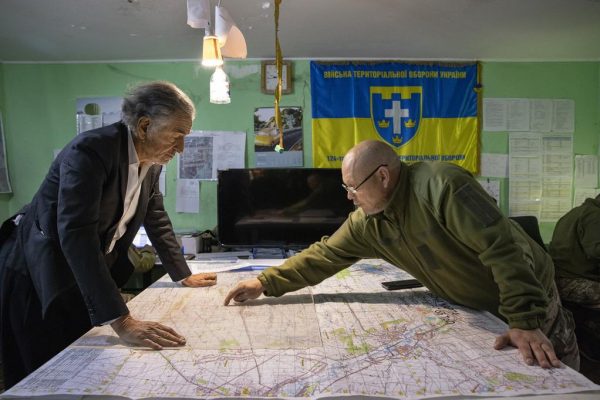


French writer-director-philosopher Bernard-Henri-Lévy (left) confers with Ukrainian military officials regarding the progress of the war against Russia in the new, firsthand, on-the-ground documentary about the conflict, “Slava Ukraini” (“Glory to Ukraine”), now available in limited theatrical release and online. Photo © Marc Roussel, courtesy of ARP Sélection/UniFrance.

Following these travels, the film crew returned to Kyiv before heading south to the Oblast region, home to the warm water ports of Odesa and Kherson on the Black Sea, both of which came under attack by Russian forces because of their strategic nature and were still considered hot spots at the time of filming in November 2022. However, by the time of the crew’s arrival in the area, both cities were in Ukrainian hands, despite periodic bombardments of infrastructural targets by Russian missiles and the positioning of snipers across the Dnieper River, which runs through Kherson. Such measures were looked upon as scorched earth initiatives, designed more than anything else to harass and inconvenience in retreat, but they were nevertheless dangerous, as the filmmaker found out when he and his crew were hurriedly shepherded out of harm’s way when they came within the snipers’ sights.


The crew’s filmed escape from the snipers illustrates one of the key elements characterizing this picture – its content was all real, no editing, staging or alteration of any kind, a genuine, firsthand chronicle of what actually happened to Lévy and his production team while on their visit to Ukraine. The compilation of this footage thus calls to mind the work of US television crews that were present on the ground to film what happened during the Vietnam War. While this film didn’t capture as much battlefield footage as what happened in Vietnam, there are segments that illustrate the bona fide threats that the filmmaker and his staff faced while compiling their account of this all-too-real story.


Perhaps the most pertinent theme that runs through this documentary is its depiction of the unparalleled (and much publicized) sense of unity among the Ukrainian people in battling this ordeal. What’s unique here, however, is the way that this is illustrated through the film. The solidarity of Ukraine’s citizens is so pervasive that it touches virtually every element of society, with everyone working concertedly in tandem, each doing his or her part in their respective milieus to help ensure victory. They truly understand the bigger picture at play here, and they give their all to execute their various tasks to see its goals fulfilled.



Standing amidst the rubble of buildings destroyed by Russian offensives, filmmaker Bernard-Henri-Lévy (center) and his production crew assess the condition of territory reclaimed by tenacious Ukrainian forces as seen in the new, firsthand, on-the-ground documentary about the conflict, “Slava Ukraini” (“Glory to Ukraine”). Photo © Marc Roussel, courtesy of ARP Sélection/UniFrance.

The director organically captures the stories of those involved in this effort. There are, of course, numerous accounts of soldiers and sailors diligently carrying out their missions with courage and precision. Then there are the stories of everyday citizens doing everything from collecting, assembling and distributing food and supplies to those affected by the conflict to the caregivers watching over the children to see that they’re protected and still receiving an education, even during a time of war. The roles of laborers are not overlooked, either, such as the workers at a former Soviet steel mill who are processing product necessary for carrying out the war effort. This even includes the country’s coal miners, who continue to extract this precious resource to fuel the mill’s blast furnaces. Indeed, everyone has a role to play in this immense undertaking, and the film brings them all to light.


The film also makes a point of highlighting the part that foreigners are playing in this conflict. While it’s well known that Ukraine has been receiving ample international assistance from the West in terms of weapons and supplies, the country has also been benefitting from the direct involvement of foreign nationals in country on the ground. Soldiers-for-hire from 32 nations have been participating in the war, as exemplified in an interview with a French infantryman who volunteered to fight, not only because he saw it as the right thing to do, but also because he has a personal vested interest: to help find and protect his Ukrainian wife and family, whose fate at the time of filming was unknown.


Of course, perhaps the most important foreign national in this story is the filmmaker himself, French writer-director-philosopher Bernard-Henri Lévy. His humanitarian activism in Ukraine dates back to the 2014 Maidan Revolution, when the country’s citizens clashed over the future direction of the nation – one with closer ties to the European Union or the continuation of its affiliation with Vladimir Putin and the Russian Federation. Lévy saw the handwriting on the wall if Russian influences were to be allowed to continue unabated, jeopardizing Ukrainian freedoms and its desire to align itself more with the West. And, as the tensions escalated in the time since then, he has made it one of his goals to draw attention to the situation and what it could mean, not just for Ukraine, but also for the West in general.



Ukrainian soldiers search for Russian troops who called a special hotline to signal their desire to desert their posts, one of many diverse efforts aimed at bringing an end to the ongoing conflict, as seen in director Bernard-Henri Lévy’s new firsthand documentary, “Slava Ukraini” (“Glory to Ukraine”), now available in limited theatrical release and online. Photo © Marc Roussel, courtesy of ARP Sélection/UniFrance.

I had the pleasure of seeing this film at a special screening featuring the director in person for a Q&A session after the picture. In that session, he discussed some of his activist efforts, many of which weren’t covered in the film. For example, he noted that the proceeds from the film will be donated to charitable organizations assisting in the war effort. Moreover, Lévy added, in shooting the picture, he and his colleagues amassed roughly 200 hours of footage (which, remarkably, was pared down to an economical and well-organized runtime of 1:35:00). Amongst the unused footage he shot were the stories of many Ukrainian citizens who suffered tragic losses at the hands of the Russians, material that he is convinced could be used as visual testimony in war crimes trials when they come to pass (not if they come to pass) in what he foresees as a certain victory over the invaders, especially given the unified spirit of the nation’s citizens and the way in which the conflict has been progressing. Now that’s commitment.


In telling the stories of the Ukrainian nationals who he interviewed for the film, the director narrates these tales by drawing from his own philosophical background, presenting them with a poetic touch (which, admittedly, can get a bit flowery at times but is nevertheless quite admirable for taking a decidedly different approach to this material). He waxes expressively in speaking about what has happened to Ukraine’s citizens, none of whom asked for any of what has happened to them. Simultaneously, he draws from the history of previous international conflicts, such as the Spanish Civil War and World War II, to draw parallels between those events and what has happened in this engagement. For instance, Lévy compares Putin’s ill-timed, poorly considered invasion of Ukraine to that Adolph of Hitler’s invasion of Russia during World War II, proving once again that those who don’t learn from history are doomed to repeat it.


When all of these factors are taken together, “Slava Ukraini” paints a comprehensive, inspiring picture of a people who are willing to do whatever it takes to overcome the atrocities that have been inflicted upon them. To the Ukrainians, the question of reaffirming their sovereignty has itself never been a question to begin with, and this documentary brings that notion front and center. And Lévy doesn’t deny that this is, by its nature, a partisan film. But, in making the case for this nation and its citizens, he has put forth an important picture that anyone who truly believes in the preservation of freedom and democracy should see (and tell others about). There’s more at stake here than just one nation’s autonomy. The people of Ukraine understand that, and it’s time the rest of us did as well.



French writer-director-philosopher Bernard-Henri-Lévy (center) is escorted by Ukrainian troops to one of the hot spots in the country’s war with Russia, as depicted in the filmmaker’s new, firsthand, on-the-ground documentary about the conflict, “Slava Ukraini” (“Glory to Ukraine”). Photo courtesy of Cohen Media Group.

In a conflict like this, no matter what firepower a contingent of combatants may have, perhaps the most powerful weapon those forces possess is their beliefs, specifically those related to their outlook, their objectives and their confidence, resources that the Ukrainians obviously have in abundance. And those beliefs are important, for they have a direct line to what manifests in the reality of those who adhere to them, thanks to the conscious creation process, the philosophy that makes such outcomes possible. It’s unclear how many of Ukraine’s troops and citizens are aware of this school of thought, but, considering the success they’ve experienced thus far, it’s obvious they’re well acquainted with its principles – and how to put them to use.


This is particularly true in light of the views held by the Russians, who have been abandoning their posts in droves. This is apparent in the huge numbers of invading troops who have simply walked away from their assigned tasks, despite whatever consequences they might face. This is also evidenced by the success of a Ukrainian program that has enabled Russian soldiers to safely defect by calling a special hotline in which the foreign troops can arrange to meet with their opponents to be escorted out of danger and retribution from their own commanders.


So why has this been happening? According to Lévy, it’s because the Russians don’t believe in the supposed cause they’ve been coerced into fighting for. They don’t see the purpose, so they can’t get behind it, and this, coupled with the focused tenacity of the Ukrainians, has led to the Russians’ demoralized attitude, sagging support and declining success on the battlefield. And who says our beliefs don’t create our reality?


The Ukrainians’ efforts have been further bolstered by beliefs in specific areas, notions designed to enhance their basic will for success. For instance, as events have unfolded, it’s become obvious that the Ukrainians have tremendous faith in their convictions, a belief that they’re certain about the justness of their cause, a powerful add-on to the convictions supporting their basic intents. Likewise, as the film illustrates, the Ukrainians have been inventive in their approach to this venture, such as the aforementioned hotline. They have successfully made use of whatever is available to them to carry on the fight, including in undertakings not directly related to combat (such as improvised infrastructural and transportation systems), even if these solutions are anything but conventional. This represents a pronounced willingness to think outside the box, to draw upon beliefs in such areas as innovation and resourcefulness that set aside any fears, doubts or limitations that might otherwise hinder their efforts. These may seem like small and simple steps in themselves, but, when combined with the Ukrainians’ other beliefs, they add up to quite a lot. Indeed, who in their right mind would want to take on an opponent with an arsenal of intent like that?



Despite the liberation of the Ukrainian seaport of Odesa, the city is still largely devoid of people as the threat of war with the Russians hangs over it, as depicted in the new documentary, “Slava Ukraini” (“Glory to Ukraine”). Photo © Marc Roussel, courtesy of Bernard-Henri-Levy.com.

Most importantly, though, the Ukrainians have embraced a belief that victory is theirs to be had in the end. It may take some time to reach that point, and there may be more setbacks along the way. But the outcome, in their minds, has already been determined, a result that Lévy shares as well. In fact, as noted above, sharing that notion widely is one of the main reasons he made this film. Given Ukraine’s geography, situated squarely between Russia and Western Europe, the nation is seen as a transitionary bridge between these two opposing forces, and the war is as much about protecting the West against Putin’s aggression as it is about protecting the country’s sovereignty. The Ukrainians understand that, and they want their Western allies to grasp this, too. That’s why those who live outside its borders should care about – and believe in – the importance of their victory as well.


Slava Ukraini” may not fit the standard documentary mold (especially in its eloquent voiceovers), but it nevertheless enlightens us to a far greater degree than many other films about this conflict, not to mention the subject of warfare in general. Admittedly, there is some footage that sensitive viewers might find disturbing, so those prospective audience members should take this into consideration when making a screening decision. However, in light of what this film has to offer, I’d be curious to see what else the director captured in the other 198 hours of filming that didn’t make the final cut. “Glory to Ukraine” provides valuable insight into an event that has the potential to leave a significant and long-lasting impact not just on the residents of Ukraine and its neighbors but on the totality of humanity as well. And, if a spry 70+-year-old can take up the cause to bring this story to the public’s awareness, the least we can do is watch and spread the word about it. The film is available for screening in limited theatrical release and can be found online from multiple streaming platforms.


For Westerners on both sides of the Atlantic, the war in Ukraine is one of those stories that can’t be ignored, much like what happened in the former Yugoslavia in the 1990s. However, maintaining public interest in it – especially in a country like the US that has grown war-weary after its involvement in places like Iraq and Afghanistan – can be difficult, especially when the relevance of this conflict is rarely made sufficiently clear. “Slava Ukraini,” however, is a vehicle that can help to change all that. By playing up its importance, as well as by illustrating the hopes, challenges and inspiration of the Ukrainian people, the film has the potential to change (and reinvigorate) the hearts of minds of outsiders whose support the war-torn country’s citizens can desperately use – before it’s too late.


Copyright © 2023, by Brent Marchant. All rights reserved.

Monday, May 8, 2023

Retrieving Personal Power on The Cinema Scribe

Tune in for the latest Cinema Scribe segment on Bring Me 2 Life Radio, beginning Tuesday May 9, available by clicking here. You can also catch it later on demand on Spreaker, Spotify, Apple, iHeartRadio, Google Podcasts, Castbox, Deezer, Podchaser and Jiosaavn.


Sunday, May 7, 2023

‘Viking’ stresses the need for flexibility, resourcefulness

“Viking” (2022 production, 2023 release). Cast: Steve Laplante, Larissa Corriveau, Fabiola N. Aladin, Hamza Haq, Denis Houle, Marie Brassard, Martin-David Peters, Marie-Laurence Moreau, Christopher Heyerdahl, Eric Davis, Mélanie Elliott, Francis Lamarre, Adrienne Richards, Kevin Sin, Sam LaBrie, Spencer Streichert, Paarth Kelkar. Director: Stéphane Lafleur. Screenplay: Eric K. Boulianne and Stéphane Lafleur. Web site. Trailer.


When we take on challenging, risky or dangerous tasks, it usually helps to have a back-up plan in place. No matter how well we might plan for all conceivable contingencies, there may be times when things still slip through the cracks and need to be addressed. But, even with such a Plan B option, there may yet be occasions that defy even our best projections and sincerest intentions for trying to identify solutions for the unexpected. In these cases, we’re often dumbfounded and left scratching our heads. So what do we do then? That’s what a team of intrepid problem-solvers seek to deal with in the wry, insightful new French Canadian sci-fi comedy, “Viking.”


In 1976, NASA launched the Viking program, which consisted of two unmanned space probes sent to Mars to conduct various forms of research. The probes each consisted of two components, an orbiter and a lander, a highly sophisticated design for the time, And, because of this level of sophistication, a special ground-based troubleshooting team was organized to investigate and address any technical problems that might arise. This special team was credited with solving any issues that emerged and played an important role in the success of those missions.


Skip ahead to the present day, as humanity prepares to embark on its first manned mission to the Red Planet. Considering the even greater complexity of this venture – one that, despite extensive crew training, would still need to account for the unpredictable nature of human beings – the space agency decided that it needed to organize a psychological troubleshooting team to address unforeseen issues involving the astronauts, one whose essential mission would be patterned after its technological counterpart established during the Viking missions. It was believed that an Earth-based team of doppelgangers living under conditions similar to their Martian colleagues could be employed as a sort of test kitchen to analyze the problems at hand and to come up with solutions that could be recommended to the space-faring explorers.


Organizers of this undertaking sought to accomplish this by screening applicants whose personalities, likes, interests and character most closely resembled those of the mission members. These metrics were seen as the most important considerations in selecting candidates, with other concerns, like gender and ethnicity, assumed to be secondary. These “surrogates” would stand in for the astronauts as part of the ground-based team, essentially assuming the personas of their Martian colleagues. They were expected to play the parts of the crew members except when being officially debriefed by the organizers. It was a plan that all seemed so very logical and well thought out. However, given the aforementioned unpredictable quality of human nature, could such rational thought realistically be applied in a way that would guarantee success in troubleshooting problems?


An Earth-based team of surrogate astronauts live lives parallel to those of the crew on the first manned mission to Mars to act as troubleshooters for their Red Planet counterparts, as seen in the wry French Canadian sci-fi comedy, “Viking.” Photo courtesy of micro_scope/Les Films Opale.

As the film opens, the last of the Earth-based screening is under way. The story focuses on David (Steve Laplante), a high school gym teacher who applied for the program as a way to vicariously live out his long-cherished dream of becoming an astronaut. He has been designated as the stand-in for crewman John Shepard (Eric Davis). Joining “John” are his co-horts Steven (Larissa Corriveau, standing in for her Martian counterpart (Francis Lamarre)), Gary (Hamza Haq, standing in for his double (Kevin Sin)), Liz (Denis Houle, standing in for his colleague (Mélanie Elliott)) and crew leader Janet Adams (Fabiola N. Aladin, standing in for the real mission chief (Adrienne Richards)). Supervising the ground crew is the lead organizer, Christiane Comte (Marie Brassard), and her trusty assistant, Jean-Marc (Martin-David Peters). And, after an inspiring motivational speech about the importance of this Earth-based project given by Roy Walker (Christopher Heyerdahl), head of the American space agency in charge of the Mars mission, the five surrogate astronauts are off to their remote desert base to begin their 2½-year task, a momentous occasion for David as he finally realizes the fulfillment (sort of) of a long-held ambition.


The counterparts each live in quarters fitted with a device that prints out a daily briefing noting the mood and condition of his or her Martian colleague. This information, coupled with a summary of issues compiled by Janet, are presented for discussion at a morning breakfast meeting. But David soon finds out that the topics brought up for debate are anything but significant. The five team members discuss mundane matters like one of the crew members (John) flagrantly exceeding his daily sugar ration for use in his morning coffee – two lumps instead of the designated one. And, because David is standing in for John, the onus of coming up with a solution to this Mars-shattering issue is thrust upon him, a situation in which the simulated ridicule of the other astronauts is heaped upon him by their earthly stand-ins. This is followed by similar discussions involving the length of shower times, the promotion of suitable body hygiene and a borrowed but long-unreturned ballpoint pen, issues that get beaten to death during the morning meetings.


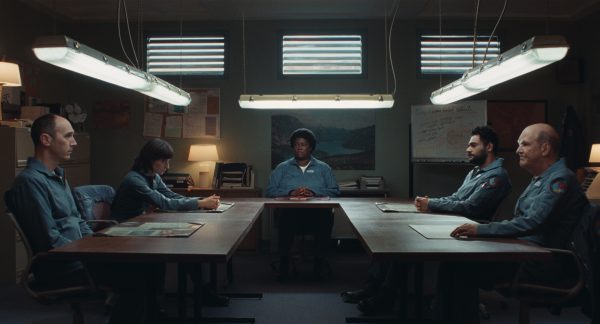
Morning meetings held by a special troubleshooting team (clockwise from left, Steve Laplante, Larissa Corriveau, Fabiola N. Aladin, Hamza Haq, Denis Houle) to discuss issues experienced by the first manned mission to Mars quickly grow tiresome and petty for this band of earth-bound counterparts, as depicted in writer-director Stéphane Lafleur’s latest feature, “Viking.” Photo courtesy of micro_scope/Les Films Opale.

David soon begins having doubts about this Earth-bound mission. He speculates that such a disproportionate focus on these kinds of minutiae might be undermining the enthusiasm and effective functioning of their Martian counterparts, a suggestion that’s viewed as supposedly coming “out of character” for what the real John might say. To complicate matters, David begins to think that the criticisms leveled against his ideas are arising directly from the minds of his terrestrial colleagues and not from those of the astronauts they’re supposed to be portraying. In essence, the lines between David and “John” are becoming blurred, as is the case with all of his other earthly associates. He can’t help but wonder, what’s really going on here?


Turning to Christiane and Jean-Marc for guidance provides little clarity. They often communicate in what appears to be a circular, ambivalent form of double-speak. On the one hand, they encourage David to openly express his concerns to them, but, on the other hand, they continually assert his need to stay “in character.” But at what point is he to employ each approach? That’s something that’s not made especially clear. It’s almost as if Christiane, Jean-Marc and everyone else involved in this project are winging it as they go along, and that becomes more apparent the longer the mission goes on – and the issues up for examination and resolution grow progressively more ludicrous and, in some cases, extremely serious. Plan B, it would seem, just doesn’t exist, both for the organizers and their crew, as well as for the astronauts themselves. Devising practical, meaningful answers seems to become progressively more difficult, particularly when the astronauts themselves grow ever more leery of, and resistant to, the proposed solutions.


So what’s to become of all this? That’s hard to say, given that it appears everyone is increasingly flying by the seat of his or her pants, especially when issues related to such matters as leadership, communication, cooperation and staying in character grow ever more dubious and seemingly unsolvable. Will the hoped-for purpose behind the ground crew be fulfilled? Or will it begin to crumble over a lack of focus, guidance and logistics? And what will that mean for the astronauts and ground crew? Stay tuned.


As much as we might like to think that we can plan things down to the smallest of details, surprises still seem to have a way of turning up, leaving us to figure out what to do for the unexpected. We might well question this, asking ourselves, “How could we have missed something like that?” Moreover, we could well add to that by asking why it happens. There must be a purpose behind it, but what is it?


Surrogate astronaut mission organizer Christiane Comte (Marie Brassard, left) and her trusty assistant, Jean-Marc (Martin-David Peters, right), are often sought for guidance by their puzzled crew members but seldom find it in the French Canadian sci-fi comedy, “Viking,” available for streaming online. Photo courtesy of micro_scope/Les Films Opale.

When we embark on such grand planning schemes, we generally approach them from a standpoint of comprehensiveness and inclusivity, with these exercises being tests of our flexibility and resourcefulness to address all of the issues that arise. But what of the overlooked items? Why have such oversights become part of these plans? Perhaps it has to do with the foundation underlying such efforts – a belief that we possess the necessary flexibility and resourcefulness to address whatever issues come our way. However, that thinking implies we already have all the answers in hand, and that conceivably might prompt us to ask ourselves, “How much of a test of our flexibility and resourcefulness is that?” It’s akin to knowing all the questions on an exam before we take it. Is that really a meaningful assessment of our knowledge and wherewithal to solve problems?


If we’re to be truthful with ourselves in testing our abilities in these areas, it would seem that the only fair way to do so is to build in the unexpected up front. When confronted with such unforeseen circumstances, we’re forced into throwing out the rulebook and coming up with innovative approaches to resolving these unplanned-for issues. What’s more, if we’re truly convinced that we’re as flexible and resourceful as we think we are, that means we must also incorporate a belief that maintains we can indeed succeed at such tasks. And that’s important considering the role that our beliefs play in manifesting the reality we experience, a product of the conscious creation process, the philosophy that maintains we draw upon those intangible resources in materializing our existence.


Understanding this should be inherently crucial to undertaking a task like the one attempted in “Viking.” However, considering how often conditions go awry on so many fronts – both on Earth and Mars – it would seem that the organizers and participants in this venture have overlooked this consideration. While it’s true that they’re often thrust into having to tap into their flexibility and resourcefulness, they often experience assorted errors and conundrums when they do so, suggesting that, on some level, they might not be as sold on their level of expertise as they’d like to think they are. And that kind of intrinsic doubt can torpedo one’s efforts, no matter how seemingly convinced we are of their viability.


It goes without saying that thinking outside the box – surpassing fears, doubts and limitations – is essential in situations like this, especially when far-flung unexpected developments arise. This becomes apparent in the film, for example, when “John” and “Steven” embark on an outdoor assignment involving a Martian ATV in the surrounding terrestrial desert. First, the vehicle gets seriously stuck in the sand. And, while attempting to dislodge it, they have an unexpected encounter with a pair of local cowboys on horseback (Sam LaBrie, Spencer Streichert), a situation assuredly unlike anything the real astronauts might experience. How are the surrogates supposed to handle a scenario like that while remaining in character? (So much for replicating authenticity.)


Then there’s the matter of having to figure out when the Earth-bound crew members are supposed to be “themselves” versus when they’re supposed to stay in character. It’s a question that the organizers don’t seem to have figured out very well. The original plan called for the crew to remain true to the personas of their Martian counterparts at all times except during debriefings, but that plan goes out the window quickly and often, and Christiane and Jean-Marc don’t appear to have any viable solutions for addressing what should be a core component for carrying out this mission.


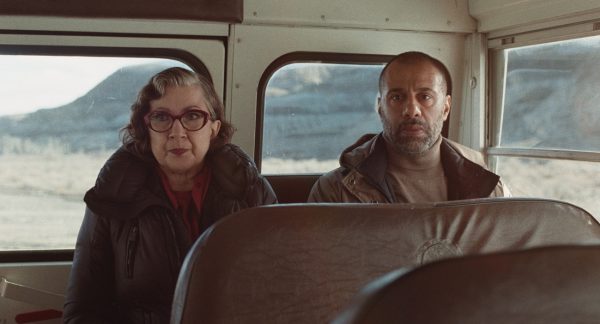
Unexpected interaction with “outsiders,” such as a pair of cowboys (Sam LaBrie, Spencer Streichert), create awkward challenges for a pair of desert-based surrogate astronaut troubleshooters (from left, Larissa Corriveau, Steve Laplante) in writer-director Stéphane Lafleur’s latest feature, “Viking.” Photo courtesy of micro_scope/Les Films Opale.

On top of this, the lack of clarity on this point creates confusion for the ground crew. They’re often left asking themselves, “How far do we take this?” For example, what’s supposed to transpire when a gender-related issue comes up for one of the surrogates who’s portraying a member of the opposite sex? That can be a seemingly insurmountable (and often quite hilarious) predicament for the woman playing Steven and the man playing Liz.


Similarly, what’s to happen when the Earth-based crew receives important news affecting their counterparts, such as developments affecting the well-being of the astronauts’ family members? Do they say something and cause potentially serious disruption of the Mars mission, or do they stay silent on these issues? What’s more, should the surrogates try to come up with solutions for their space-faring colleagues in these situations by staying in character and trying to imagine how their Martian doubles would react? And what if they’re wrong in their assessments and proposed solutions? Couldn’t that lead to devastating psychological harm for those trapped on a faraway planet and unable to get home? Suddenly, these matters don’t seem so funny anymore.


Meaningful solutions could be hard to come by under circumstances like these, especially if the underlying confidence needed to devise them is lacking due to insufficient belief support. This is where the power of discernment comes into play. When faced with such challenges like these, the astronauts, surrogates and organizers (as well as the rest of us for that matter) must learn how to tap into this skill to devise the means for carrying on. This can be tricky enough for those well versed in it, but it’s particularly critical for those who are flying by the seat of their spacesuits, as all these individuals are.


This is an important point for viewers, too, as this aspect of the film serves as a poignant metaphor for audience members. In many regards, the scenes in which the characters are working out their discernment issues serve as potent parables for what those sitting in the theater or in front of their computer screens need to be doing when it comes to resolving such similar matters in their own daily lives. This is especially true when it comes to analyzing the pertinence and relevance of things like official dictates handed down by authority figures, symbolized here by some of the dubious suggestions of the project’s organizers. We all went through our share of this, for example, with the many draconian measures implemented during the height of the COVID-19 pandemic. Likewise, we’re seeing this coming through in matters related to free speech on the internet and social media, out-of-control political correctness, and even such areas as what kinds of cars we can drive and what kinds of stoves we can cook on. In essence, these measures are pushing us to assess these conditions and ask ourselves a number of questions: How far are we willing to allow ourselves to go when it comes to these kinds of matters? Are these orders being issued for our genuine well-being, or are they exercises in social conditioning to see how far we can be pushed (and controlled)? And what kind of long-term impact will they have on us, our sense of self and our aptitude for self-determination? That’s quite a lot to think about, especially coming from a comedy.


A pair of Earth-bound surrogate astronauts, “Steven” (Larissa Corriveau, left) and “John” (Steve Laplante, right), prepare for an outdoor assignment similar to one to be conducted by their Martian counterparts in the new sci-fi comedy, “Viking.” Photo courtesy of micro_scope/Les Films Opale.

If nothing else, “Viking” should be seen as a cautionary tale about our need to preserve the means to chart our own paths, lest we lose our ability to ultimately do so. Maintaining that sense of independence, individuality, self-awareness and personal self-confidence is crucial if we hope to manifest the existence of our dreams. And keeping sight of the flexibility and resourcefulness necessary to make that possible can’t be overemphasized enough. Otherwise, our mission just might get scrubbed.


What would you do if you encountered problems while serving as a member of the first mission to Mars? Well, for starters, you’d probably want to watch this movie to figure out what not to do. This comedic what-if offering from writer-director Stéphane Lafleur is one of the most inventive and inspired films I’ve seen in quite some time. Its wry (and sometimes quite dark) humor is simultaneously hilarious, insightful and metaphorical, not to mention astoundingly original, with some of the best writing I’ve come across in ages. The film’s intriguing foundation and telling narrative speak volumes to us on multiple levels (some of which have nothing at all to do with space travel; in fact, one could think of this as a fusion of science fiction and a Stanley Milgram behavioral experiment). All of this is backed up by the picture’s fine performances, superb score, gorgeous photography and outstanding art direction/production design, along with more than a few cinematic homages to such otherworldly classics as “2001: A Space Odyssey” (1968). It’s so heartening to see a film these days that’s highly intelligent, raucously funny, supremely thoughtful and eminently entertaining all at the same time. This feature may not have received much fanfare thus far, but this truly is a picture well worth seeing (thankfully it’s available for streaming on multiple platforms). It’s sure to put you into orbit.


Considering how much “Viking” has going for it, it should come as no surprise that it has received more than its fair share of accolades. The film was nominated for a whopping 10 Canadian Screen Awards, including its achievements in sound editing, sound mixing, art direction/production design, costumes, hair and cinematography (for which it took home the top prize), as well as nods for its original screenplay, director, lead actor (Laplante) and best picture. And, in my view, it was a deserving candidate in all of those categories.


As this film so clearly illustrates, under the right conditions, it can be easy to lose oneself if we’re not vigilant. There’s much at stake if that happens, too, some of which might feel just as emotionally and psychologically devastating as being left out to dry far from home. Confidently preserving our sense of identity, remaining flexible and resourceful, and shrewdly applying our discernment skills can see us through, whether we’re tackling an everyday challenge or participating in a grand extraterrestrial adventure. In either such case, that could truly represent one giant leap for both man and mankind.


Copyright © 2023, by Brent Marchant. All rights reserved.

Wednesday, May 3, 2023

New Movies for May on Frankiesense & More

Join yours truly, Good Media Network Movie Correspondent Brent Marchant, and show host Frankie Picasso for five new movie reviews on the next Frankiesense & More video podcast, to begin airing Thursday May 4 at 1 pm ET. Tune in on Facebook by clicking here or YouTube by clicking here for all the fun and lively discussion!


Sunday, April 30, 2023

This Week in Movies with Meaning

Reviews of "Renfield," "Framing Agnes" and "The Moon & Back," as well as a podcast preview, are all in the latest Movies with Meaning post on the web site of The Good Media Network, available by clicking here.


Thursday, April 27, 2023

‘The Moon & Back’ wrestles with grief, creativity, adolescence

“The Moon & Back” (2022). Cast: Isabel May, Missi Pyle, Nat Faxon, P.J. Byrne, Miles Gutierrez-Riley, Taiv Lee, Roman Michael, Molly Jackson, Riley Madison Fuller. Director: Leah Bleich. Screenplay: Leah Bleich. Web site.


Where do we turn when the bottom falls out? That’s difficult enough at any age, but what is one to do when going through an impressionable time of life, such as adolescence? The coming of age considerations that teens face are often burdensome enough in themselves. However, when they’re compounded by a significant loss, starting over may seem impossible. Such are the conditions that a devastated young woman must figure out for herself in the new comedy-drama, “The Moon & Back.”


When Peter and Diane Gilbert (Nat Faxon, Missi Pyle) got married, they were madly in love with one another. In fact, Peter endearingly told his new bride that he would indeed love her to the moon and back. And later, when the couple welcomed the arrival of their new daughter, Lydia (Riley Madison Fuller), that love expanded even further, filling their home with palpable, undeniable warmth. This pervasive affection was further enhanced by an enduring sense of creativity and playfulness, qualities primarily put in place by Peter, a move that infused the family’s household with positive, inspiring, mutually supportive vibes. The bond between father and daughter grew particularly strong under these conditions, with each of them becoming adoringly devoted to one another.


However, when a teenage Lydia (Isabel May) entered high school, circumstances drastically changed as Peter’s health began faltering, eventually leading to his untimely death. It goes without saying that Lydia was devastated. She withdrew into herself, falling into a relentlessly unremarkable holding pattern. And, after a year of this, as Lydia began her senior year, she seemed more lost than ever.


Such is the prologue of this film, told largely through simulated home videotape archives. As the main story opens, Diane tries coaxing Lydia out of her malaise. After all, the time is fast approaching when they’ll need to make some decisions about Lydia’s college plans. Diane initially approaches the subject tactfully, but, given Lydia’s grief-stricken state of mind, she’s ambivalent about continuing her studies, an attitude that worries mom. She wants her daughter to further her education, despite the financial hardships it will place on the household, but she’s met with intractable indifference. Lydia has intentionally put her life on hold, and Diane wonders whether she’ll ever start moving forward again.


Circumstances soon change, however, when Lydia stumbles upon a half-written sci-fi screenplay that Peter had been working on prior to his death. She’s intrigued by the script and decides that making a movie based on this material would make for a fitting tribute to her dad. It’s not exactly the plan that Diane had in mind, but, if it motivates Lydia to start doing something with her life again, she’ll willingly throw her support behind it.


Thus begins Lydia’s experiment to find herself. Having never made a movie before, she’s embarking on a project in which she truly doesn’t know what she doesn’t know. But that doesn’t stop her from launching into this exploration of the unknown. And so, armed with only a video camera, a half-written script, a handful of money and a whole lot of gumption, she sets off on this journey of discovery.


Lydia is by no means alone in this endeavor; she has ample support from a ragtag array of backers who are truly in her corner and want to see her succeed, especially since they know how much this project means to her personally. She receives zealous backing from her high school guidance counselor, Mr. Martin (P.J. Byrne); classmates Simon (Miles Gutierrez-Riley), Josh (Taiv Lee) and Mariana (Molly Jackson); her neighbor, George (Roman Michael); and, of course, her mother. It’s indeed encouraging to see how readily they all rally to her cause, aptly illustrating that the assistance we need somehow manages to materialize when we need it most. And, as events unfold, it becomes apparent that Lydia really needs it.


Enthusiasm aside, Lydia has her work cut out for her on this project. Having no experience as a filmmaker, she has to improvise much of what she does as she goes along. This is further complicated by not having a finished script for the picture, prompting her to figure out where she ultimately wants to take the story. Then there’s the pressure to be true to her dad’s intent, which is considerable, since he never finished the screenplay, leaving her to intuit where she thinks the story should go to fulfill his vision.


What’s more, undertaking a venture like this at a time of life that’s fraught with its own inherent challenges can be particularly daunting. The coming of age process can be difficult enough in itself without the added stress and anxiety that often accompany endeavors like this. And the absence of the one person who one would most likely turn to for advice at a time like this – in this case, Lydia’s dad – can be even more trying. But the fact that the budding auteur is willing to take on all of these challenges simultaneously speaks volumes about just how inherently ambitious she truly is. That’s a big step for someone who not long before had trouble getting off the dime to get on with her life. Indeed, with determination like that, there’s no telling what else she might be able to accomplish – maybe even venture to the moon and back.


Moving forward when we suffer a debilitating setback can be quite a burden. The feeling of being deflated is often more than we can handle. And, as Lydia’s experience in the wake of her father’s death illustrates, it’s a painful ordeal that takes away much of our enthusiasm for wanting to do anything. So where do we go from there?


The most obvious answer is looking for a way to pick up the pieces and carry on. But, before we can do that, we first have to believe in the notion that such a step is even possible. And, when we’re weighed down by such palpable emotions as grief, longing and despair, mustering up the faith and conviction to foster such beliefs is, at the very least, unnerving, if not overwhelming. Thus, getting past such a discouraging outlook is essential if we ever hope to get our lives back on track, particularly when it comes to employing the conscious creation process, the philosophy that maintains we draw upon the power of our thoughts, beliefs and intents in manifesting the reality we experience. It’s unknown whether Lydia has ever heard of this school of thought, but, if she ever hopes to make something meaningful and fulfilling out of her life, she had better consider it as a means for reaching that goal.


Lydia is starting from a difficult place in this regard. Not only does she not know how to fulfill her objectives, she can’t even envision what they might be. By not knowing what we hope to achieve, we don’t even know where to start, let alone how to reach a desired destination. So the question once again becomes, where do we go from here?


Since the primary purpose of one’s existence is to create it, anyone who is experiencing what Lydia is going through might want to consider that objective as a starting point. In essence, this involves looking for something of a creative nature that will generate a sense of personal satisfaction. It gives us something to believe in and an undertaking into which we can direct our energies, and virtually anyone who has embarked on such an endeavor can testify to that effect. The key, of course, is finding such a project and being willing to pour ourselves into it, a practice that generates the beliefs necessary to make it possible.


Lydia Gilbert (Isabel May, left) seeks to get her life back on track after suffering a devastating personal loss in director Leah Bleich’s delightful coming of age comedy-drama, “The Moon & Back.” Photo courtesy of Prodigium Pictures.

That’s precisely what happens for Lydia when she finds her dad’s unfinished screenplay. The discovery sparks her interest in multiple ways – it gives her something to focus on, it gives her something to which she can provide a sense of completion and it gives her a way to pay tribute to Peter, something she needs to do to get past her grief and provide a much-needed sense of closure. Its inherent artistic nature also embodies the very notion of creativity, what lies at the core of the conscious creation process. By tackling this project, Lydia has a valuable opportunity to get back in step with her purpose for living, to rejoin the existence of which she is a part.


It helps immensely that she has so many backers in her corner, too. Their support provides validation for this undertaking, not only as a means to honor her father, but also to provide direction for getting her life back on track and infusing it with a much-needed sense of purpose (one that could even lead to the development of a vocation, giving her the focus that has been so lacking in her life for a long time). It comes at a significant time in her life, too, considering the often-challenging conditions that arise when one goes through the coming of age process. Her movie project serves as something of a buffer against those considerations, helping her to grow and mature into adulthood and to keep petty adolescent distractions at bay that might otherwise consume a disproportionate amount of her consciousness and attention.


Perhaps most importantly, though, this venture enables the healing process to go forward, something Lydia desperately needs. It enables her to adopt a new perspective on her reality, a change that allows her to employ a new overall outlook on life, one that carries the potential to radically shift the nature of the existence she experiences. This is not to suggest that putting her old life behind her requires her to erase memories and emotions about her father; rather, it means altering her frame of mind so that she can put that portion of her life in a new context, one that retains the best of that time without preventing her from moving forward into a new way of living. As the conscious creation process maintains, everything is in a constant state of becoming, but that evolution can be thwarted when we implement beliefs that intentionally seek to derail that process, as she has been doing for some time. It’s nice to see that she’s found a way to eliminate that stagnation, one that has restored her forward progress, made it possible to contextualize her grieving and allowed her to once again have some fun in her life. And all it took was implementing a little creativity.


Coming of age can be difficult enough in itself, but, when we lose someone who has been a source of valuable guidance in the midst of that process, the result can be shattering. Under conditions like that, it can be easy to lose one’s way. So it is for Lydia, who needs to chart a new course for herself. And, when she does, she learns that an important part of coming of age means letting go of what no longer serves us and being willing to strike out on our own – even leaving behind the source of inspiration who helped us get so far. Writer-director Leah Bleich’s charming comedy-drama provides viewers with a refreshingly distinctive take on material typical of this genre, providing just the right amount of heart tugs but without overdoing it, all the while serving up both laughs and serious moments that successfully avoid the clichés often found in stories like this. The narrative manages to stay on track quite well, despite a few meandering lulls, keeping the storytelling crisp and economical. And, given the excellent, incisive, edgy character development here, this offering strikes me very much as being the movie that “Lady Bird” (2017) was striving to be but could never quite get right. Indeed, “The Moon & Back” is a fun, pleasant, enjoyable little diversion, but it’s by no means a lightweight, just what a film of this stripe should be.


Unfortunately, finding “The Moon & Back” at the moment may be a little difficult. The picture has primarily played the film festival circuit, and news of a general distribution in theaters and/or online has not yet been forthcoming. Nevertheless, viewers interested in this offering would serve themselves well by catching this delightful charmer if a screening opportunity were to present itself, especially in communities that stage film festivals.


No one wants to endure a devastating loss. Such tragedies are difficult enough in themselves, and envisioning what comes in their aftermath can be frightening, both in terms of their impact and what might be involved in going through them. Yet situations like this are one of the inevitabilities to which we’re all subjected at some point in our lives. We may not like having to undergo them, but they nevertheless provide us with an opportunity to learn how to respond to adversity. They test our ability to cope. They test our resiliency to bounce back from these situations. And they teach us how to be creative and flexible in overcoming hardship. There may even be the proverbial silver linings buried within them. No matter what results, however, they afford us the chance to grow as individuals, and that can prove exceedingly valuable in the long run, a heartfelt gift bequeathed to us from those who have left us, one that can help us to become who we were meant to be.


Copyright © 2022-2023, by Brent Marchant. All rights reserved.

Monday, April 24, 2023

‘Renfield’ explores taking back one’s personal power

“Renfield” (2023). Cast: Nicholas Hoult, Nicolas Cage, Awkwafina, Ben Schwartz, Shohreh Aghdashloo, Adrian Martinez, Brandon Scott Jones, Camille Chen, Bess Rous, Jenna Kanell, Danya LaBelle, Rhonda Johnson Dents, Christopher Matthew Cook, Michael P. Sullivan, Rosha Washington, James Moses Black. Director: Chris McKay. Screenplay: Ryan Ridley. Story: Robert Kirkman. Web site. Trailer.


No one likes to go through life without access to one’s personal power. Doing so leaves us vulnerable to being taken for granted and under the thumb of others who care only about themselves and have no regard for us. If allowed to continue unchecked, such circumstances can become toxic co-dependent relationships that are difficult to escape, potentially trapping us in perpetuity. So how do we extricate ourselves from such situations? That’s the underlying focus of the new campy horror romp, “Renfield.”


For a seeming eternity, former real estate lawyer Robert Montague Renfield (Nicholas Hoult) has been a virtual slave to his powerful master. Having journeyed from his native England to Eastern Europe to close what he hoped would be a lucrative land deal to support himself and his family, Renfield approached his prospect with great gusto and enthusiasm, only to have the proposal take a drastic left turn when the target extends to him a proposal of his own – immortality. The seductive allure of that possibility wins over the young attorney, despite the strings that come attached with it, the most significant of which is agreeing to become a devoted servant to his new boss, an offer that Renfield readily accepts. But, despite what he’s been promised, Robert has no idea what he’s getting himself into given who his new master is – Dracula (Nicolas Cage).


In the years that follow, Renfield is introduced to high society and influential people. But, in exchange for this, he’s saddled with the responsibility of attending to all of his vampiric boss’s needs, such as going out every day and securing Dracula’s “dinner.” The routine gets old over time, and Renfield grows dissatisfied. He hasn’t seen his wife and child in ages, and the possibility of that happening grows progressively less likely. He also feels stuck in a meaningless existence with no hope of personal fulfillment. Nevertheless, he begins contemplating changes in his life, even though striking out in a new direction proves far more difficult than expected, keeping him trapped for decades.


After years of this, an event occurs that could change Renfield’s fortunes. Dracula is seriously injured when the night stalker is unexpectedly exposed to daylight, nearly causing his demise. His severely weakened condition requires intensive care to restore his health, and, because of this, he becomes more dependent on Renfield than ever. However, given the Count’s depleted state, he must remain in seclusion most of the time, holed up in an abandoned hospital in New Orleans, the duo’s adoptive new home. That convalescent isolation actually frees up Renfield’s routine somewhat; as long as he satisfies his master’s basic needs, there’s little that Dracula can do to keep tabs on his servant’s movements, enabling him to pursue his own interests, most notably changing his life to better suit what he wants from it.


Robert Montague Renfield (Nicholas Hoult, left), personal assistant to Count Dracula (Nicolas Cage, right), seeks to change his life by taking back his personal power in the new campy horror romp, “Renfield.” Photo by Michele K. Short, courtesy of Universal Pictures.

Renfield decides to enroll in a support group helping individuals who are wrestling with the challenges of toxic co-dependent relationships. This self-help program proves quite enlightening, especially when the group’s facilitator (Brandon Scott Jones) informs his organization’s newest member that the key to overcoming situations like this is to take steps to take back one’s sense of personal power. It’s a revelation akin to a proverbial lightbulb going off over Robert’s head, and so he starts taking steps to that end – clandestinely getting his own apartment, covering his walls in motivational posters, saying his daily affirmations and buying himself a more cheerful, upbeat pastel wardrobe. It’s all a far cry from the dour, dismal lifestyle he’s been accustomed to living for so long.


But, as Robert soon discovers, there’s more to taking back one’s power than simply acquiring transformative surface trappings and mouthing the words that go with these ideas. It’s a process that requires deeds as much as thoughts. He gets a chance to put that notion into practice when he unwittingly becomes embroiled with a powerful New Orleans mob family, the Lobo clan, particularly its chief braggart muscle man, Teddy (Ben Schwartz), and oily, glamour puss matriarch, Bellafrancesca (Shohreh Aghdashloo). When the Lobos stage a raid on a questionable nightspot, Renfield is present when the hit goes down and immediately springs into action to protect the club’s patrons, innocent bystanders caught in the crossfire. He also offers support to police authorities when they arrive on the scene, particularly an idealistic officer, Rebecca Quincy (Awkwafina). And, when all is said and done, Robert and Rebecca forge a solid connection based on both their intense interest in law enforcement and, to a lesser degree, one another.


The situation becomes further complicated when the Lobos go in search of this mystery man who thwarted their raid, a pursuit that eventually leads them to the abandoned hospital and to Renfield’s boss. When Dracula learns who they are, why they’re there and what Robert has quietly been up to, the Count feels betrayed. However, upon meeting the mob family, he also finds new allies to both seek out the traitor Renfield and to join forces with them in implementing his plan to take over both New Orleans and the world beyond.


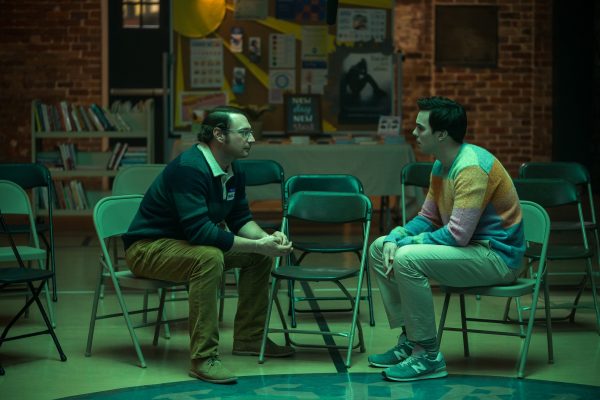
Robert Montague Renfield (Nicholas Hoult, right), personal assistant to Count Dracula, seeks to change his life by joining a support group for those seeking escape from toxic co-dependent relationships led by Mark (Brandon Scott Jones, left), a facilitator who offers guidance on how to proceed, as seen in the new campy horror romp, “Renfield.” Photo by Michele K. Short, courtesy of Universal Pictures.

Before long, Robert and Rebecca get wind of what’s going on, and they realize what they’re up against. In addition to the alliance between Dracula and the Lobos, the enemies have the support of a police department that’s rotten to the core. Rebecca is already on the outs with the agency given her relentless investigation into the death of her father, a fellow officer. And, now that she’s taken a more aggressive posture to take down all the bad apples, she’s put herself and her sister, Kate (Camille Chen), an FBI agent, in jeopardy.


With circumstances like these, the deck is truly stacked against Robert. But conditions like these are in many ways ideal to prompt him to take action to take back his power. And, with a sidekick like Rebecca to offer ample inspiration, he’s got the means to put these practices into play. But will it be enough against the combined forces of Dracula, a powerful mob family and a monolithically corrupt police department? That’s a lot of power to be taken back.


Seeing one’s way clear of a toxic involvement isn’t always easy. For starters, one may not recognize the very existence of such an arrangement, let alone all of the consequences that come with it. And, even if it’s pointed out to the victim, he or she may not believe it, choosing to seek solace in denial. But, for those who are open-minded enough to consider the possibility, making such a change might seem too daunting to take the steps necessary to implement them. In all of these scenarios, nothing changes, and those caught up in them stay stuck, unable to move forward or remove the hindrances keeping them locked in place.


However, this is not to suggest that nothing can be done about these situations. As the support group facilitator astutely observes, those who feel persecuted by their co-dependent relationships can change the game by taking back their personal power, something they often don’t realize they’ve given away (and voluntarily at that). Admitting this is half the battle, and believing that we can do something about it is the tonic. Of course, that belief component is crucial given the role it plays in manifesting the reality we experience as a result of the conscious creation process, the philosophy that makes this outcome possible. It’s unclear whether those seeking to make a change are aware of this school of thought, but those who opt to give it a try may well find themselves pleasantly surprised at the result.


Idealistic New Orleans police officer Rebecca Quincy (Awkwafina, center) seeks justice in a pervasively corrupt police department in director Chris McKay’s “Renfield,” now playing theatrically. Photo by Michele K. Short, courtesy of Universal Pictures.

As anyone familiar with this thinking knows, beliefs are powerful and persistent tools. But, if we choose to give away that power to a co-dependent relationship partner, as Robert has done, it can leave us without the wherewithal to materialize what we want for ourselves. This is because all of our power and beliefs are focused on fulfilling the wants and needs of others, implicitly placing us in a secondary position. In the end, how fulfilling can that be? It’s a painful lesson that the protagonist has come to learn over many years, and he desperately wants to rectify that. Unfortunately, that may not be easy given how this precious resource has been drained from him in light of the power and persistence of the beliefs that have made this outcome possible.


This is not to say that Renfield can’t get his power back. However, he must believe in the possibility and take steps to realize its manifestation, first with his beliefs and intents and then with his actions. He’s obviously up against a lot to achieve that goal, but those forces can benefit Robert by prompting him to galvanize his convictions, to make sure he’s focused on and committed to attaining his objective. That can go a long way to making it happen.


A common misconception where co-dependency is concerned is that it’s limited to the dynamics associated with close personal relationships, be it with romantic partners or family members. But, in essence, it can also be tied to anything that prompts us to give away our personal power, functioning almost like an addiction. And, from that, it’s apparent that Robert is not the only one in the film afflicted with this condition.


For example, in order for the Lobo family to maintain its criminal empire and its control over the residents of New Orleans, its members have had to buy into a way of life in which they’ve sacrificed their personal power for the sake of their greed-driven goals. This has meant, of necessity, that they’ve had to accept violence, killing, mayhem and other similar atrocities as the norm, regardless of how they might affect them personally. It’s a huge trade-off that they’ve been coerced into making as a means to pursue their objectives and maintain their status.


Similarly, Dracula has had to do the same in order to live the life of a vampire. He’s had to give up being able to go outside during the daytime. He’s had to make sure that he has access to a steady supply of fresh blood for feeding. And he’s had to accept the consequences associated with failing to live up to these conditions. This choice has rendered him powerless against living his life any other way. In essence, he, too, has given away his personal power to fulfill this ambition.


Mob matriarch Bellafrancesca Lobo (Shohreh Aghdashloo, left) lectures her overzealous son, Teddy (Ben Schwartz, right) on how to conduct “business” in director Chris McKay’s new campy horror romp, “Renfield.” Photo by Michele K. Short, courtesy of Universal Pictures.

Then there’s the police department, which has made a comparable choice of its own. To benefit from the perks and payoffs that come from cooperating with organized crime, its high-ranking officers, such as Rebecca’s boss, Capt. Browning (James Moses Black), have compromised themselves to accommodate their partners in crime (literally). This, in turn, has alienated its virtuous staff members (and probably the citizens of New Orleans), leaving authorities to continually figure out ways to sustain themselves, a task that undoubtedly calls for them to routinely pour their energies into maintaining their position of power, a significant drain on this precious resource.


The sad part in all this is that none of the Lobos, Dracula nor the police fundamentally realize what they’ve gotten themselves into. By having to continually shore up their respective positions, they’re continually investing their power in simply maintaining the status quo. That lack of awareness and outpouring of power, in turn, have provided Robert and Rebecca with a valuable weapon against them – the ability to channel their own power into combatting what is becoming an innately dwindling resource, despite the combined forces that have arisen as a result of their unholy alliance. Who do you think is ultimately going to win that battle?


From the foregoing, the benefits of taking back one’s personal power should be obvious. But, as this film also illustrates, what often seems obvious to outside onlookers isn’t always readily apparent to those caught up in dicey situations like this. That’s why assessing and understanding our beliefs is so important, especially when it comes to the management of that power. If we remain oblivious or unconcerned, we run the risk of giving it away, leaving us unable to manage our affairs, particularly those where the input of that resource is important to fulfilling the objectives we hope to achieve. Robert and Rebecca understand this, and we’d be wise to follow their example.


I must admit that I had some doubts about this one going in. Those who know me are well aware that I’m not a huge fan of horror flicks (unless they’re smart horror or campy comedic romps). But director Chris McKay’s refreshingly humorous take on the Prince of Darkness mythology as told through the eyes of his longtime personal assistant pleasantly surprised me. As a melancholic soul who’s looking to get more out of life than the perpetuation of his unfulfilling tenure as a glorified go-fer, Renfield seeks to change his destiny, a sentiment that many of us can probably relate to. What I found most intriguing about this film is the way it successfully (and hilariously) merges the personal growth/self-help theme in a horror flick context, a brilliant fusion that works amazingly well. To be sure, considering the story’s horror roots, there’s plenty of blood-dripping gore as this yarn unfolds, but it’s all presented with a delightfully whimsical, albeit macabre sense of play, especially in its exceptionally well-choreographed, over-the-top campy action sequences, segments reminiscent of pictures like “The Kingsmen” and “Deadpool” franchises. The narrative also features ample sendups of the self-help/personal growth community, sequences that deliver big belly laughs at the expense of New Age dilettantes who believe that simply reciting a mantra will somehow lead to profound universal enlightenment.


Count Dracula (Nicolas Cage) seeks to implement a fiendish plan to take over the world in the hilarious new campy horror offering, “Renfield.” Photo by Michele K. Short, courtesy of Universal Pictures.

Admittedly, the pacing lags in a few spots, and the meshing of the story threads could have been handled a little more deftly at times. Nevertheless, despite these modest missteps, the laughs are definitely in huge supply here, thanks in large part to the film’s excellent cast, including the fine performances of Hoult as the lost but transformation-minded milquetoast and Aghdashloo as the cheesy mob matriarch. But the one who really steals the show here is Cage, who turns in his best work in years (perhaps even of an award-worthy caliber), memorably embodying the character of Dracula and genuinely making it his own, much like what Michael Keaton did with Beetlejuice and Ryan Reynolds has done with Deadpool. “Renfield” is truly a lot of fun, presenting a skillful blend of substantive, deceptively nuanced material wrapped up in a vehicle where such content is least likely expected. So go sink your teeth into this one; you’re sure to have a bloody good time. The film is playing theatrically.


Freely giving away something that’s so vital to the functioning of our daily lives can carry grave consequences, outcomes that we often can’t see or aren’t even aware of until it’s too late. And, when this practice is allowed to settle in and get cozy, reversing it can be exceedingly difficult. But, considering what’s at stake, it would behoove us to make the effort to get it back before there’s no hope of retrieving it. As something that’s the lifeblood of our existence, we can’t afford to recklessly dispense it. Considering what we’re potentially giving up by doing so, we stand to lose too much – and that would surely leave us in the lurch, where no amount of self-help practices can help us get it back.


Copyright © 2023, by Brent Marchant. All rights reserved.