Reviews of "The Land of Steady Habits," "Fahrenheit 11/9" and "Mapplethorpe," as well as a radio show preview, all in the latest Movies with Meaning post on the web site of The Good Media Network, available by clicking here.





Reviews of "The Land of Steady Habits," "Fahrenheit 11/9" and "Mapplethorpe," as well as a radio show preview, all in the latest Movies with Meaning post on the web site of The Good Media Network, available by clicking here.

“The Land of Steady Habits” (2018). Cast: Ben Mendelsohn, Edie Falco, Thomas Mann, Bill Camp, Connie Britton, Elizabeth Marvel, Michael Gaston, Charlie Tahan, Victor Slezak, Josh Pais. Director: Nicole Holofcener. Screenplay: Nicole Holofcener. Book: Ted Thompson, The Land of Steady Habits. Web site. Trailer.
For many of us, certainty and stability have a definite comforting appeal. We enjoy the predictability and reliability, a soothing reassurance that life will go on as we’ve known it. However, such an existence can also become a stifling trap, one the suffocates us, often without us becoming aware of it until it’s almost too late. This is where the value of change and pushing past established limits becomes desirable, if not essential, to our happiness, concepts explored in the new character study, “The Land of Steady Habits.”
Anders Hill (Ben Mendelsohn) feels lost. The recently divorced, recently retired former financial professional seeks the happiness that eluded him in his former life. But, no matter how hard this middle-aged suburbanite looks, he never seems to find it. Of course, it doesn’t help that he makes more than his share of bad decisions along the way (more on that later).
As Anders pursues a new life in earnest, he professes what appears to be a sincere desire to be a better person than he was in his old existence. For instance, he claims to have given up being a financial advisor because, in his view, the profession is built on principles of inherent greed with no moral compass, all designed to simply feather the nests of its practitioners, many of whom don’t realize or care what they may be doing to their clients. What’s more, he looks back on his old life – one not unlike that of many of his fellow Westport, Connecticut residents – as an endless exercise in mindless tedium, full of daily conscience-numbing ordeals designed to pursue illusions of happiness that never quite pan out and that do nothing to help shape or improve one’s personal character.
So, having come to these realizations, Anders decided to chuck it all. In addition to abandoning his profession, he divorced his wife, Helene (Edie Falco), an attempt to escape an empty marriage and an overstuffed house filled with materialist comforts that became more constraining than liberating. He also left behind many of his former friends, most of whom remain blindly stuck on the treadmill of their conventional conformist lifestyles, such as his onetime close companions Sophie and Mitchell Ashford (Elizabeth Marvel, Michael Gaston). In fact, about the only connection to his past that he has deliberately tried to maintain is his relationship with his son, Preston (Thomas Mann), a twenty-something college graduate recovering from substance abuse issues who’s now working dead-end jobs to stay clean and make ends meet.
However, having purged himself of so much, Anders now has a lot of space to fill up in his life. He spends most of his time decorating his new townhouse, but, beyond that, there’s little to occupy his days. Consequently, he ends up becoming embroiled in those aforementioned bad decisions. For instance, he pursues a string of meaningless sexual encounters, most of which end up disappointing (for various reasons). But, more troubling than that, Anders has a knack for landing himself in the middle of some highly questionable situations, such as an unlikely (and some would say unhealthy and enabling) friendship with Charlie (Charlie Tahan), the Ashfords’ drug-abusing teenage son, who desperately looks for a way to escape an impending stint in rehab after an overdose incident. And then there’s his involvement with Barbara (Connie Britton), a woman whom Anders meets in a strip club men’s room after she binges on liquor, presumably to ditch the date who brought her there in the first place.
Given these situations, one might understandably question the protagonist’s judgment. But, in spite of these highly problematic circumstances, Anders genuinely seems to want to do the right thing; he just doesn’t know how. And, because of that, his handling of these incidents rarely turns out for the best. Are these matters that simply get out of hand? Or is Anders just ignorant?
What’s more, despite his contention of wanting to escape his old life, there are times when Anders seems drawn back to it, almost as if he regrets his previous decisions. But a desire to go back solves nothing, especially since the conditions of his former existence have now changed. For example, in a moment of weakness (some might say stupidity), he pays a drunken, impromptu visit to his old home in the middle of the night, a move that nearly gets the uninvited intruder’s head bashed in by Donny (Bill Camp), a former professional colleague who has now become Helene’s new live-in love interest. Indeed, it would seem there really is no going back.
So what is Anders to do? That’s what he needs to sort out, not only in terms of how to get these particular situations resolved, but also for what he wants to do with himself and his life going forward. Having courageously freed himself from the shackles of his former life, he has a clean slate at his disposal. And, with a potentially brave new future in front of him, he faces the prospect of brighter days ahead and becoming the better person he wants to be. The trick, though, is figuring out how to get there.
Starting over in life is often fraught with challenges. Breaking away from those “steady habits” can be liberating, but, when the pillars holding up our lives disappear from beneath us, we find ourselves grasping for whatever means of support we can find to keep us from going under. For many of us, we become so accustomed to our lives following set, predictable patterns that we don’t know what to do when all of the familiar, readily recognizable signposts are removed. As a consequence, we desperately search for solutions to build a new foundation.
But, as Anders’s experience illustrates, how do we proceed with that? In essence, it comes down to what we believe constitutes the basis of our existence. And it’s through those beliefs that we need to make our start, for they provide the cornerstones of what goes into manifesting our reality, the chief underlying principle of the conscious creation process. Through our thoughts, beliefs and intents, we shape the existence that materializes around us, providing us with the world we experience.
Where Anders is concerned, he’s basically starting from scratch. With virtually his entire reality wiped away, he’s creating anew from the ground up. And, since his canvas is blank, he’s free to manifest whatever he wants. But, as someone who’s used to life defined by a limited number of predictable parameters, he’s obviously having trouble envisioning – and subsequently materializing – something different, despite the open-ended creative freedom he’s now afforded himself.
With no practice at creating a life that diverges from what he has long known, Anders fumbles about trying to find his way. And, given his lack of experience at thinking outside the box, he has trouble getting things right. He doesn’t know what to manifest, because he’s not entirely sure what he believes. That muddled uncertainty is thus reflected in the chaotic outcomes he materializes.
To be sure, Anders knew enough that he needed to get out of his previous existence, a realization for which he should be heartily commended. However, with no clue what to implement as a replacement, it’s no wonder that his life is such a jumble. That, of course, requires some serious sorting out. But, again, with a lack of experience in this area, it’s a process that might not fall into place right away – at least until he figures out how to get a handle on recognizing and affirming his beliefs.
Some may look upon Anders’s actions, choices and beliefs with disapproval, disdain or even contempt. But such assessments are patently unfair. After all, how many of us get things right on the first try, especially when we lack experience in these areas? We all make “mistakes” as part of our learning curves (goodness knows I’ve made some beauties along the way). However, this is a process of trial and error, of testing out different lines of probability, helping us rid ourselves of what doesn’t work and moving us closer to what ultimately does.
This is a core life lesson that nearly all of us go through, largely because it’s a means of addressing (and, one hopes, solving) all of the subsequent life lessons that come along in various areas of our lives. Those who try to deny that they’re going through this are deluding themselves, especially when they judgmentally point fingers at others for their “missteps.” It’s a notion that calls to mind that familiar Biblical adage “Let he who is without sin cast the first stone.” None of us deserves to be subjected to such treatment – even Anders.
As noted above, Anders should be saluted for his decision to move on when he could see that his life was no longer serving him. Despite occasional pangs of wanting to retreat into the comfort of his past, he’s generally committed to forging a new existence, something that many of his peers – indeed many of us – may never muster the courage to tackle. And, even though he may not have been fully aware of the reasons why he needed to move on at the time he made his decisions, it becomes apparent as his story plays out that he had good cause to justify his beliefs and actions to make a change. This demonstrates that, on some level, he’s successfully tapped into his intuition, the essential but often-underused tool that contributes to the belief formation process. This in itself implies that he’s on the right path toward realizing a more fulfilling future through conscious creation. We should all wish him well.
Despite a slight tendency to meander at times, “The Land of Steady Habits” provides an atmospheric look at the illusory joy that necessarily comes from living a life of routine and conformity, damningly skewering many widely held misconceptions about what it takes to be and stay happy. This sometimes-humorous, sometimes-melancholic exploration features excellent performances (especially Mendelsohn) and characters who are more real than what audiences typically see on screen, something that some viewers may find distressing. But such affecting reactions are a telling tribute to the impact of the filmmaking. Indeed, director Nicole Holofcener again proves that she’s one of the most insightful auteurs in the business today, delivering yet another fine offering in her excellent repertoire.
Those interested in seeing this picture may have to do some searching to find it. As a Netflix release, the film’s current theatrical run is limited and likely to be short before the production transitions to the company’s streaming service, an approach employed in the distribution of such previous titles as “Beasts of No Nation” (2015) and “Mudbound” (2017). So, if you want to see this offering on the big screen, act fast!
Change can be a scary prospect, but it’s often one of the best and healthiest experiences we can have. It opens up new vistas and provides us with opportunities to explore aspects of life that would otherwise escape us. But, even more importantly, pushing past limitations reveals elements of ourselves that we never knew existed, giving us a shot at all manner of new adventures, a practice well worth making a habit.
Copyright © 2018, by Brent Marchant. All rights reserved.
Reviews of "The Wife" and "Crazy Rich Asians," as well as three film festival previews, are all in the latest Movies with Meaning post on the web site of The Good Media Network, available by clicking here.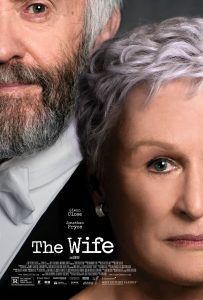



“The Wife” (2017 production, 2018 release). Cast: Glenn Close, Jonathan Pryce, Christian Slater, Max Irons, Elizabeth McGovern, Harry Lloyd, Annie Starke, Alix Wilton Regan, Karin Franz Körlof, Nick Fletcher. Director: Björn Runge. Screenplay: Jane Anderson. Book: Meg Wolitzer, The Wife. Web site. Trailer.
When we wonder why our reality turns out as it does, if we want an honest answer to that question, we have to ask ourselves what motivates us. All too often we drift through life not taking stock of our intentions, letting life unfold seemingly on its own, as if we’re oblivious to the part we play in its manifestation. But, even if we believe we have no hand in the process or are afraid to see what those motivations might entail, in the end we can’t ignore them or how we employ them, a subject explored at length in the new domestic drama, “The Wife.”
Famed, best-selling author Joseph Castleman (Jonathan Pryce) is on the verge of the biggest accomplishment of his storied career. As a candidate for the Nobel Prize in Literature, he nervously awaits word from the awards committee beside his ever-supportive wife, Joanie (Glenn Close), who has spent many years dutifully attending to his every need. And, when word finally arrives that he’s been named the winner, he’s ecstatic. However, the same can’t be said for Joanie. Sure, she puts on a smiling face, but, somewhere amidst all the celebrating, she just doesn’t seem to share in her husband’s happiness. The question, of course, is why.
[caption id="attachment_10116" align="aligncenter" width="300"]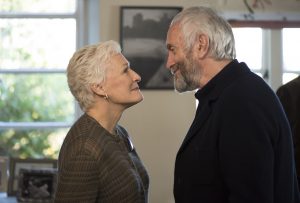 Best-selling author Joseph Castleman (Jonathan Pryce, right) and his dutiful wife, Joanie (Glenn Close, left), prepare to celebrate his win of the Nobel Prize for Literature in the new domestic drama, “The Wife.” Photo by Graeme Hunter, courtesy of Sony Pictures Classics.[/caption]
As the couple prepares to head to Stockholm, Sweden for the awards ceremony, Joanie’s mood grows ever more perplexingly dour. And the more her celebrated spouse is thrust into the limelight, the harder it is for her to contain her feelings, which gradually surface as part melancholy, part resentment and part rage. But what’s behind these emotions? For what it’s worth, that begins to emerge, too, thanks to the increasingly inquisitive and intrusive questioning of her son, David (Max Irons), and of an ambitious would-be biographer, Nathaniel Bone (Christian Slater), both of whom accompany Joseph and Joanie on their trip.
In quiet moments between the festivities, Joanie turns reflective, thinking back to the days when she first met her future husband while she was his creative writing student at Smith College. Through a series of flashbacks, viewers discover how a young Joanie (Annie Starke) and a young Joseph (Harry Lloyd) came together. Details of their romance and of their respective literary aspirations are revealed, aspects of which helped forge and fuel the feelings that Joanie is experiencing now. The question is, can she handle the revelations that are finally breaking through and demanding attention? And, perhaps even more importantly, what implications will they carry as she and Joseph look to move forward with their lives.
[caption id="attachment_10117" align="aligncenter" width="300"]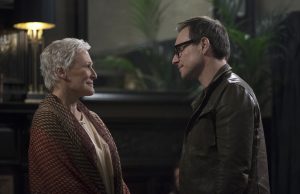 Ambitious, would-be biographer Nathaniel Bone (Christian Slater, right) aggressively tries to coax information about a Nobel Prize-winning author from the writer’s wife, Joanie (Glenn Close, left), in director Björn Runge’s new domestic drama, “The Wife.” Photo by Graeme Hunter, courtesy of Sony Pictures Classics.[/caption]
Joanie’s reflection process deals with many issues, but it principally focuses on her motivations, the reasons underlying what she does and did. This is essentially the same practice we engage in when we employ the conscious creation process, the means by which we manifest the reality we experience through the power of our thoughts, beliefs and intents. It can be a trying process, especially if we come up against motivations that we were unaware of, particularly if they involve matters we dislike. It can also be disheartening, exasperating and troublesome if we had been engaged in such practices for a protracted period of time. Thoughts of wasted efforts, foolishly expended energy and other worrisome concerns come to the forefront. And it’s those issues that Joanie must now face front and center.
For instance, as a creative writing student, Joanie obviously had a love of the craft. And, from all indications, based on the glowing feedback from her professor-turned-spouse, she had real talent. Yet, from all appearances, she simply walked away from it, without hesitation, seemingly because of the discouraging advice she received from author Elaine Mozell (Elizabeth McGovern), a prolific and gifted but commercially unsuccessful writer who told Joanie that women couldn’t cut it in the male-dominated publishing industry of the late 1950s.
So why did Joanie cave? Fear of failure? A desire to spare herself the kind of frustration that Ms. Mozell endured? Or did she instead decide to refocus her efforts on being a devoted wife and mother? But was the domestic life enough for someone who obviously had so much to say? And now, years later, seeing Joseph experience such success, can she live with her past decisions?
[caption id="attachment_10118" align="aligncenter" width="300"]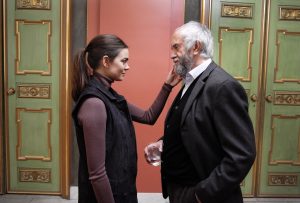 Philandering author Joseph Castleman (Jonathan Pryce, right) takes a liking to a photographer (Karin Franz Körlof, left) assigned to document his receipt of the Nobel Prize for Literature in the new dramatic release, “The Wife.” Photo by Graeme Hunter, courtesy of Sony Pictures Classics.[/caption]
As becomes apparent, though, such considerations ring hollow. There’s more to the feelings that are now surfacing, and they suggest that she’s been concealing some bigger, even more troubling secrets for decades, revelations that she can no longer contain. What is she to do with them as she struggles to keep a lid on them that will no longer stay in place?
Then there’s also Joanie’s relationship with Joseph. As the flashbacks reveal, she fell for her future husband rather easily – while he was already a married man and father of a young daughter. Were they truly in love and destined to be together, or was she an impressionable young admirer who took advantage of an opportunistic situation? And, if the latter, could she realistically live with that?
What’s more, after many years together, it became apparent that Joseph was a serial philanderer, pursuing affairs without being especially discreet about them. This penchant even follows the couple to Stockholm, where Joseph engages in a less-than-veiled flirtation with a photographer (Karin Franz Körlof) assigned by the Nobel Committee to document his time in Sweden. This is another consideration that Joanie must wrestle with.
[caption id="attachment_10119" align="aligncenter" width="300"] Best-selling author Joseph Castleman (Jonathan Pryce, center) gives thanks for winning the Nobel Prize for Literature at a banquet in his honor in “The Wife.” Photo by Graeme Hunter, courtesy of Sony Pictures Classics.[/caption]
On top of all this, Joanie must consider her feelings about the way Joseph treats David, an aspiring author in his own right. As a protective mother, she’s naturally concerned about her child’s feelings. This instinct is particularly strong, given that she can see the talent that her son possesses, something that Joseph tends to dismiss out of hand. His hypercritical assessment of David’s work clearly eats away at him, and Joanie is troubled by this, seeing Joseph’s heavy-handed scrutiny as unduly harsh. She can’t help but wonder if her husband feels threatened by their son’s talents and if his scornful treatment is legitimate criticism or perverse jealously. In light of that, then, she begins to question the respect she holds for Joseph. Can she genuinely continue to support him the way she has for so many years?
Joanie’s introspection on these issues is a lot to bear, especially in the shadow of all the praise being heaped on a man she’s beginning to have serious doubts about. The questions raised by David and Nathaniel exacerbate this process, too, as if they’re prodding her into accelerating her scrutinous activity. It’s as if she’s intentionally drawn these taskmasters into her existence to keep her on track, to continue the process of evaluating motivations she’s long kept at bay.
Indeed, the process is difficult, but it also has the potential to pay significant personal dividends. For example, it holds the promise of facing fears and prompting Joanie to live courageously, perhaps for the first time in decades. It also makes it possible to unearth some long-buried personal integrity, enabling her to openly be her true self, again for the first time in ages. These are significant personal gains not to be minimized.
[caption id="attachment_10120" align="aligncenter" width="300"]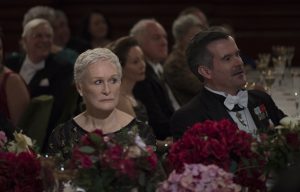 In a moment of panic and realization, Joanie Castleman (Glenn Close, left) comes to understand her true life purpose during a conversation with King Gustav of Sweden )Nick Fletcher, right) in the new domestic drama, “The Wife.” Photo by Graeme Hunter, courtesy of Sony Pictures Classics.[/caption]
But, perhaps most importantly, Joanie’s motivation assessment enables her to see clearly her true purpose in life, perhaps for the first time. This becomes apparent at a banquet honoring the Nobel recipients in which the presenter of the awards, His Royal Highness Gustav of Sweden (Nick Fletcher), speaks of his “job” as king, after which he asks Joanie if she, too, has a job of her own. After a protracted, reflective pause, she waxes poetic with a response that she indeed has a job – that of kingmaker. Yet, even with such a frank, insightful acknowledgment – a realization that she has perhaps come to for the first time in her life – there’s a certain discontentment with her own answer, suggesting that her evaluation of her motivations is still incomplete, that she must continue to dig deeper into the amalgamation of thoughts, beliefs and intents that has shaped her reality as it has materialized – and to decide if she wants to keep manifesting it the same way that she has throughout all that time.
For all of the film’s many worthwhile metaphysical strengths, though, there are aspects of the picture that come up short. The biggest issue is the story’s predictability, some of which is apparent even in the trailer and the remainder of which tends to become fairly obvious early on in the movie. This lack of suspense consequently undermines a plot where there should have been intrigue aplenty. What saves the film from this innate shortcoming, however, is the power of the performances by Close, Pryce and Slater, all of whom are outstanding in their respective parts. In fact, this could be the role that finally earns Close her long-overdue Oscar, considering that she shows a range here not previously apparent in most of her other performances. If strong portrayals and philosophical insights are enough for you, by all means see this one, but, if you find formula story lines tiresome, you might want to skip this release.
Motivations can be tricky to deal with, because we can convince ourselves to turn a blind eye toward them, especially if we’re afraid of what we might see. But, nevertheless, they’re always with us, like companions for the journey. So, if we’re to make the most of our trip through life, we should pay attention to what they are and what they’re intended to achieve. To do less is to face a lifetime of disillusionment and disappointment, the makings of tragedy far more troubling than anything even the most talented novelist could ever conceive.
Copyright © 2018, by Brent Marchant. All rights reserved.

